


Sometimes, all it takes is one unexpected bill, a change in income or a few months of overspending to throw your household budget off track. Maybe your grocery bill keeps climbing, your credit card balance isn’t going down, or you’ve stopped tracking expenses because life has been too busy.
Whatever happened, you don’t need to wait until January to make a fresh start. You can reset your household budget at any time of the year.
One thing we’ve learned at Canadian Budget Binder is that budgeting isn’t about being perfect. It’s about understanding where your money is going and making decisions that work for your household. Sometimes that means cutting expenses. Other times, it means adjusting your budget because prices, income or family circumstances have changed.
And occasionally, it means opening your budget binder, looking at the numbers and starting again. Let’s get your household finances back on track without making things more complicated than they need to be.
What Does It Mean to Reset Your Household Budget?
A budget reset is a chance to review the financial plan you’re already using and make changes based on what’s happening in your life today. You might need a reset because you’ve been spending more than planned, household bills have increased, your income has changed or you’ve fallen behind on tracking your money.
It doesn’t necessarily mean your original budget was a bad one. A budget that worked for your family last year might not work today. For example, if groceries and utilities are costing more than you originally planned, you can’t keep pretending those expenses haven’t changed. Your budget needs to reflect reality, even when the numbers aren’t what you want them to be.
If you’re completely new to budgeting, start with our How to Create a Realistic Budget guide. If you already have a budget but need to get organized again, keep reading.
Five steps to reset your household budget at a glance:
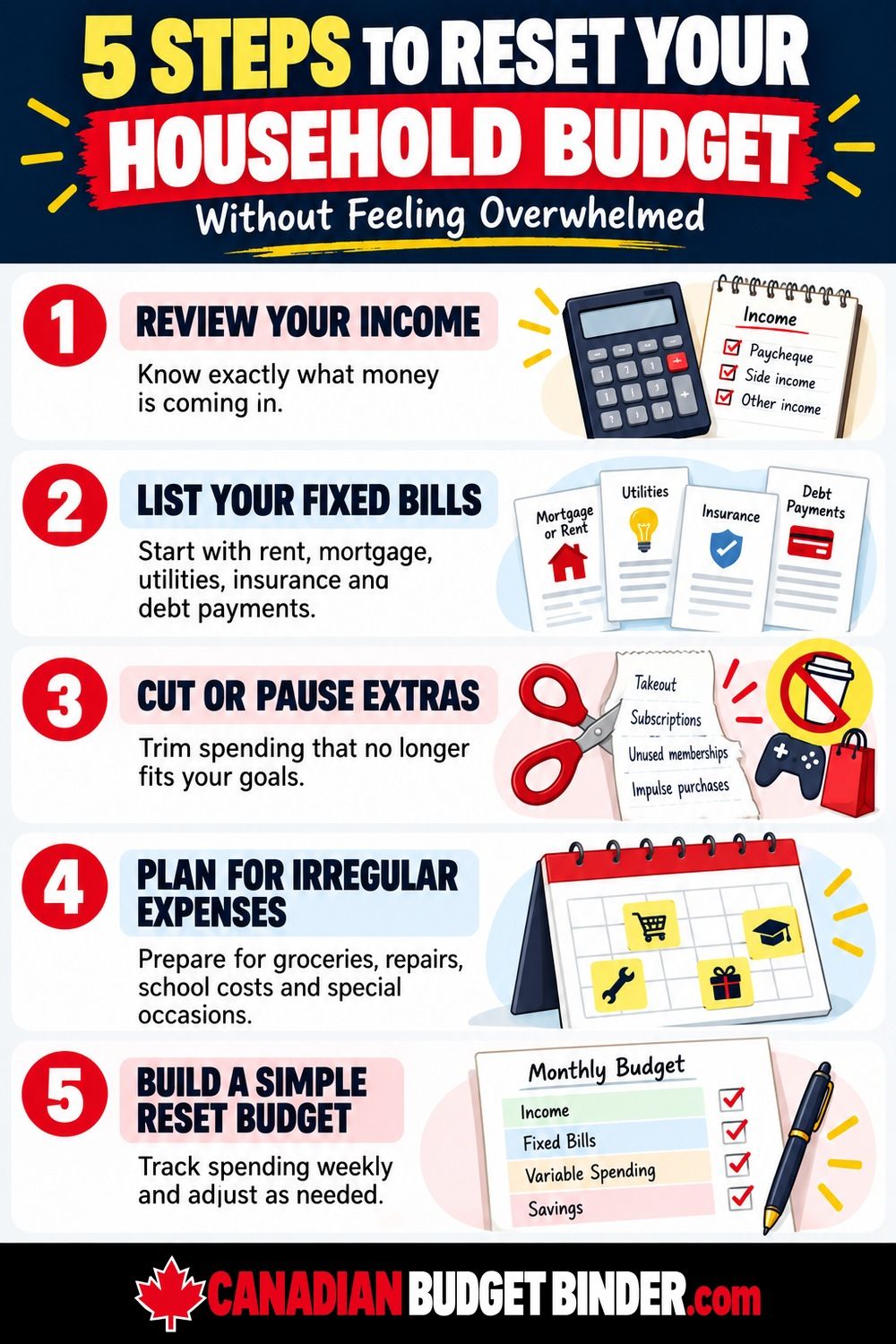
1. Look at Your Current Financial Situation
Before you start changing your spending categories, find out exactly where your household finances stand. I recommend gathering your recent bank statements, credit card statements, pay information and household bills. Look at your actual take-home income and the money you’ve spent over the past month or two.
You may discover that certain expenses have increased without you noticing. Other times, you’ll realize that you’ve been spending money on things you no longer need or use.
The purpose isn’t to beat yourself up over past purchases. It’s to understand what’s happening so you can decide what needs to change.
Your budget should be based on what you earn and spend today, not what you hope the numbers will look like.
2. Compare Your Income Against Your Expenses
Once you have your financial information together, compare your household income with your expenses.
Start with your essential bills.
Housing, groceries, utilities, transportation, insurance and necessary debt payments are important parts of your household budget.
Then review flexible expenses such as restaurants, entertainment, subscriptions and other purchases.
Don’t forget about savings contributions and irregular expenses that aren’t due every month.
If you’re spending more than you’re bringing home, the difference needs attention.
You may be able to reduce certain expenses, negotiate bills or adjust spending categories.
If your income is irregular, use a cautious estimate based on your earnings history rather than assuming every month will be your best month.
And remember, not every household has enough flexibility to solve a budget shortfall by cutting discretionary spending.
When essential expenses are consistently higher than income, you may need additional support, payment arrangements or a more significant financial plan.
3. Decide What Needs to Change First
Trying to fix everything in one afternoon can make budgeting feel overwhelming.
Instead, look for the expenses causing the biggest problems.
Maybe your grocery budget is consistently too low for the amount your family needs.
Perhaps your internet bill has crept up, or you’re paying for subscriptions that nobody uses.
You might also discover that transportation expenses are costing more than expected.
Choose a few realistic adjustments rather than trying to change every spending habit overnight.
For example, if you’ve been overspending on takeout, you could plan more meals at home.
If your grocery budget is too low, increase it to a realistic amount and look at which other categories can be adjusted.
If a service provider has raised its prices, find out whether a better plan is available.
A household budget should help you make informed decisions, not leave you feeling that every purchase is a mistake.
4. Review Your Bills Before Assuming You Can’t Save More
Sometimes the savings you’re looking for are hiding in expenses you’ve been paying for years.
One of my favourite experiences with negotiating a household bill happened while we were visiting family over the Christmas holidays.
A family member had been struggling with unreliable internet service.
The Wi-Fi kept cutting out, and it was frustrating for everyone trying to use it.
Our relative had contacted the service provider but wasn’t getting anywhere.
They had been told that replacing equipment or arranging additional service could mean paying more money.
When you’re living on a limited income, even an unexpected service charge can make a difference.
I decided to call the company and ask a few questions.
After discussing the problem and reviewing the account, we arranged technical support at a substantially reduced fee.
What had originally been presented as a $50 charge was reduced to $5.
But that wasn’t all.
I also negotiated $35 off the monthly internet bill for six months.
Our relative was delighted.
You could practically see the savings being added up while we were still discussing the changes.
That experience reminded me how important it is to question the bills we’re paying.
Not every company will offer discounts, and there’s no guarantee you’ll get a better deal.
But it’s worth comparing available plans, asking about customer offers and finding out whether you’re paying for services you no longer need.
If you negotiate a temporary promotion, record its expiration date so you can prepare for the bill to increase again.
One phone call won’t solve every financial problem, but reviewing recurring bills is a practical place to start.
5. Make Room for Projected Expenses
Another reason household budgets get off track is that we forget about expenses that don’t arrive every month.
At Canadian Budget Binder, we call these projected expenses.
These are costs you know are coming, even though they aren’t necessarily part of your regular monthly bills.
Christmas gifts, vehicle maintenance, annual insurance payments, property taxes, school expenses and other irregular purchases can put pressure on your finances if you haven’t planned ahead.
The expense might arrive suddenly, but that doesn’t always mean it was unexpected.
One of the best changes we made to our household budget was learning to set money aside for expenses before they were due.
You may not be able to save the full amount immediately, especially when finances are tight.
But understanding what is coming gives you an opportunity to prepare.
You can read more about our approach in How We Designed Our Budget Step 10: Projected Expenses.
6. Include Your Debt in the Budget Reset
If you’ve fallen behind on credit cards or other debt payments, don’t leave those balances out of your financial review.
Write down what you owe, the interest rate, the minimum payment and the payment due date for each debt.
Understanding the complete picture helps you decide what you can realistically afford.
If your budget allows extra debt payments, you can evaluate which balances to target first.
Paying more towards high-interest debt can reduce interest costs, while focusing on smaller balances may help some households stay motivated.
Whatever approach you choose, account for required payments and essential living expenses first.
If you’re struggling to keep up with your debts, contact your creditors to discuss available options.
You can also review the Financial Consumer Agency of Canada’s debt-help information, including guidance about qualified credit counsellors.
There’s nothing wrong with asking for professional guidance when you need it.
7. Choose a Financial Goal You Can Actually Reach
When you’re trying to reset your budget, it’s tempting to set a dozen financial goals.
You might want to pay off debt, build an emergency fund, lower your grocery bill, save for Christmas and stop overspending all at once.
Those are worthwhile goals, but trying to tackle everything simultaneously can become frustrating.
Start with one or two priorities that make sense for your situation.
Maybe you want to track grocery expenses for the next month.
Perhaps you want to find room for a small emergency savings contribution or reduce a particular credit card balance.
Choose something measurable and review your progress regularly.
Even a small improvement is worth recognizing when you’re working towards a more stable household budget.
8. Make Budget Reviews Part of Your Routine
Once you’ve reset your budget, don’t put it away and forget about it.
A budget needs attention because income, expenses and family circumstances change.
You don’t necessarily have to spend hours reviewing your finances.
A quick weekly check can help you monitor upcoming bills and see whether certain spending categories are getting close to their limits.
At the end of the month, compare what you planned to spend with what actually happened.
If your grocery spending was higher than expected, ask yourself why.
Was there a price increase? Did you buy extra pantry supplies? Was there an unexpected family expense?
Understanding the reason is more useful than simply deciding that you overspent.
Use what you’ve learned to improve the next month’s budget.
According to the Financial Consumer Agency of Canada, reviewing your budget regularly and adjusting it when your circumstances change can help you build a more realistic financial plan.
That’s exactly what we want.
What If Your Budget Reset Doesn’t Work Right Away?
Give yourself time to adjust.
Sometimes you’ll make changes and discover that they aren’t realistic.
Maybe you’ve reduced your grocery allowance too far, or you’ve forgotten a bill that only arrives every few months.
That doesn’t mean budgeting isn’t working.
It means you’ve learned something new about your household finances.
Make the necessary adjustment and keep tracking your progress.
If your income genuinely isn’t enough to cover essential living costs and required payments, treat that as a financial problem that deserves support, not simply a budgeting mistake.
Review your available benefits, contact service providers or creditors where appropriate, and consider seeking qualified financial guidance.
The goal is a plan your household can actually live with.
When Is the Best Time to Reset a Household Budget?
The simple answer is whenever you need to.
You don’t need a new calendar year, a Monday morning or a special budgeting challenge.
You might decide to reset your finances after a job change, a move, a large unexpected expense or a period of overspending.
You can even decide today that you want to understand your money better.
The important part is getting started and following through.
Household Budget Reset Checklist
Use this quick checklist whenever your finances need a fresh start. You don’t have to finish every step in one sitting.
- Review your household’s current take-home income.
- Check recent bank and credit card statements for actual spending.
- Identify essential bills and expenses that have increased.
- Choose one or two realistic spending changes.
- Ask service providers whether a better plan or rate is available.
- Set aside what you can for upcoming projected expenses.
- List debt balances, interest rates and minimum payments.
- Schedule a weekly check-in and a month-end budget review.
Your Budget Doesn’t Have to Be Perfect
When I first started writing about household budgeting, I wanted Canadians to understand that managing money doesn’t have to feel like punishment. That hasn’t changed.
A budget is a tool to help you make decisions about your income, bills, savings and financial goals. It’s not a competition with your neighbours or a test you have to pass.
Sometimes the smartest financial decision is to spend less. Sometimes it’s to negotiate a better price. And sometimes it’s to recognize that your circumstances have changed and your budget needs to change too.
If your household finances have fallen off track, don’t wait for the perfect moment to start again. Open your budget binder, review the numbers and make one practical change. Then keep going.
A budget reset isn’t about starting over from nothing. It’s about using what you’ve learned to move forward.
For more help, explore our free Canadian budgeting tools and printables or read The Ultimate Guide for Beginner Budgeting.
Thanks for reading,
Mr. CBB
Discussion: Have you ever had to reset your household budget? What was the first expense you changed?
Financial stress is definitely real, but I am having a positive outlook that I can overcome all these financial challenges with right outlook and strategies. Happy New Year!
Happy New Year to you as well Jamie.