

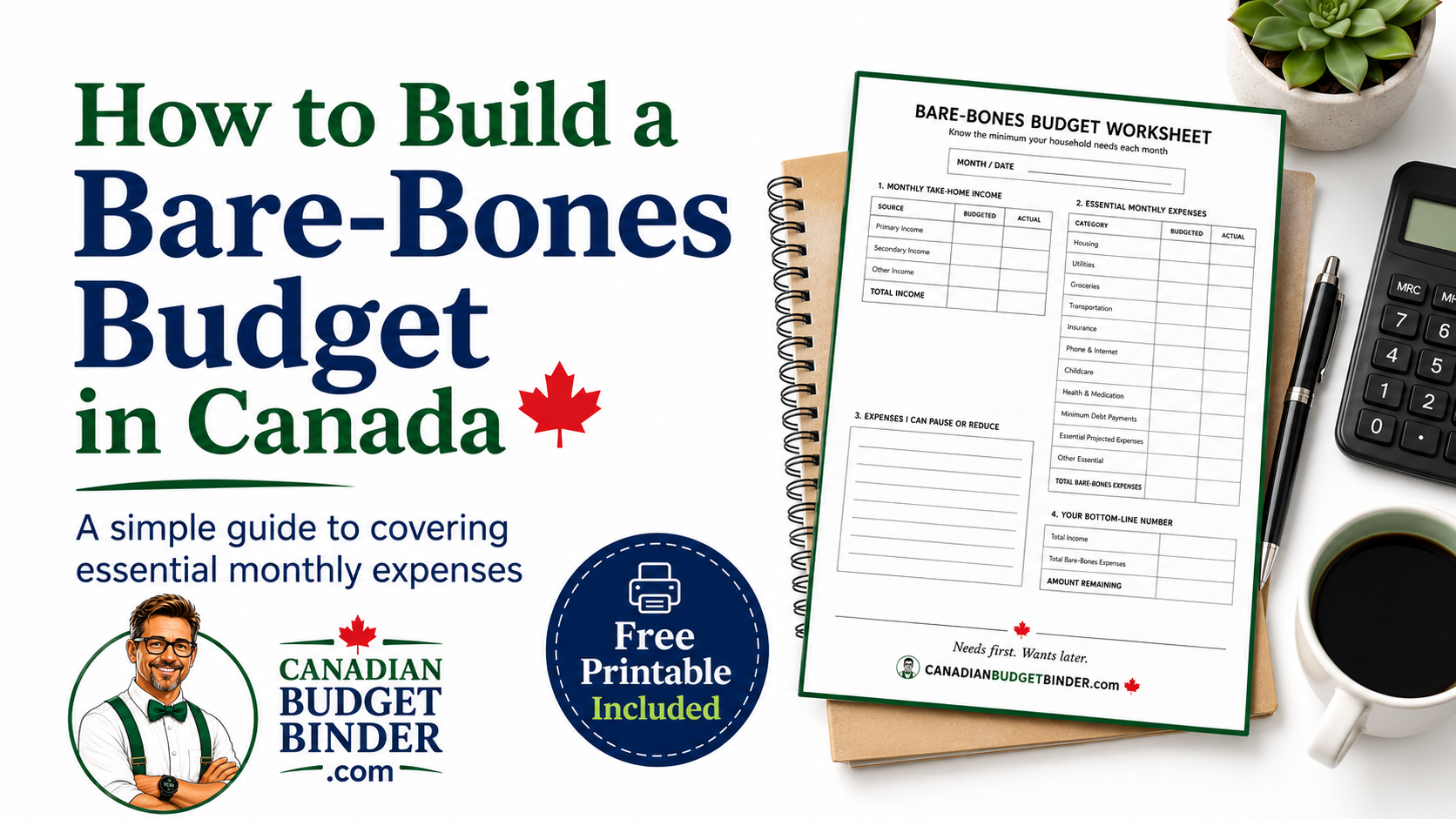

If budgeting feels complicated, start simple.
A bare-bones budget shows you the minimum amount of money your household needs each month to cover essential expenses and financial obligations.
You don’t need a fancy app, complicated spreadsheet or dozens of budget categories to get started.
In fact, when we first began seriously tracking our money, one of the biggest lessons we learned was that trying to keep all the numbers in our heads wasn’t working.
Putting our income and expenses in front of us changed that.
Whether you’re new to budgeting, dealing with a loss of income, trying to pay down debt or simply wondering how much it really costs your household to get through a month, a bare-bones budget is an excellent place to start.
I’ve also created a free Bare-Bones Budget Worksheet that you can print and use as you work through the steps below.
What Is a Bare-Bones Budget?
A bare-bones budget is a stripped-down version of your regular household budget.
It includes the expenses you need to pay and removes or reduces expenses you could temporarily live without.
Think of it as answering one important question:
What is the minimum amount of money my household needs each month to keep the bills paid and the necessities covered?
Knowing that number is useful even if you’re doing well financially.
If your income suddenly drops, someone loses a job, or an unexpected financial problem arises, you’ve already done the homework.
You know what needs to stay and what can go.
When Should You Use a Bare-Bones Budget?
You don’t have to be in financial trouble to create one.
A bare-bones budget can help when:
- You’re learning how to budget for the first time
- You’re living paycheque to paycheque
- Your household income has dropped
- You’re preparing for a possible job loss
- You’re dealing with an expensive month
- You’re trying to pay down debt faster
- You’re rebuilding your finances after an emergency
- You want to increase savings for an important financial goal
- You want to know the true minimum cost of running your household
I also believe every household should know its bare-bones number, even if it continues using a more detailed monthly budget.
It’s valuable to have this information before you need it.
Free Bare-Bones Budget Printable
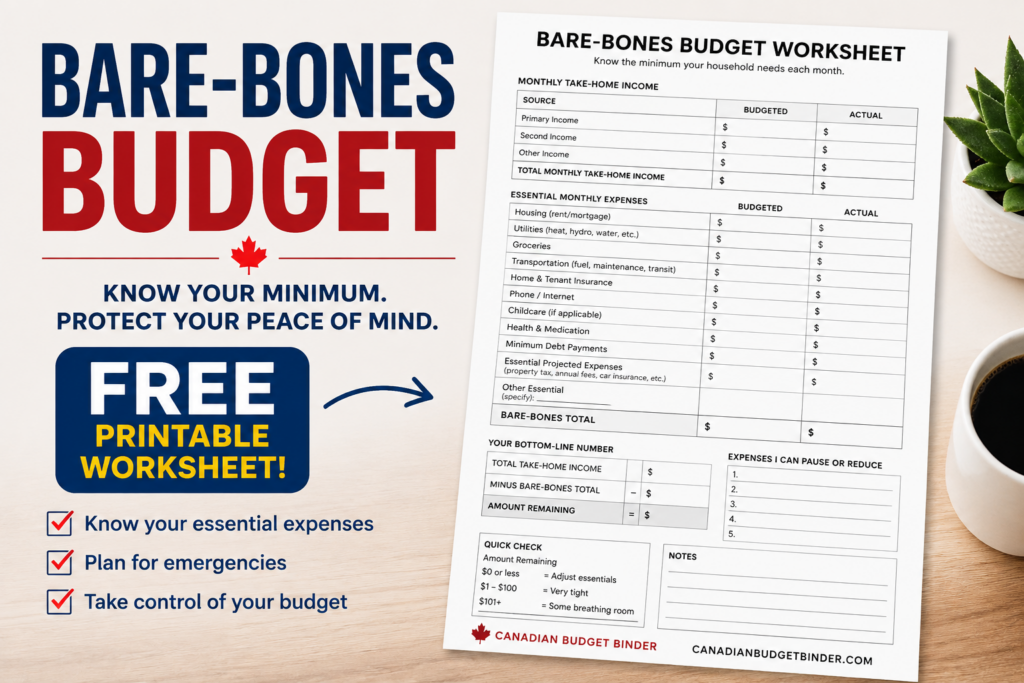
To make the process easier, I’ve created a free Bare-Bones Budget Worksheet that you can print and fill out at home.
The worksheet helps you:
- Record your monthly take-home income
- List your essential household expenses
- Compare budgeted and actual spending
- Identify expenses you can pause or reduce
- Calculate your total bare-bones expenses
- Determine how much money remains after your essentials are covered
Download the Free Bare-Bones Budget Worksheet here.
This worksheet is especially helpful if you’re new to budgeting or want a simple way to calculate your household’s minimum monthly needs.
What Should Be Included in a Bare-Bones Budget?
There is no single list that fits every Canadian household.
What is essential for one person may not be essential for another.
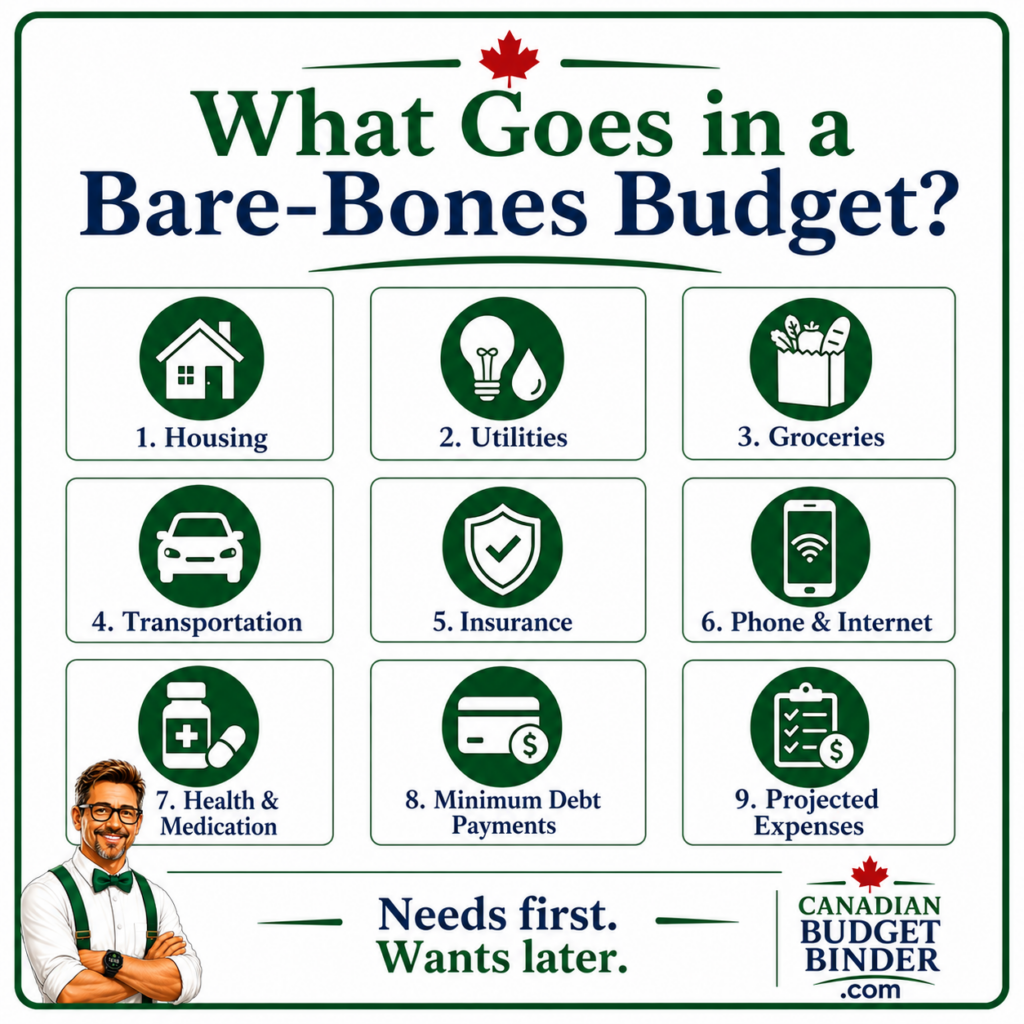
Generally, however, your bare-bones budget will include expenses such as:
Housing
- Rent or mortgage payment
- Property taxes, if you pay them separately
- Condo fees, if applicable
- Necessary home or tenant insurance
Keeping a roof over your head comes first.
Utilities
Your basic utilities may include:
- Hydro/electricity
- Natural gas or other heating costs
- Water
- Necessary waste or municipal charges
You may be able to reduce consumption, but these bills generally can’t disappear.
Groceries and Basic Household Needs
A bare-bones grocery budget doesn’t mean you stop eating well.
It means concentrating on necessities and temporarily reducing convenience foods, takeout, restaurant meals, and other extras.
Meal planning, shopping your pantry and freezer first, comparing unit prices, and buying sale items your household will actually use can all help.
You can find more ideas in my Ultimate Canadian Grocery Shopping Guide.
Transportation
Transportation is different for every Canadian household.
Your essential transportation expenses might include:
- Public transit
- Vehicle payment
- Car insurance
- Fuel
- Necessary parking
- Basic vehicle maintenance
If you need your vehicle to get to work, take your children to school or childcare, attend appointments, or live somewhere without reasonable public transportation, those expenses may be necessities.
Phone and Internet
A premium package isn’t a necessity, but basic phone and internet service may be.
Many Canadians rely on these services for work, banking, school, appointments, and communication.
The goal isn’t necessarily to eliminate them. It may be to find a less expensive plan.
Insurance
Depending on your household, essential insurance might include:
- Home or tenant insurance
- Auto insurance
- Life insurance
- Health or disability coverage
Reviewing insurance costs doesn’t automatically mean cancelling coverage.
Instead, make sure you’re paying for coverage you actually need.
Childcare and Essential Family Expenses
If childcare allows you to work, it belongs in your essential budget.
The same applies to other unavoidable household or family expenses that allow your household to function.
Medication and Necessary Health Expenses
Prescription medications and other necessary health expenses should be included.
These are needs, not optional spending.
Minimum Debt Payments
Your bare-bones budget should include at least the required minimum payments on debts such as:
- Credit cards
- Lines of credit
- Student loans
- Vehicle loans
- Personal loans
If your goal is aggressive debt repayment, you can add extra payments after you’ve determined your essential monthly expenses.
What Doesn’t Belong in a Bare-Bones Budget?
This is where needs and wants become important.
Expenses that can often be reduced or temporarily removed include:
- Restaurant meals and takeout
- Entertainment
- Streaming services
- Non-essential subscriptions
- Vacations
- Recreational shopping
- Clothing you don’t currently need
- Premium phone or television packages
- Hobbies and memberships
- Convenience purchases
That doesn’t mean these things are bad.
We spend money to enjoy our lives too.
A bare-bones budget is simply designed to show what you could live without if you needed to reduce spending quickly.
How to Build a Bare-Bones Budget Step by Step
You can create your budget on paper, with a printable, in Excel, or using whatever budgeting method makes sense to you.
Don’t let the tool stop you from starting.
Step 1: Calculate Your Monthly Take-Home Income
Start with the money that actually reaches your household after deductions.
Include regular sources of net income that are available to pay household expenses.
If your income changes from month to month, review several months of deposits.
You might choose a conservative monthly figure rather than building your bare-bones budget around your highest-income month.
The important thing is to use realistic numbers.
Step 2: Look at What You’re Actually Spending
Go through recent:
- Bank statements
- Credit-card statements
- Bills
- Receipts
This is one of the best ways to find expenses you’ve forgotten about.
We learned early in our budgeting journey that estimating our spending in our heads was not enough.
The numbers on paper told the real story.
Step 3: Separate Needs From Wants
Go through each expense and ask yourself:
Would I still have to pay for this if our household income dropped tomorrow?
If the answer is yes, it probably belongs in your bare-bones budget.
If you could cancel it, delay it, reduce it, or live without it for a while, it may be a want.
Be realistic, though.
A budget needs to work for your household, not somebody else’s.
Step 4: Total Your Essential Monthly Expenses
Add together your essential categories.
For example:
- Housing
- Utilities
- Groceries
- Transportation
- Insurance
- Phone/Internet
- Childcare
- Health expenses
- Minimum debt payments
The total is getting very close to your household’s bare-bones monthly number.
Step 5: Don’t Forget Expenses That Aren’t Paid Monthly
This is one of the easiest budgeting mistakes to make.
Some bills arrive:
- Every few months
- Twice a year
- Once a year
- Seasonally
We call these projected expenses at Canadian Budget Binder
Instead of waiting for the bill and wondering where the money will come from, estimate the annual cost and set aside part of it each month.
For example, if an unavoidable annual expense costs $600, saving $50 a month prepares you for the bill.
I’ve written an entire guide explaining how we use projected expenses in our budget.
Step 6: Compare Your Bare-Bones Expenses With Your Income
Now do the most important calculation:
Monthly net income − bare-bones expenses = money remaining
If you have money left, you can decide where it needs to go.
Depending on your situation, that might include:
- Building emergency savings
- Paying extra toward debt
- Funding projected expenses
- increasing savings
- Adding selected wants back into your regular budget
If your essential expenses exceed your income, that’s important information too.
It tells you that cutting entertainment and small purchases alone won’t solve the problem.
At that point, look carefully at the larger expenses and bills to see what can realistically be reduced.
If you’re at risk of missing required payments, contact the company or creditor involved as early as possible rather than ignoring the bill.
A Simple Bare-Bones Budget Example
Let’s use a hypothetical Canadian household with $4,500 in monthly take-home income.
Their essential expenses might look like this:
| Essential Expense | Monthly Amount |
|---|---|
| Housing | $1,650 |
| Utilities | $250 |
| Groceries | $600 |
| Transportation | $450 |
| Insurance | $200 |
| Phone and Internet | $150 |
| Minimum Debt Payments | $300 |
| Childcare/Health Essentials | $250 |
| Projected Essential Expenses | $150 |
| Total Bare-Bones Expenses | $4,000 |
That leaves $500.
This is only an example.
Someone living in Toronto, rural Ontario, Alberta, Nova Scotia, or anywhere else in Canada could have completely different numbers.
The point isn’t to copy someone else’s budget.
The goal is to calculate your number.
A Bare-Bones Budget Is Not Necessarily Your Regular Budget
This is an important distinction.
Your regular monthly budget can include things that make life enjoyable:
- Entertainment
- Hobbies
- Dining out
- Travel savings
- Gifts
- Personal spending
Your bare-bones budget is the financial safety-net version.
You may never need to live on it for long, but knowing how much it costs to cover your essentials is extremely useful.
When you’re first learning to budget, however, a simple basic budget may also be easier to manage than jumping directly into a complicated spreadsheet.
Once you’re comfortable tracking income and expenses, you can add more categories and detail.
Should You Track Every Dollar?
When you’re new to budgeting, I recommend tracking as much as possible.
Those small purchases add up quickly, particularly when they’re made with cash or spread across several debit and credit cards.
Tracking your spending also teaches you something a budget estimate cannot:
What you actually spend compared with what you thought you would spend.
Those are often two very different numbers.
You don’t have to become obsessed with every penny.
The goal is awareness.
Don’t Confuse Projected Expenses With Emergencies
Another lesson we learned was that an expense isn’t an emergency simply because the bill doesn’t arrive every month.
Property taxes, annual insurance premiums, routine vehicle maintenance, Christmas, and other predictable expenses shouldn’t automatically empty an emergency fund.
If you know an expense is coming, you can plan for it.
An emergency fund is for expenses that are unexpected and necessary.
If you’re working on yours, read How Much Should Canadians Have in an Emergency Fund?.
Use a Free CBB Budget Printable
If spreadsheets make you nervous, start with pen and paper.
There is nothing wrong with a simple printable budget.
Start with the free Bare-Bones Budget Worksheet included with this guide, then explore the other budgeting tools available at Canadian Budget Binder.
You’ll find a large collection of free budgeting tools and printables designed to help with budgeting, debt repayment, savings, and household organization.
You can also browse the Canadian Budget Binder free printable Budget Binder for even more worksheets.
Start simple.
You can always make your budget more detailed later.
Learn the CBB Budgeting System
If you want to go beyond a basic budget, I’ve documented the process we used to build our own household budget.
My free 10-Step Mini Budgeting Series walks through:
- Gathering financial information
- Choosing budget categories
- Tracking receipts
- Organizing your budget
- Balancing income and expenses
- Reviewing bills
- Planning projected expenses
You can also read about common budgeting mistakes and how to avoid them.
Budgeting doesn’t have to be perfect.
It needs to give you enough information to make better decisions with the money you have.
Bare-Bones Budget FAQ
What is the purpose of a bare-bones budget?
A bare-bones budget calculates the minimum amount your household needs to cover essential living expenses and financial obligations.
It can be useful during a loss of income, a financial emergency, or a period of aggressive saving or debt repayment.
Is a bare-bones budget only for people in debt?
No.
Even a debt-free household can benefit from knowing its minimum monthly cost of living.
It gives you a financial baseline you can use for emergency planning and savings goals.
Is a bare-bones budget meant to be permanent?
Not necessarily.
A strict, bare-bones budget can be used temporarily during difficult financial periods.
However, keeping a bare-bones version of your regular budget available is useful because you’ll know exactly what you can cut if your financial situation changes.
Should savings be included in a bare-bones budget?
Essential projected expenses should be accounted for because those bills will eventually need to be paid.
Emergency savings and other savings goals depend on your financial situation and the income you have after essential expenses.
Even a small amount saved consistently can be a starting point.
What if my bare-bones expenses are higher than my income?
That’s a warning that your household’s essential obligations exceed the money currently coming in.
Review the largest categories first rather than concentrating only on tiny purchases.
Look for expenses that can genuinely be reduced and deal with payment problems early rather than waiting until bills are already overdue.
Start With the Basics
Budgeting changed the way we looked at money because it gave us something estimates and mental calculations never could:
a clear picture of where our money was going.
You don’t need to build the perfect budget on day one.
Start with your income.
List your necessities.
Know your bare-bones number.
Track what you spend.
Then improve the budget as you learn more about your household finances.
That’s how a simple budget becomes a useful financial tool.
Before you go, don’t forget to download the free Bare-Bones Budget Worksheet and calculate the minimum amount your household needs each month.
Discussion: If you had to switch to a bare-bones budget tomorrow, which expense would be the hardest for your household to reduce?
Where Our Money Went in May 2018
Hey everyone!
Another decent month was had at the CBB household, with extra income from selling unused items around the house.
Sounds exciting, but we have expenses that will increase over the next few months, including a new fence (around $7k), a deck, and other backyard landscaping.
As for spending in May, there was not much out of the ordinary; however, more trips back to my mother-in-law’s house meant we spent more on eating out.
Because her disease means she no longer cooks, we often end up eating out, although we pack a cooler with snacks for the ride down.
Home Maintenance went up as I started buying items for jobs around the house, and we also purchased plants to decorate the outside for the summer.
Our daycare expenses also increased slightly because we had to add extra days in May for Mrs. CBB to help her mother with doctor appointments.
Have a great month, everyone!!
Mr.CBB
Percentages May 2018
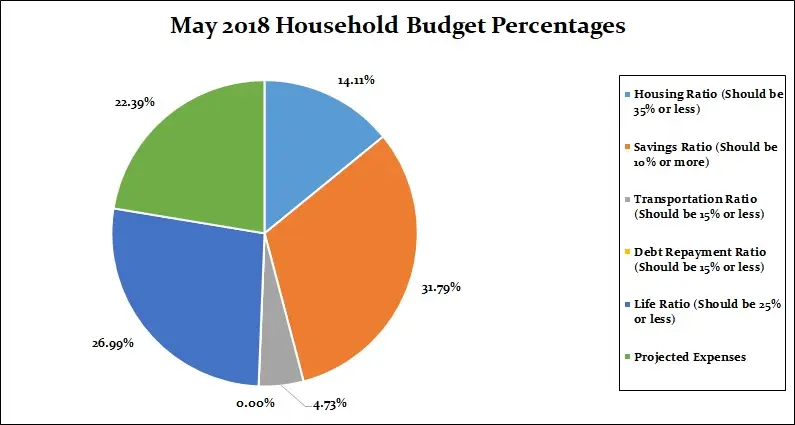
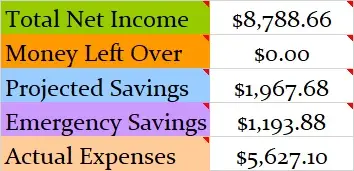
Our savings of 31.79% include investments and any projected expenses for this month, based on an income of $8,788.66.
We set aside money for projected expenses that must be paid in the coming months.
The other categories were reasonably standard this month, even if the Life Ratio is a little high and close to the maximum.
All categories took 100% of our income, showing that all the money we earned for the month was accounted for.
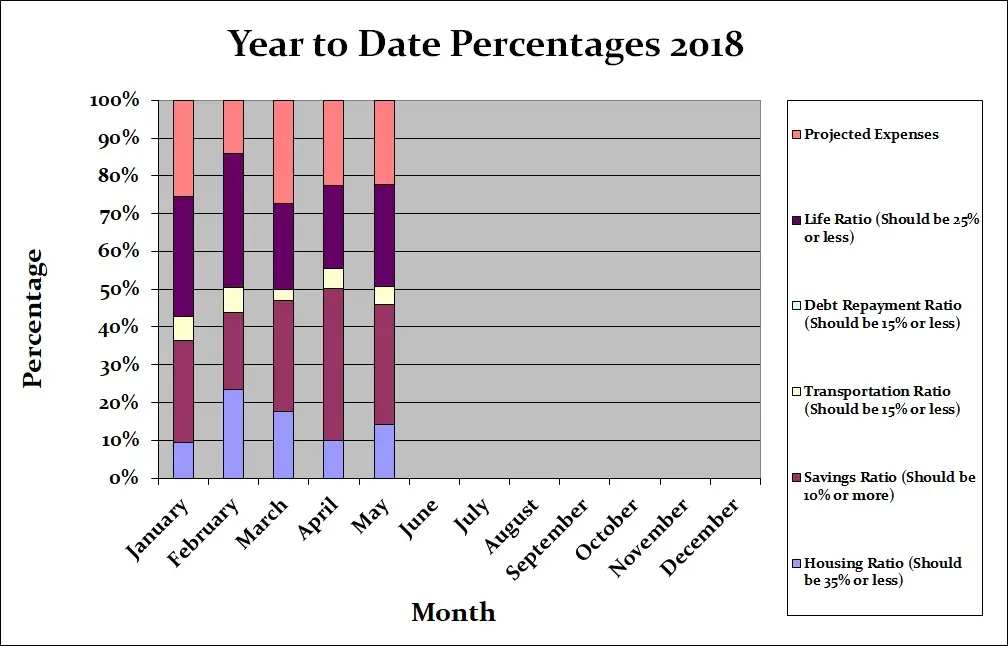
Percentages Month By Month
Breaking Down Expenses
Below is a breakdown of our expenses, which helps us understand where all our money goes.
Since May 2014, we’ve been mortgage-free, so much of our money will be directed at savings, investments, and renovations.
I hope you view this as an educational tool rather than comparing your financial numbers, as our situations are unique.
Spending less than we earn and budgeting our money has been the easiest way for us to pay down debt and save money.
It may be different for you.
- Chequing– This is the bank account from which all our debt is paid.
- Emergency Savings Account– This is a high-interest savings account.
- Regular Savings Account– This account holds our projected expenses.
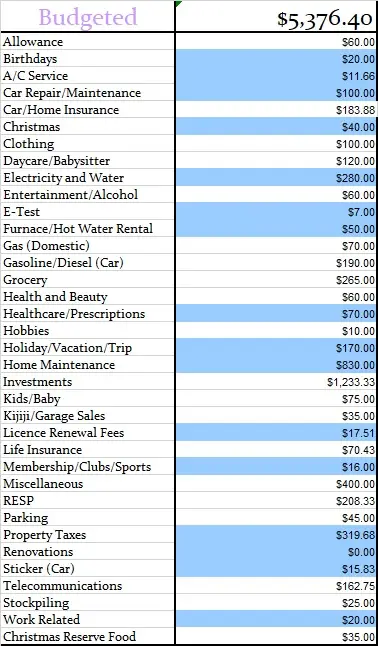
- Monthly Budgeted Total: $5,376.40
- Monthly Net Income Total: $8,788.66
- (Check out our Ultimate Grocery Guide to see where our grocery money goes)
- Projected Expenses: These are expenses we know we will pay for throughout the year = $1,967.68
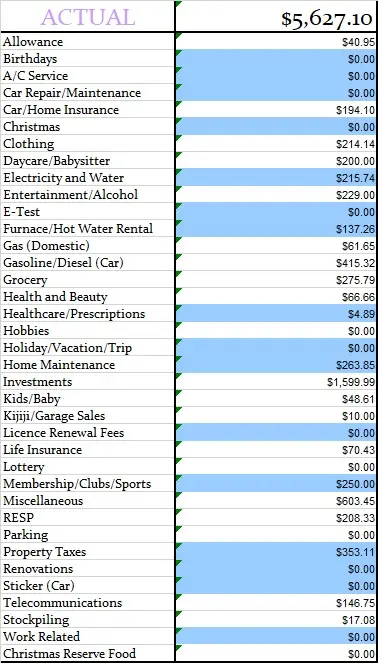
- Total Expenses Paid Out: $5,627.10
- Total Expenses Actually Paid Out: Calculated is $8,788.66 (total net monthly income) – $1,967.68 (projected expenses) – $1,193.88 (savings into emergency fund) = $5,627.10
- Actual Cash Savings going into Emergency Savings: Calculated is $8,788.66 (total monthly net income) – $5,627.10 (actual expenses paid out for the month) – $1967.68 (projected expenses) = $1,193.88
Results
Time for the juicy category numbers and to see how we made out with our monthly budget.
Below you will see two tables, one is our monthly budget, and the other is our actual budget for May 2018.
The following financial numbers represent two adults and a toddler, plus retirement investments.
Colour Codes
If highlighted in blue, that means it is a projected expense.
Budgeted Amounts for May 2018
Actual Expenses For May 2018
Updates Month By Month
In case you missed our updates and want to do a quick search, I’ve compiled them on one handy page: the monthly budgets page.
Happy Budgeting CBB’ers!
Thanks, Mr. CBB! I’m impressed at the details of these budget summaries. I think I’m more of the “barebones” type, The Pie of Life type, or the Gail Vaz Oxblade categories type. Whichever way, the benefit of using a budget is indisputable. You can see all the buckets where your money is going into, and it gives you some feeling of control. There are times when I’m left with such little disposable income, but at least I know where the rest of my income went — ie, mortgage, RRSPs, RESPs, insurance, groceries, etc. Yes, some months we have stuck to our budget, some months we are under budget and some months required more spending. The benefit I get out of monthly budgeting is that if I’ve had a heavy spending month, then I know that I have to cut back significantly in the next month to balance it out.