

Estimated reading time: 10 minutes
If your household struggles with electricity bills, the Ontario Electricity Support Program (OESP) could make a meaningful difference. Eligible lower-income households receive a monthly credit directly on their electricity bill, rather than a payment deposited into a bank account.
Under the current rules, regular OESP credits range from $35 to $75 per month. Some eligible households can receive a higher monthly credit of $52 to $113, depending on their circumstances. What you qualify for depends mainly on the number of people in your home and your household’s combined annual after-tax income. You have to apply: the credit does not automatically appear on every qualifying person’s bill.
The Ontario Energy Board (OEB) reports that OESP helped an average of 252,000 households per month and provided $175.9 million in on-bill credits during the 2024–25 reporting year. That is a reminder that many people use this assistance, even if they have never heard of it. Source: Ontario Energy Board, Bill assistance programs.
How our family discovered OESP
I originally wrote about this program in 2019, after my family helped my mother-in-law get a better handle on her household expenses. Her electricity bills were difficult to manage on a limited income. At times, the household received bills of several hundred dollars covering two months of electricity use.
We examined the bills and looked at what was using power. Heating and cooling, older appliances, and several freezers were contributing to the cost. We also learned about OESP and helped her apply for support.
Looking back, I wish we had known about the program earlier. It is easy to assume that a high bill is something you simply have to pay, especially when you are already juggling food, housing and other necessities. An electricity credit will not fix every financial problem, but it can be part of a more manageable monthly budget.
If you’re helping an older family member with finances, check the available assistance rather than assuming home ownership or retirement automatically makes someone ineligible. Our family also learned that planning for future care costs matters; see Long-Term Care Home Expenses to Consider.
Who qualifies for the Ontario Electricity Support Program?
You may qualify if you are a customer of an Ontario electricity utility and your household meets the program’s income and household-size rules. Some residents of apartments, condominiums or other individually metered buildings can also qualify when they receive electricity bills from an eligible unit sub-meter provider.
The OESP credit is not limited to seniors, homeowners or people who receive government benefits. Households on a low or fixed income should check their circumstances through the Ontario Energy Board’s official OESP information.
The OEB states that Ontario Works and Ontario Disability Support Program (ODSP) recipients automatically qualify for OESP and should contact their caseworker to apply. That does not mean the credit will necessarily appear without the application being arranged.
Current OESP household income limits
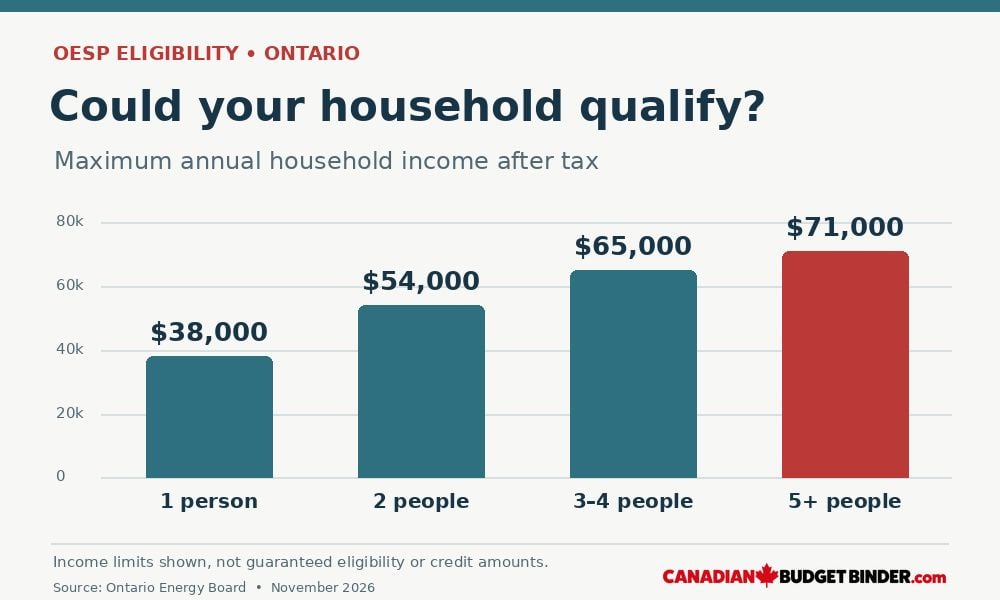
Ontario expanded OESP income eligibility effective March 1, 2024. The figures below show the maximum combined annual after-tax household income that may qualify under the regular schedule. Meeting the income limit alone does not guarantee approval.
| People in the household | Maximum annual after-tax household income |
| 1 person | $38,000 |
| 2 people | $54,000 |
| 3–4 people | $65,000 |
| 5 or more people | $71,000 |
How much could OESP take off your monthly electricity bill?
For most qualifying households, the monthly credit ranges from $35 to $75. The OEB’s current table has several income bands, with the amount varying by household size.
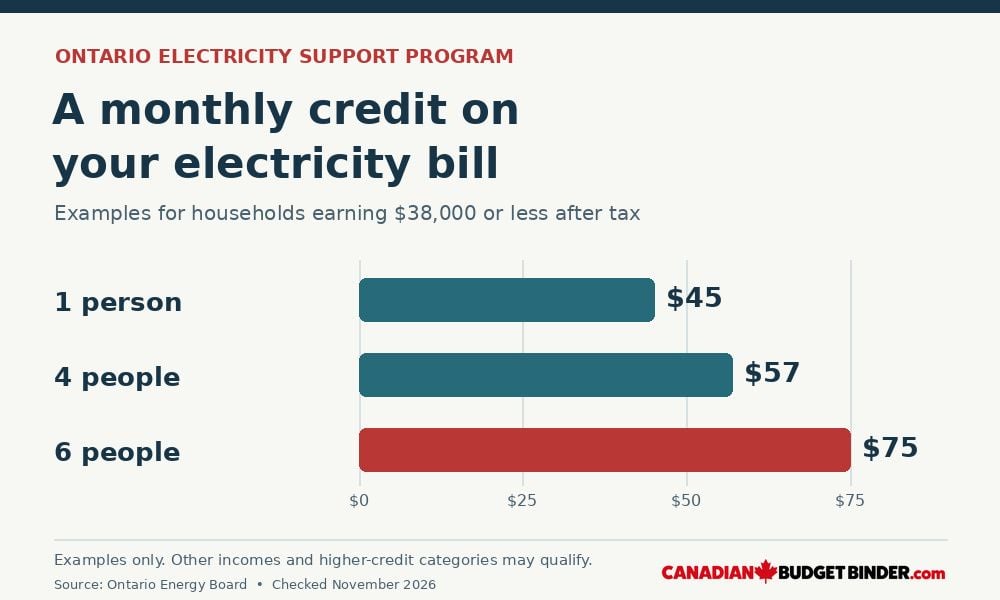
To make that easier to picture, here are three examples for households with a combined annual after-tax income of $38,000 or less:
- One person: $45 per month.
- Four people: $57 per month.
- Six people: $75 per month.
Certain households can receive higher credits of $52 to $113 per month. These may include people who use electric heating, depend on qualifying electricity-intensive medical equipment, or are Indigenous or live with an Indigenous household member. The exact amount and eligibility conditions still matter. Not everyone will receive the maximum credit.
For the full schedule, refer to the Ontario Energy Board’s OESP credit table.
How to apply for OESP
Applications can be made online, by mail, or with help from an authorized intake agency. There is no fee to apply, and a home inspection or energy audit is not required.
- Find your most recent electricity bill. The application uses your account and service-address details.
- Gather household information. You will need the names and dates of birth of household members as recorded with the Canada Revenue Agency. The official application may request Social Insurance Numbers or temporary tax numbers for residents aged 18 or older. Give that information only through the secure official process.
- Start the application. Visit the official OESP portal, or ask an authorized intake agency for free assistance if you prefer help or a paper application.
- Complete the required consent process. The program uses consent to verify household income through the CRA.
- Check for a decision and credit. The OEB says an eligibility decision generally takes four to six weeks after it has received and reviewed a complete application and signed consent forms. If approved, the credit generally appears on the electricity bill in about six to eight weeks.
If you have not filed a recent tax return or your finances have changed since you filed, a program intake agency can explain how to provide evidence of your present situation. Use the official application and intake-agency information.
Privacy reminder: Canadian Budget Binder does not process OESP applications. Please never share your SIN, full electricity account number, income-tax documents or private medical information in our comments.
Do you need to reapply?
Most approved accounts receive OESP for two years before needing to reapply. An account holder aged 65 or older, or receiving a CPP disability pension, generally has a five-year eligibility period. Moving or a change to household circumstances can affect your application; confirm any changes with the program.
What if you’re behind on the bill? Look at LEAP
The Low-income Energy Assistance Program (LEAP) is different from OESP. While OESP provides ongoing monthly credits, LEAP provides emergency financial assistance to eligible electricity or natural-gas customers who are in arrears and face disconnection.
Under current Ontario Energy Board rules, LEAP may cover up to $650 toward an overdue electricity bill, or $780 if the home is heated electrically. The maximum for an overdue natural-gas bill is $650. You cannot receive more than you owe, and the approved grant is paid to the utility, not to the customer.
LEAP requires an application through a designated intake agency. If you have been warned that your service may be disconnected, contact your utility and an intake agency promptly. See the official LEAP instructions and agency list.
Ontario’s winter disconnection rules
For November 15, 2026 through April 30, 2027, licensed electricity utilities may not disconnect residential customers for non-payment during the annual winter prohibition. This protection does not automatically apply in the same way to unit sub-meter providers, so customers in individually metered buildings should confirm their rights directly. The prohibition does not erase overdue balances or prevent late charges. OEB — Rules for electricity utilities.
If you are struggling, ask your provider about an arrears payment arrangement and the additional customer-service protections available to qualifying low-income customers. Do not wait for a disconnection notice to become urgent.
Ways to reduce electricity use without sacrificing health or comfort
OESP is one source of help; reviewing electricity use is another. When we looked at my mother-in-law’s bills, inefficient appliances and unnecessary extra equipment were part of the problem. There may be practical ways to cut waste without spending large amounts on replacements.
- Compare actual electricity use. Look at kilowatt-hours (kWh) on several bills, not just the dollar total.
- Review your electricity price plan. Ontario has Time-of-Use, Tiered and Ultra-Low Overnight options for eligible customers. The best plan depends on your pattern of use. Check the OEB’s current electricity rates, rather than relying on an old rate table.
- Check appliances and unused equipment. Old or seldom-used freezers, heaters and other appliances can increase your usage. Replace equipment only after considering the cost and likely savings.
- Protect essential heating, cooling and medical equipment. No savings tip should compromise safe indoor temperatures or medically necessary electricity use.
- Budget for water separately where appropriate. Some municipalities send combined utility statements, but OESP is an electricity bill program; it does not provide a water-bill credit.
Some eligible households may also qualify for free or subsidized efficiency improvements through Ontario’s Save on Energy programs. Check the current program rules before applying.
Avoid OESP scams
The OEB and OESP are not affiliated with private companies selling home energy products or upgrades. You do not have to accept a home visit, inspection or energy audit to apply for OESP. Be cautious about unexpected calls or messages asking for account details or government identification.
Use the real OESP website and the Ontario Energy Board to verify program information. Do not provide personal details to people who contact you unsolicited claiming to guarantee a rebate.
Where to ask for help
- OESP applications and intake agencies: OESP.ca.
- Current credit amounts and rules: Ontario Energy Board — OESP.
- Telephone: 1-855-831-8151.
- Email: help@OntarioElectricitySupport.ca.
- TTY: 1-800-855-1155.
- OEB-listed contact hours: 8:30 a.m.–5 p.m. (confirm business days and holidays before calling).
OESP will not be right for every household, but if paying electricity bills is a struggle, it is worth checking. You may also want our Senior Discounts in Canada A–Z Directory, which covers other savings opportunities.
When families are trying to organize paperwork after major life changes, it can also help to review the related CBB article Why You Need a Will Before Death.
Discussion: Have you applied for OESP or helped a family member apply? What was the process like for you? Please keep account numbers and other sensitive personal details out of the comments.
This article is for general information. Eligibility thresholds, amounts, application rules and protections can change. Always check the Ontario Energy Board or the official program website for the latest requirements.