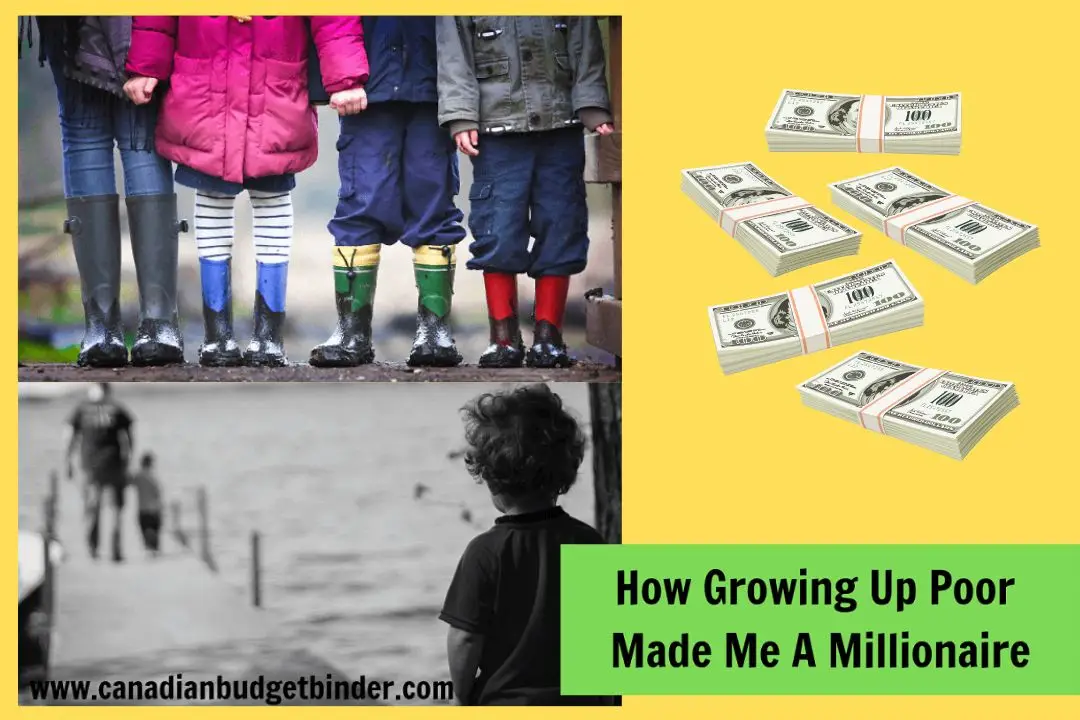
Understanding the challenges of growing up poor in Canada can shed light on the need for continued poverty reduction efforts.
Making Ends Meet In Canada
In 2015, one in every eight Canadians (12%) lived in poverty, and since then, Canada has invested in the social and economic well-being of Canadians through a Poverty Reduction Strategy.
Growing up poor in Canada as a child impacts all facets of life, but it’s something that can be turned into a success story.
Growing Up Poor And the Cost of Housing
Lack of income and suitable housing costs are one of the main reasons for homelessness in Canada.
Shelters are often full, and when there is no room, struggling Canadians are sent back to the streets.
Today, in our city, just to rent a one-bedroom apartment, it costs well over $ 1,000 plus utilities.
A family of two adults and two children requires at a minimum a two-bedroom apartment, which can increase costs significantly.
Parents who own a home often struggle with increased property taxes and home maintenance costs, which can push them into debt.
Children who grow up in poverty often live in big houses, small houses, apartments, and on the streets. Besides financial education, more needs to be done.
Living in Canada, nobody should be living on the streets or struggling to put food on the table, given the resources available.
The reality is that not everyone knows how to directly impact their finances by managing their money effectively to stretch it further.
Other reasons are that families or individuals simply aren’t making enough money to cover all their expenses.
This has forced people to move in with roommates, rent a room, or live at home longer because they can’t afford to live independently.
It’s not uncommon to see kids living at home into their late 20s and early 30s, given the state of our economy.
Poverty Is A State of Mind
I think poverty is a state of mind only because we are as poor as we think, but only if we compare ourselves to everyone else.
Being unable to pay the rent, mortgage, and necessities is definitely a situation no one wants to be in.
I know that some people have to make the difficult decision each month as to which bills to pay so they can attend to their basic needs.
If we don’t work harder at managing our finances, no one else will, and the government is only going to provide so much.
That’s reality, although they have been working on a reduction strategy since 2015 to help break down barriers.
Growing Up Poor At Home
Mrs. CBB.
Growing up poor was a way of life for my family because we had very little money.
There are no times I can remember sitting with my parents to read a book or engaging in our education.
I can remember not having rain boots to walk to school or an umbrella to shield me from the rain.
Our lunch was whatever we had in the pantry or refrigerator, but most days we didn’t have much of a lunch at all.
There were no before- and after-school meal programs for kids growing up poor, like we were.
It was far easier to pretend we weren’t hungry than to suggest that our family had little money for food.
My parents never went to the food bank in the ’80s and early ’90s, when my dad was homesick, and my mom was working various cleaning jobs.
I moved back home after college to help them pay the mortgage by offering them monthly rent.
Our house was falling apart because my father could not afford to pay for repairs, and any fixes he made were made with scraps from friends.
I can remember the bathroom ceiling upstairs was caving in, and I could see inside the roof. We had to put a bucket in the hole when it rained.
The living room ceiling had a popcorn finish that was stained yellow from water leaking through the roof.
It was only a matter of time before that collapsed.
I Was Different Than Other Kids
Growing up poor was one of the hardest things I had to endure as a child because I didn’t get opportunities like other kids.
I had to work in my parents’ business from the age of 10 so my mom could go home to clean and cook.
Thankfully, my dad kept busy building his garden, so we had food to eat and store in the freezer for the winter months.
This was something he continued until his passing last year.
Now we continue gardening as a family at our house.
Is this what child labor is in Canada?
Well, in a sense, yes, because I’m sure running a business at the age of 10 is not something most kids my age would do.
They couldn’t afford to hire anyone and don’t think that just because we had a business, we had money.
We didn’t, in fact, my parents were in so much debt with the business that it eventually had to be closed down.
Eventually, my parents lost their house, business, and all of their properties.
Thankfully, my father was given a substantial amount of money from WSIB to put down as a down payment on a new home.
Living on the streets was almost a reality for our family, but we didn’t give up.
With the help of a local bank, they were able to build credit using a secured credit card, which helped them obtain a mortgage.
Today, my father is gone, and my mother is a senior living in poverty, and it breaks my heart.
You see how hard your parents work growing up, and to see them living below the poverty line in retirement breaks your heart.
Poverty In Canada
In 2017, 622,000 children under 18 years of age, or 9.0%, lived below the poverty line, down from 11.0% (755,000 children) in 2016.
The child poverty rate, according to the MBM, has declined fairly steadily since reaching its most recent peak of 15.0% (1.0 million children) in 2012. Source
People in lone-parent families recorded among the largest decreases in poverty in 2017—the proportion of people in these families living below the Official Poverty Line fell from 29.2% in 2016 to 22.7% in 2017.
The poverty rate for persons in lone-parent families has been declining steadily over the previous five years, associated with increases in child benefits.
The below chart represents after tax income median for families and unattached individuals for 2017.
For the 2016–17 benefit year, single mothers earning less than $60,000 a year received about $9,000 in benefit payments on average, making it easier for them to afford the things that give children a good quality of life, such as a safe place to live, healthy food and winter clothing.
In addition, 9 out of 10 families are receiving more in child benefits than under the previous system of child benefits.
Deep Income Poverty Canada
5.4% of Canadians (1.9 million) were in deep income poverty in 2016, making them the poorest of the poor.24.8% of working age single females22.1% of working age single males14.2% of female lone-parent families9.5% of Indigenous people living off-reserve8.3% of recent immigrants7.7% of persons with disabilities
Growing Up Poor In School
Poverty affects education and has long-term psychological effects on children, especially when they know they come from a poor home.
The effects of poverty on child development, at least from my perspective, meant that I didn’t focus in school.
I was always wondering if my parents were fighting about money or if someone was going to take our house away.
As I got older, I started to realize the financial disaster my parents were in, and it all started from a work injury and money mismanagement.
Children living in poverty struggle in different ways, so I can’t speak for them all.
I know that I didn’t have many friends growing up, as I wasn’t allowed to play outside while our parents were at work.
Not being able to participate in sports also put me on the nobody list at school because I wasn’t popular.
Poor children know they are growing up poor because they don’t get money for pizza day, bake sales, or have family vacations to share with their peers or teacher.
Effects Of Poverty On Poor Kids
Explaining poverty to a child is not something a parent wants to do, but I often heard that we couldn’t afford it.
Eventually, it all made sense to me as I put two and two together and listened to my parents argue about money.
The poor kids in school are picked on or left to fend for themselves, and that’s a reality.
You don’t have the latest lunchbox, fashionable clothes, or get to buy books at the Scholastic book fair.
I suppose I was undiagnosed with depression growing up in a low-income family, but it changed the way I thought about money.
When I started my first real job at 13, I saved as much money as I could right up until I bought my first house at the age of 30.
I wanted to be a millionaire and provide for my children in ways my parents could not.t
Learning about budgeting and finance from an early ag,e and still toda,y has allowed my husband and me to do this.
Poverty is a state of mind, but it’s how you take that mindset and make it either a success or a continued path of poverty.
Poverty Reduction Strategy Canada
The fact that Canada is working to reduce poverty is a blessing, even though some people may not feel it is doing enough.
I read about it often, but we have to remember that they can’t change everything overnight, but with the right resources, children won’t have to grow up poor.
Living under the poverty line and trying to provide for your family affects everyone, including the parents who feel backed into a wall.
Today, the Honourable Jean-Yves Duclos, Minister of Families, Children and Social Development, tabled legislationaspart of Opportunity for All – Canada’s First Poverty Reduction Strategy which was launched in August.
The Bill proposes to entrench into legislation ambitious and concrete poverty reduction targets; a 20 % reduction in poverty by 2020 and a 50 % reduction in poverty by 2030, relative to 2015 levels.
These targets will lead to the lowest poverty rate in Canada’s history. – Source
The median after-tax income for 2017 was $59,800, also the highest in Canadian history.
Data on Canada’s Official Poverty Line has been published by Statistics Canada since 2002.
Opportunity for All – Canada’s First Poverty Reduction Strategy, released in August 2018, established the Market Basket Measure as Canada’s first Official Poverty Line.
A total of 3.4 million Canadians, representing 9.5% of the population, lived in poverty in 2017, down from 10.6% in 2016.
The data for 2017 also reflects the first full year of the Canada Child Benefit and the increased Guaranteed Income Supplement top-up, both of which were implemented in July 2016.
Between 2015 and 2017, there was a decrease of 52,000 single seniors living below Canada’s Official Poverty Line.
The Poverty Reduction Strategy’s targets are aligned with the United Nations Sustainable Development Goals to eradicate poverty.
The Canada Child Tax Benefit is a tax-free monthly benefit provided to eligible parents to help support the care and upbringing of their children under the age of 18.
I know many parents who are very thankful for the Canada Child Benefit because it helps support their budget.
Being able to afford clothes, school supplies, and extracurricular activities for your child will make a world of difference for them.
Our son collects a bit over $200 a month, and since we are fortunate financially, we invest that money for him in a non-registered investment account so that when he turns 18, he will have money for his start in life.
What is the Guaranteed Income Supplement?
The Guaranteed Income Supplement is a tax-free monthly benefit for low-income recipients of the Old Age Security pension.
My mother-in-law collects this benefit each month since she does not work due to mental illness and falls below the poverty line for a senior.
We are very thankful for this benefit as it has allowed her to stay living in her home until she needs to be in a nursing home.
Growing up poor today compared to in the ’70s and ’80s when I was a child has far more benefits to help single parents and low-income families.
One of the most significant problems associated with offering tax-free benefits to Canadians is how the money is allocated in terms of budgeting.
Earning more money or being given money doesn’t always fix a situation when you are growing up poor if it is not managed right.
The struggles to provide for a family will continue year after year, but with changes to personal finance mindsets, money will stretch even further.
Discussion: Did growing up poor shape your financial future? Share your comments below.
CBB Posts You May Have Missed
These are some of the blog posts I’ve written over the past two weeks on Canadian Budget Binder.
I’m not a huge fan of marshmallows on their own, but if you add them to a recipe, I’m game.
I think everyone will agree that marshmallows and chocolate pair well together, so I’m definitely going to try this recipe.
The only difference is that I will make it a Keto brownie recipe instead; however, I still need to think about the crunchy topping.
I can make homemade keto marshmallows and have made keto brownies on many occasions.
I’ll post the pictures and the recipe once I’ve made it.
For the Brownies:
2 teaspoons vanilla
1 1/2 cup dark cocoa powder
1/4 teaspoon salt
1/2 cup chocolate chips or chopped chocolate
2 cups white sugar
3/4 cup vegetable oil
4 large eggs
For the Topping:
1 bag mini marshmallows (10.5 oz. or 5.5 cups)
2 cups chocolate chips (or chopped chocolate)
1 1/4 cups peanut butter
5 tablespoons butter
3 cups Rice Krispies, gluten-free if needed (I actually used Cocoa Krispies because I strangely can’t find plain here. Not complaining.)
Garage Sale Finds
If you have deals you’d like to share from your garage sale outings this Summer, email me your photo and tell us what you found and how much it cost to be featured.
Here are this week’s garage sale deals:
Sandwich container $.25
Carabiner clips $.25 (asking was $1)
Bunch o balloons, two new Dove deodorants, two bag clips $1
Moose head beer coin holder (including coins!!) $1
Total spent $2.50
We went through the coins when we got home. Pictured below are coins from various countries.
We also counted $3.03 USD and $6.40 CAD, so we made more money from garage sales than we spent.
Jen P.
Hey Jen,
This was by far the coolest and funniest garage sale deal that you’ve sent me over the years.
To hear that someone didn’t care enough to take money out of a piggy bank at a garage sale is mind-blowing.
Well done, and thank you for sending this in.
Mr.CBB
Home and Blog Update
Hey everyone,
The past two weeks have been mostly spent on renovations, with the upstairs bathroom continuing to undergo work.
I’m at the point where I’ve just got to tile and add the toilet and cabinets.
We haven’t bought any lighting yet; however, I did purchase LED lights for the ceiling from Amazon, along with a tap.
I was pretty amazed by the variation in prices for bathroom accessories, but I found the best price online.
Most of the building supplies we purchased from Lowe’s online, and used Ebates to earn cash back.
In the garden, our tomatoes and peppers are starting to turn colours, and we are so excited to have organic produce.
Google Search Terms
Every week, I receive tens of thousands of visitors to Canadian Budget Binder, as they have searched online and found my blog.
Yes, I can see your search terms, and sometimes they are funny.
Sell something to Value Village. Sorry, but there’s no selling happening at VV. However, you can get a 30% discount with a punch card, the more you donate.
Canadian Jam Making – I thought jam is jam, and it is made the same way, no matter where you live, based on the fruits you use. Maybe I’m wrong.
What happens when your wife spends more than you make? – You go broke
If you see the acronym (SIC) next to a word, it has copied the text exactly as it was typed in Google, and it has spelling errors
See you again in two weeks for the next Saturday Weekend Review!
Get CBB By Email + My FREE Printable Budget Binder!
Welcome, Canadian Budget Binder Friends, and enjoy your stay. As a subscriber, I want you to know you’re not alone. Everyone has debt at some point in their lives.
Most importantly, putting a plan in motion to pay off debt and live without added financial stress is critical.
Most importantly, putting a plan in motion to pay off debt and live without added financial stress is critical.
Contact CBB via the contact page with any questions. Unfortunately, Mr. CBB is not a financial advisor. See Disclaimer