


Estimated reading time: 11 minutes
Just because you shop at second-hand stores doesn’t always mean you’re getting a deal.
Today, I will analyze my top 10 common mistakes consumers make when shopping thrift.
Shop For Second-Hand Bargains The Right Way
Shopping at second-hand stores, you either hate or love it, and that’s because of our lifestyle, budget, and beliefs.
We love to shop at second-hand stores across Ontario because it has been one of the easiest ways to save our family money.
When people ask how we could pay our mortgage in five years, part of that success comes from second-hand stores.
We were never the couple to buy brand-new items unless it was necessary because having the latest and greatest never appealed to us.
There was nothing we needed to prove to anyone, especially when it came to clothing, big houses, and stuff.
We’ve been in and out of second-hand stores all our lives, but it didn’t start until we were in our 20s and living independently.
Second-Hand Shops For Student Discounts
When we were off at University, second-hand stores became our norm.
I’m sure many students and even parents of students can agree that school is high-priced as it is, and any savings is better than none.
Our local Value Village second-hand store crawls with local students throughout the year but tapers off during summer.
There’s no shame in shopping in second-hand stores like there used to be because people don’t care.
Nobody should care what anyone thinks when paying the bills and saving money.
If you’re lucky, you may have a local second-hand store that offers student discounts and even seniors discount days.
Always carry your student card on you when you shop!
Second-Hand Stores For Kids
Another popular store for parents is the second-hand baby store, where you can find inexpensive clothing for kids.
What I love about these exclusive second-hand stores is that they cater to kids and often buy back what you purchase for cash.
In our area, we have Once Upon A Child, where you can sell your used baby items to them instead of selling privately online.
The store will buy anything from baby clothes, furniture, accessories, shoes, and toys from Canadians who want fast cash.
How it works at Once Upon A Time Second-Hand Stores
Bring It In
Bring your gently used children’s clothes, shoes, toys, furniture, and baby gear.
We’ll Check It Out
A store employee will review your items and make an offer based on style, safety, and condition standards.
Get Paid Cash
If you accept the offer, you’ll get paid cash on the spot!
The Big 5 Second-Hand Stores in Canada
Mission Thrift Store
Mission Thrift Store is a volunteer-driven, non-denominational Christian organization that currently operates more than 50 thrift stores across Canada.
We provide used goods in a department store-like experience for value-conscious shoppers, who can find deals they can feel good about.
Our stores convert donated goods into cash, and the net revenue is devoted to the joint ministry of BFM Foundation (Canada) and Bible League Canada to support leadership and literacy programs in over 43 countries — giving people access to the life-giving, life-changing, Word of God.
Talize
Talize is a proudly Canadian owned and operated national for-profit retailer offering quality resale apparel and housewares at unbeatable prices.
As Canada’s newest and most unique shopping experience we offer new, like-new and vintage items all under one roof.
That means fantastic deals on brand names and designer fashions as well as accessories, leather goods, footwear, housewares, books, toys and more.
With new stores opening and over 6,000 items arriving on the floor daily, visit often to find your #talizetreasures!
Did you know that 85% of all textiles end up in landfills despite 95% being fully recyclable?
Each of our stores saves more than 2 million pounds of goods per year from landfills.
Look good and feel good about making eco-conscious choices.
Talize is a proud sponsor of the Children’s Wish Foundation, having donated over $2 million since our inception in 2005.
Goodwill Industries
Changing lives and communities through the power of WORK.
Goodwill Industries, a non-profit social enterprise, provides work opportunities, skills development and employee and family strengthening for those who face barriers such as disability or social disadvantage; with the aim of advancing individuals, families and communities toward self-sufficiency and prosperity.
The Salvation Army Thrift Store
The Salvation Army Thrift Store
National Recycling Operations’ (NRO) role, within the context of The Salvation Army, is both to generate funds to help The Salvation Army achieve its mission, and to influence positively the communities in which we operate.
The Salvation Army exists to share the love of Jesus Christ, meet human needs, and be a transforming influence in the communities of the world.
Value Village
Value Village Savers Thrift Company
Value Village, a Savers brand, is a for-profit, global thrift retailer offering great quality, gently used clothing, accessories and household goods.
Our Rethink Reuse® business model of purchasing, reselling and recycling gives communities a smart way to shop and keeps more than 700 million pounds of used goods from landfills each year.
We also help more than 100 nonprofit organizations by purchasing donated goods from them, which provides a source of revenue to help supports their vital community programs and services.
Get special text-only offers from Value Village.
Text OFFERS to 53955. Standard message and data rates may apply.
1. Read The Return Policy
For many second-hand stores, the return policy is simple: there are no returns, but ask if you are unsure before you shop.
For example, Value Village offers returns within 14 days, along with the receipt and tags for the product purchased.
There are no fitting rooms at Value Village, so what used to be a 7-day exchange is now 14 days.
The one mistake we made was not knowing that not all items at Value Village can be returned.
Therefore, you must read the price tag to tell you whether the item can be returned.
If you’re not sure, ask before you buy.
The only thing to remember is that it’s not cash back; it’s an in-store credit, so you will still have to spend the money in the store that same day buying something else.
2. Inspect Everything You Buy
One of the biggest mistakes is buying something from a second-hand store that can’t be returned, and it’s ripped, stained, missing pieces, or not working.
We’ve learned from our error and buy nothing now unless we 100% inspect it, especially if there is no return policy.
We are slightly relaxed if we buy from Talize or Value Village because they offer a return policy but still inspect all items we consider purchasing when we can.
Ask Before Opening Sealed Used Items
For example, Goodwill has no problem with us bringing up puzzles or toys that are taped to be opened and counted.
On numerous occasions, we are glad we did since there were missing pieces, and no one wants to buy something with parts missing.
At Bibles For Missions, they write on the price tag whether all items are present, which we think all second-hand stores should do.
Don’t believe these stores 100% check everything because we are human and can make mistakes.
Besides, every company has lazy employees who don’t care about quality.
Do yourself a favor and inspect everything: clothing, videos, CDs, books, bedding, towels, electronics, etc.
Just do it!
Almost all second-hand stores offer a plug-in station where you can test electronics and small appliances.
3. Try-On Clothing, Shoes, and Accessories
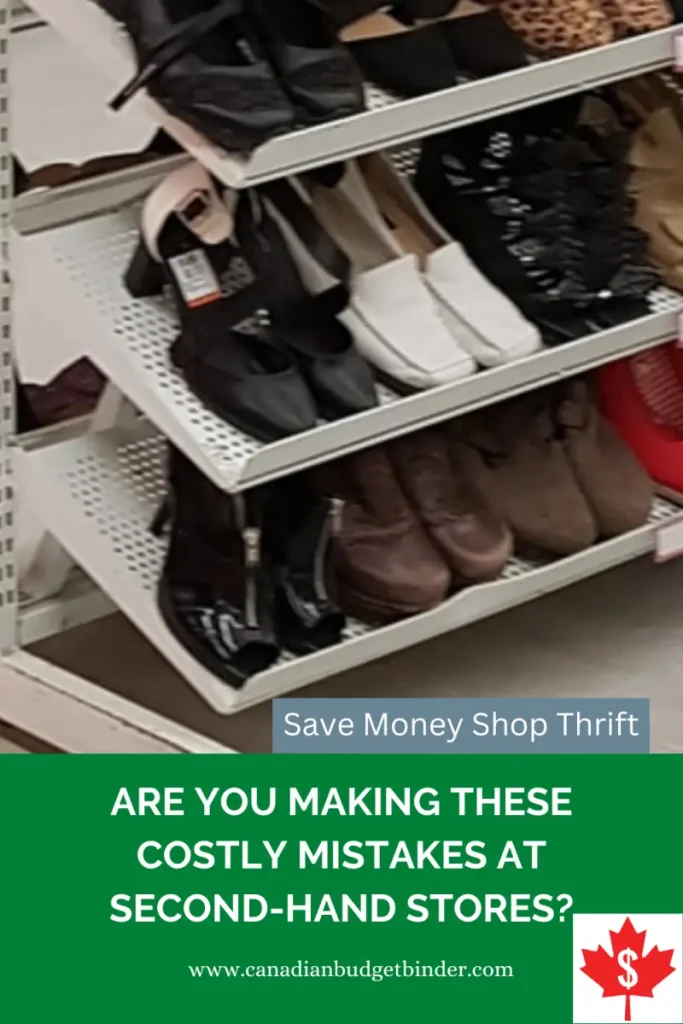
If there is no return on items at the second-hand stores you frequent, try everything on first.
The lineups can be extended if it is a busy discount day, but wasting money on something you can’t return is costly.
While trying on clothing, take the time to inspect the clothing, as mentioned above, for rips, stains, missing buttons, snaps, and zippers.
If you plan on buying a pair of used shoes, try them on and walk around in them first.
Ensure the treads are decent and have some life left in them.
4. Negotiate If You Can
When you visit second-hand stores, they want to get rid of stuff, so if you find an item priced high and there’s a problem, negotiate the price.
Our son often wanted to buy a toy, but a part was missing, so we negotiated the price down as far as we could.
Most stores will either give you a percentage discount or a new price tag offer, which has always been more than reasonable for us.
The way we look, if our son enjoys playing with a toy that costs $50 and we can get it for $2 or $3, it’s worth it.
We’ve also negotiated prices on clothing with a stain that may or may not come out but is hidden.
Almost always, we’ve got the stain out and received a discount simultaneously.
5. Don’t Remove Price Tags
I’ve made this mistake before and lost price tags and money because I couldn’t return an item.
Now, we always keep the price tags on everything we buy until we are 100% certain we are keeping it.
Sometimes, we get an item home, try it on again, and change our mind. It happens.
Other times, we bring an item home and find a defect we missed at the store.
6. Keep Your Receipts
I’m a huge advocate of having a receipt bin, box, or folder at home for all purchases regarding budgeting and returns.
I can’t think of a time when we didn’t have a return receipt because we handed it to them for the return policy or product guarantee period.
At least once a year, we shred our receipts that we no longer need, but remember that some more extensive purchase receipts may need to be held for years.
For example, we kept the receipt for our roof just in case we needed to claim the warranty or wanted to prove to home buyers when the roof was done if we decided to sell.
Having a receipt is critical to getting an in-store credit if it is offered at second-hand stores because you may be out of luck without it.
7. Donate For Discounts
We like to give stuff away for free but donate to second-hand stores to get further discount opportunities.
At Talize and Value Village, both offer to donate discount offers where you bring in used or new items, and they give you a card for a future discount.
Also, sign up online at your favorite second-hand stores to get email notifications for upcoming promotions and coupons.
At Value Village, they have a Savers Club where they send online coupons and offer special discount days just for members.
8. Shop On Discount Days
I know some of you are saying, Hell No, because it IS a zoo on discount days at all second-hand stores, no matter what the masses say.
As a valued customer, we’ve attended discount days at major second-hand stores the day before the event, and it’s still jammed with shoppers looking for bargains.
Without pause, I can tell you that we’ve been part of the round-building lineups on 50% off discount days, and it’s a rush.
One of the most significant times of the year for 50% off days is Back To School, as parents are looking for deals.
Buying your child’s clothes, shoes, and accessories at second-hand stores saves enormous amounts of money.
When we visit second-hand stores on discount days, we buy clothes, shoes, and jackets ahead of time for our son.
Instead of walking away from a deal, we buy it while we can, especially when it is high-quality.
Last week, I purchased a bag of nearly 200 pencils that he can use for years at school for $2.99.
You can’t even buy that at the local Dollar Store.
Ask About In-Store Discounts
Other second-hand stores will have color-coded discount days every day.
Bibles For Missions in our community has a color-coded display when you walk in the door.
The display tells customers which color tags are on sale for the day and the discount attached to that tag.
It’s a great way to move products out without having a monster 50% off sale.
All second-hand stores in Canada have their way of getting the product sold and out the door, but if you want the best discount, shop on discount days.
9. Take Your Time Shopping
Don’t procrastinate too much because once you walk away from an item, the next person behind you might scoop it up.
This happened to us once at Goodwill, where they have big-ticket items at the back of the shop.
You will see a tag on the item that the customer can rip off and hold until they get to the cashier for payment.
Once you have that tag, you can purchase that item before anyone else.
One day, we took too much time to decide whether we wanted a hockey net for our son that was priced at $10.
All it took was a walk down the next aisle and a small discussion, and when we came back, the tag was gone.
Sometimes, it pays to hang out in front of the item before walking away because things are often one-off at a second-hand shop.
It’s not like you can return the next day, and there will be a display full of the item you can purchase once you’ve had time to ponder the purchase.
The good thing is that return policies at certain second-hand stores allow you to return the item if it doesn’t fit your space or isn’t what you had in mind.
That hockey net retails for nearly $200 with taxes from Canadian Tire, so someone got a great bargain.
10. Missing A Bargain
If you’re unsure about an item, you can return it because you’re uncertain if it’s a bargain, buy it, or Google it.
We don’t have a data plan on our phones, so if we find something we think is a great deal, even for resale, we buy it.
In the worst case, we return it but are regulars in the store.
Knowing what items are hot for resale always helps if you’re in the market to make extra cash.
Often, we buy toys and anything brand new that we know we can resell for profit to help offset the costs of what we buy for ourselves, such as clothing.
It’s a business plan for our budget because many people out there have no interest in second-hand stores but like a deal.
We do the leg work and reap the extra cash at the end, so it’s worth it to us.
Take Advantage Of Second-Hand Store Surveys
One last thing I want to mention is that if the second-hand stores you visit offer a survey after you shop, do it.
Talize offers an online survey where you can win a $50 gift card just for telling them how they did when you visited their store.
At Value Village, every fifth customer gets a second receipt with their purchase and a code to complete a survey.
It only takes a few minutes, and they give you a $2 savings when you spend $5.
I’ll take any savings I can get, especially at second-hand stores.
And remember, if second-hand stores aren’t for you or you don’t believe in them, you don’t have to shop at them.
The money you earn allows you to spend it where you wish, and that’s ok, too.
Discussion: What other tips can you offer Canadian consumers when shopping at second-hand stores?
What other popular second-hand stores in Canada can you think of that I may have missed?
Leave me your comments below, as I’d love to hear from you.
Mr.CBB
I volunteer in a thrift shop which has much better prices than VV or Goodwill. Why pay $3-$6 for a hard-cover book at VV when this shop sells hard-covers for $2 (unles otherwise tagged which is rare) and $1 for soft-covers. Childrens book are even cheaper 4-5 for $1. Each week there is a 50% off sale of one type of items, be it shoes, clothing, books, sewing supplies, linen, dishes, CD & DVD etc etc etc. Regular prices are fair eg $5 for pants and $6 for jeans, regardless of size. Adult shoes are $4/pair unless tagged otherwise, boots are $6/pair. If some item of clothing is stained or torn etc it is not put out for sale. Of course the staff are all volunteers, andsomemistakes can be made. but generally all items are useable. The store supports a Christian school, providing funding for needy children to attend, and each month a percentage is given to one of several local charities. We still have thefts, honestly if someone couldn’t pay for a $1 item I feel quite sure it may be given to them, saddens me that people feel they must steal. Love the thrift shop concept, love my “job”, only problem arises when I see things I didn’t know I “needed”.!!
Habitat for Humanity Restore was not mentioned in your artcle, but the ones here sell clothing in addition to building and household items. Proceeds from their sales are used to build affordable housing in their local cmmunities.
My favourite thrift shop is St. Vincent de Paul aka ‘Vinnie’s’. They are a not-for-profit and all proceeds are used in the local community to support food pantries and other programs.
If you donate items to them, like, say 3-4 boxes, they give you a coupon for $5 off any $25 purchase that you can spend any time. They always have a seniors discount and they always ask you. You never have to remind them.
They do have special discount days like seasonal clearances and back-to-school, but they are so crowded. I find going the day before may cost a little more, but the selection is huge and you are not fighting people for stuff or losing out. Those are the times when that $5 coupon is useful too.
Hi Alexsandra,
I had no idea that Habitat for Humanity Restore sells clothing and I’ll definitely add that to the article as it was forgotten. Thanks for letting me know. I was in before Covid and ours did not sell clothing but things may have changed. I might have to visit and check it out as it’s on my way to work. I also didn’t know about getting a coupon from the Thrift Shop. Thanks for sharing that as well. All great tips.
Mr. CBB
Hi there, very helpful info here, thanks! I’m in BC; the Value Villages here (and very possibly across the board?) changed their exchange timeframe during COVID, and it still remains; instead of 7 days (as stated on yr site), it’s now 14 days (might be due to not reopening the change rooms?).
Hi Lukas,
Thanks for the information.
I called our local Value Village, and you are correct.
They have changed from 7 days to a 14-day exchange.
I’ve updated the post and added the text option for special deals which I wasn’t aware about.
Have a great day!
Mr. CBB