


Estimated reading time: 18 minutes
Get an inside look at how Maureen and Dave cope with the financial impact of caring for their disabled child.
Discover what they have found helpful in managing this unique challenge.
Their heartfelt and courageous story comes at the perfect time, with much to be thankful for.
I got a call Friday morning that my $10,000 cheque from an insurance policy that had come due would be in my account by Monday.
I got a call from our daughter’s group home on Friday afternoon with more news.
Our daughter, who has been diagnosed with KBG syndrome, causes the gums to recede.
When the gums recede too far, the roots of the teeth are exposed, causing pain.
There is skin grafting surgery that they can do. It is not covered by any government plan.
The cost of the grafting surgery is estimated to be $10,000.
Costs Involved With Our Disabled Daughter’s Group Home
Our disabled daughter lives in a group home where she is very well cared for and happy.
In Canada, group homes are funded differently, whereas our daughter is government-funded for personal care.
She receives an approximately $900 monthly government pension, covering rent, utilities, and food.
The family is responsible for clothing, entertainment, and miscellaneous medical costs not covered by OHIP or Family Benefits.
An example is her allergy medications, which cost approximately $80 per month.
Hearing aids now cost $5500.00 in 2022.
The hearing aids last three years, and the government pays for a new set every five years.
The family must pick up the cost of one set at $5500.00 every three years.
This article aims to let you glimpse how my husband, our two sons, and I are paying these bills.
Financial Impact Of Caring For Our Disabled Child
So this is our story.
In 1987, we sold our house and two rental properties in Toronto and moved to London, Ontario.
This promotion was for me, and I would make over $100,000 in gross income.
After we sold the three properties, we had $200,000 in our pockets.
We paid $180,000 for a lovely house in the only school area where students used computers.
Our sons are intelligent, and we wanted them to be computer-educated.
We put down $140,000 on the house and took a $70,000 mortgage.
The deposit was $60,000 into a government-guaranteed investment at Confederation Life Insurance Company.
At the time, this was considered a very safe financial institution.
We chose the insurance company over The Royal Bank because it paid higher interest than the bank.
Lesson learned. A few points of interest should not be your primary consideration.
The institution’s stability is essential, especially with a possible impending recession.
Dave got a job in London, making $45,000 per year.
Diagnosing Our Daughter As Disabled
Our daughter was suffering from unexplained problems, which concerned us.
There were expenses, but with both of us bringing in a decent amount of money, I guess no one paid attention.
Looking back and having the time to add things up, we spent approximately $600 monthly on extra care and something like $100 per foot walking support.
The doctors were stumped about how to help her and treated them with band-aid solutions.
We know now; that since genetic testing is available, what is causing the problems?
No stone was left unturned in searching for answers for our daughter’s condition.
She was seen at every hospital and institution in Ontario to see if anyone could help her.
These diagnostic trips took time away from our work.
They also caused extreme stress as we realized the doctors had no idea how to help our daughter.
As she began to age, her hearing started to go, and hearing aids cost $3300.
The government paid for a new set every three years, although sadly, they only lasted two years.
Understanding the financial stress on a family with a disabled child is essential.
Decisions must be made as other children in the family must be looked after.
Does the family pay for the hearing aids, or allow their child to be deaf until the government funds another set?
Not at all, and there was no choice for us, so we paid for the extra hearing aids.
These decisions are gut-wrenching and painful, but we knew what to do.
Not only is a family doing its best and maybe exhausted trying to care for the child, but it is also forced to make these painful decisions.
Job Loss And Tapping Into an Emergency Fund
In 1989, the company Dave worked for suddenly closed, costing us $45,000 yearly.
Yes, we had an emergency fund; however, that disappeared fast.
Related: How much money should we save in an emergency savings fund?
A better choice would have been an income-producing asset.
At this point, we are starting to get into credit card debt.
We barely made it, living pay to pay, although we were sure the situation would sort out.
Big lesson: the situation never sorts itself out; only creative thinking can do that.
Remember that in the 80s, most people did not have a cell phone and no internet like we are used to today.
One morning, we opened the newspaper, and across the front page, we read that Confederation Insurance Company had filed for bankruptcy.
That $60,000 we invested disappeared for 12 years, and we were paid no interest during that time.
The company’s assets were broken up and sold off, and it was impossible to track the money.
Our best estimate is that we received $30,000, half of our original insured investment.
A better choice would have been to pay off the house in full and have no mortgage.
Related: Why did we pay our mortgage off instead of 100% investing?
Refinancing First House in 1990
In 1990, we went to the bank with all our paperwork to discuss refinancing our first house.
The bank manager looked at our Confederation Life Investment documents and said. “I wish I could say something different, but these papers are worthless.”
To keep going, we refinanced, increasing the mortgage enough to handle six months’ payments and pay off the credit card debt.
It felt good, but I know now that was the wrong decision.
We should have sold that big house and moved to something smaller that we could afford.
Always Be Ready For The Next Curve Ball
Dave was home taking care of the boys and our financially beneficial daughter.
When he was staying home, there was no need to pay for extra care.
I loved my job, and all seemed to be heading in the right direction.
One night just north of Barrie, Ontario, I was driving my big fancy company-paid-for Buick.
We were on a 5-day trip to show off the company’s latest designs to our northern customers.
Suddenly, with no warning, my vision started to go black.
Luckily, I had my friend who took over driving after I pulled over.
When we arrived in Sudbury, I struggled to walk but continued working.
Sales trips were different in the 90s than they are today.
As the representative, you had to show the products to the customer.
We completed the five-day sales trip, where I presented the product sitting down.
It’s a good thing it was a chair company I worked for. Humor.
Receiving Bad News From The Doctor
In London, my doctor sent me to the Ivey Eye Clinic, where I spent three days.
Then my doctor had to deliver the news that they thought I had Multiple Sclerosis (MS).
After a few visits to the MS clinic, the doctors confirmed my diagnosis.
The doctors diagnosed the cause of this sudden onset of MS symptoms as stress-related.
The government’s idea of leaving parents to care for disabled kids is not good.
You have the disabled child to care for, and now you have the parent down too.
Disabled children are not generally considered for group homes until they are 20.
Long-Term Disability Insurance For Our Disabled Girl
I purchased long-term disability insurance in the early 80s and paid a $110 premium each month.
The premium was $110.00 per month, which included a clause that said if my doctor said I was disabled, the policy must pay.
My company offered short-term disability that kicked in almost immediately.
The long-term policy started paying us six months after the short-term disability.
Now here we are, and I’m in a wheelchair most days while Dave is out looking for a job.
The disability income is paying the mortgage and the bills, and our daughter is in the hospital more than she is at home.
Recession Of The 1990s
It’s the early 90s, the economy has tanked, and there is a profound recession.
Every other house in our neighborhood seems to be for sale.
Twice, Dave found jobs; however, after working for a few months, both companies decided to move out of Canada.
Six months went by, and again with no warning, the insurance company stopped paying us.
I called that company daily, and their reason for the stop payment was that they needed to assess my case.
The insurance company sent me to their doctors, who immediately said I was disabled and could not do my job.
The insurance doctors instructed my doctor to take away my driver’s license.
It took seven months for this reassessment of my case.
We finally got the back pay, and the monthly payments continued until I was 65
Debt Kept Piling Up
It was 1999; we had gone seven months with no income and were deep in debt.
We had refinanced the house two times and were in over our heads in credit card debt.
We were forced to sell our house for $160,000, $20,000 less than the purchase price.
As soon as we got the money, we again paid off all our credit card debt.
We moved into a rented townhome where the rent was $600/per month, which included utilities.
After all was said and done, we had $9000.00 left from our original $200,000.
The Red Lobster student program accepted both of our sons, who worked three nights a week.
A lot of what they earned went into care for their sisters.
They are both doing very well in their early 40s, married, with kids, and making decent incomes.
One son is a real estate agent in Toronto, and the other sells giant welding machines in factories.
Financial Education – Debt Repayment and Investing
Money was tight, but we managed daily, month by month.
Time was one thing we had, so we read the book Rich Dad, Poor Dad.
Doing so allowed us to regain our financial security, and we continued reading books about debt.
Liquidity of Dividend Stocks
Then we read finance books about investing in stocks and discovered dividend stocks.
After learning about dividend stocks, we began our investing journey.
To us, investments could not be static. In other words, they had to pay us regularly.
Chartwell Riet was the one we started with because the buy-in was around $5.00 per share.
The dividend was at 4.1.
Buying Low Selling High
One day, we went to the thrift store, where I purchased a set of 8 glasses in a carrying tray for $8.00.
We cleaned them up at home and sold them for $60.00 to an antique shop.
Remember, there was no e-bay, so it was a nice profit of $52.00.
Back then, that was enough for groceries for three people for one week.
Related: How To Buy Low And Sell High Garage Sale Finds
I knew those glasses were worth something because I had seen them in a Home Magazine.
Recently, I bought a set of 3 cast iron pans in their original box for $40.00.
On eBay, one like mine recently sold for $160.00, so I’m up $120.00 on paper.
But I’ll hold on to it until I can get a $200.00 real cash asset.
Lady’s Investment Club
We purchased some other investments in small companies.
You must be careful where you invest your money, as they can go bust.
We also started an investment plan at the bank to purchase a certain amount of Royal Bank stock every quarter.
I joined a ladies’ investment club modeled after The Bernstein Ladies.
We met once a month, and each member had to present stock to the group for purchase consideration.
You learn when you have to teach someone else.
Buying Real Estate To Reduce University Costs
During the fall of 1997, one son went to university, where he stayed in residence for one year.
That was too costly, so we purchased a duplex the second year for $90,000.
My father had a life insurance policy and I was named the beneficiary.
There was an amount we could borrow from the policy.
We took out $25,000 for the down payment on the duplex.
The house needed a lot of TLC, as you could write your name in the dirt on the wall.
However, the bones of the building were good, and it mainly needed cosmetic upgrades.
The three of us, Dave, my son, and I, worked tirelessly on that house together.
Walking was almost impossible then, so my job was to sit on the wooden floor with my hand sand around me.
I remember this project of making the duplex rentable as a good time and began to feel that I could, once again, contribute.
We rented the two-bedroom apartment on the main floor for $900.00 plus hydro.
Our son took one bedroom upstairs and rented the other room to another student for $350.00, including hydro.
Income from this house was supposed to pay back the insurance policy loan, but it never did.
The house made a decent cash flow, but once again, most of the money went for things our daughter needed.
Borrowing From an Insurance Policy
Ask questions for those of you who plan to borrow from an insurance policy.
If you pay the interest on the loan each year, the death benefit will not decrease more than the original loan.
However, if you pay nothing, the insurance company will charge the policy with the interest payments, and you will soon end up at zero.
The following fall, our son presented us with another income property he had found.
It had eight bedrooms, one room for him and seven to rent.
We rented each room for $350, including hydro, and made this son the property manager.
It was up to him to collect and deposit rent, cut the lawn, and do other property maintenance.
It’s 1998; we have two rental properties and $9000 in the bank.
On paper, we had approximately $180,000 in equity with tangible cash assets of $9000.
What is an Asset and a Liability?
I learned from Rich Dad and Poor Dad what an asset is
An asset puts money into your pocket, whereas a liability takes money out of your pocket.
Today, we are only interested in two different types of assets
We own liquid assets and move up and down in paper value.
These assets pay money into our pockets on regularly scheduled payout times.
We have an investment at a bank that pays us an agreed amount of cash each month.
Intellectual property that pays each quarter can be considered a liquid asset.
Work or service assets differ as they kick us back services or goods we would generally have to use our cash.
However, this asset is sometimes taxed.
Maximizing these assets helps us keep more cash to pay medical expenses.
An example might be renting out a bedroom in exchange for outdoor gardening help.
Grocery Budget For Two Adults
Another good example here is learning to grocery shop without overspending.
Our grocery budget is $55 a week for two adults.
That is $2860 annually for two adults; we eat meat and drink good coffee.
I started reading Canadian Budget Binder when it began twelve years ago.
The skills I have learned from studying CBB by reading blog articles are an asset to me.
Trading Coupons To Reduce Grocery Costs
Here is an example: The 44-pod Starbucks coffee box is $31.99 or 72 cents per cup.
I had a coupon for $6.49 that I had traded for making the coffee for $25.50, 57 cents per cup.
Then, I claimed on a rebate app called Check Out 51 for $6.50.
After all the savings, the box of 44 pods is $19.00, or 43 cents per cup.
I can’t complain; this is a reasonable price for a Starbucks dark Sumatran coffee cup.
Ultimately, I have kept $12.99 in savings in my pocket.
Purchasing Our Forever Home
By 2013, I was offered a one-time payment of the remaining disability payments at a 10% discount.
In 2015 I will turn 65, and my monthly insurance payments will stop.
We took the money and decided to find a house in Northern Ontario.
After searching, we finally purchased a home for $200,000.
Since this was our permanent residence, we got the mortgage at 10% down.
At this time, everyone wanted mortgage money for rental properties.
Mortgage Credit Line
The private residence mortgage was easy for us, and we negotiated for a $100,000 credit line as part of the mortgage.
This means that we pay down the principal amount of the mortgage.
Doing so allows us to spend the same amount of money.
If you incur unplanned expenses, as we do, this is a good plan.
The availability of an instant credit line has been used many times over the 17 years we have lived here.
Our current mortgage is $60,000, and hopefully, one day, we can pay it off.
Zero-Based Budgeting Is Simple
Now we have to be very careful with any money that we spend.
We must generate all the monthly income so we can pay our expenses.
Our first step was to sit down and access every cent we had.
Related: CBB 10-Step Budgeting Mini-Series
Then, we chose a budget that we thought would work for us.
The Zero-based budget (ZBB) was something we had learned about on CBB.
Using a ZBB is simple, where every bit of cash gets placed into a budget category.
His budget makes saving easy because even extra money has a place in the budget.
We allocate $20.00 per week for food, which is enough for coffee, milk, cream, and essentials.
Related: How older people can earn extra money in Canada
Foraging In The Wilderness
Luckily, we both have a lot of wilderness experience, so getting food from Mother Nature is something we enjoy doing.
The Homesteading movement began, and we found this lifestyle rewarding and enjoyable.
It’s also worth noting that after our first winter here, I was walking without aids.
Foraging, Raising and Trading Food

We raise, forage, or trade for 70% of our food.
Dave raises 65 meat chickens, enough for us, our two sons, and the group home.
We also have layers of chickens that produce eggs daily for our family.
Our vegetable gardens produce both vegetables to eat and sell to earn extra cash.
We spend $350.00 per spring on the gardens, which puts food on the table and money in the bank.
This year, we sold $180 in fresh organic Rhubarb and $200 in squash.
Once again, I aim for zero with a kick out of our food.
Related: How to grow potatoes in a pot

We had beef cows for nine years and no longer plan on raising beef.
In our freezer, we have the last of the beef, and when it’s gone, we will negotiate with a local farmer for a side of beef.

Foraging Is Fun
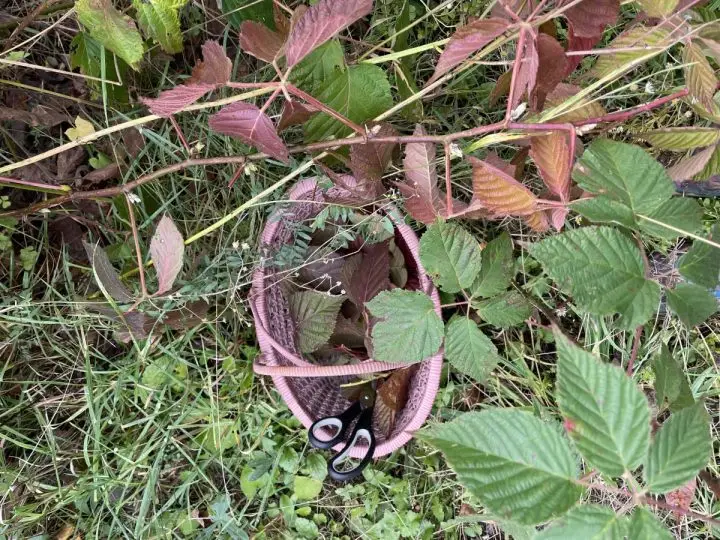
We sustainably forage for green vegetables to help supplement our harvest.
In spring, we cut green leaves from wild leeks, then wash, bag, and freeze them.
From our foraging harvest, we get greens for about one year.
Foraging for wild strawberries is in June, followed by raspberries in July and blackberries in late August.
After we eat as many fresh berries as we want, the rest are frozen.
We like to add wild berries to the top of hot oatmeal for a winter breakfast.
Right now, we are foraging crimson wild blackberry leaves.
The crimson leaves are dried and become our hot afternoon tea.
This tea’s unique flavor is similar to a fine English breakfast blend.

Stress and Illnesses
Most summer days, we kayaked right off our dock, which was fun for all of us.
Our daughter was settling into the group home very well at the time.
I have also had no more nights spent in the hospital.
Could that doctor have been right?
Did the Stress of caring for our daughter bring on MS?
Struggling To Pay Bills As Older People
In our early 70s, we still struggle to pay her bills.
We love where we live and enjoy life to the fullest.
I wish I could say raising and caring for a disabled loved one is easy. It’s not. It’s incredibly challenging.
My family is strong, maybe stronger, because of the challenges we’ve faced and overcome.
Thanksgiving will see the whole family gathered around the table in our little house, enjoying each other’s company and eating one of Dave’s home-raised chickens.
Story As told by Maureen and Dave, edited by Mr. CBB.
Thank You, Dave and Maureen, for sharing this incredible story about your lives.
You’ve shared that anything is possible, and we must find ways to make things work in hard times.
I’m glad you found Canadian Budget Binder and have made it your home for family finances and frugal living.
Best Wishes,
Mr. CBB
P.S. We found a fantastic new Canadian app, Too Good To Go.
It’s free to download from the App Store. It’s similar to Flashfood but includes limited quantities of leftover restaurant food, bakeries, and grocery stores. I’ve added the app and plan to try it soon so I can do a full review.