
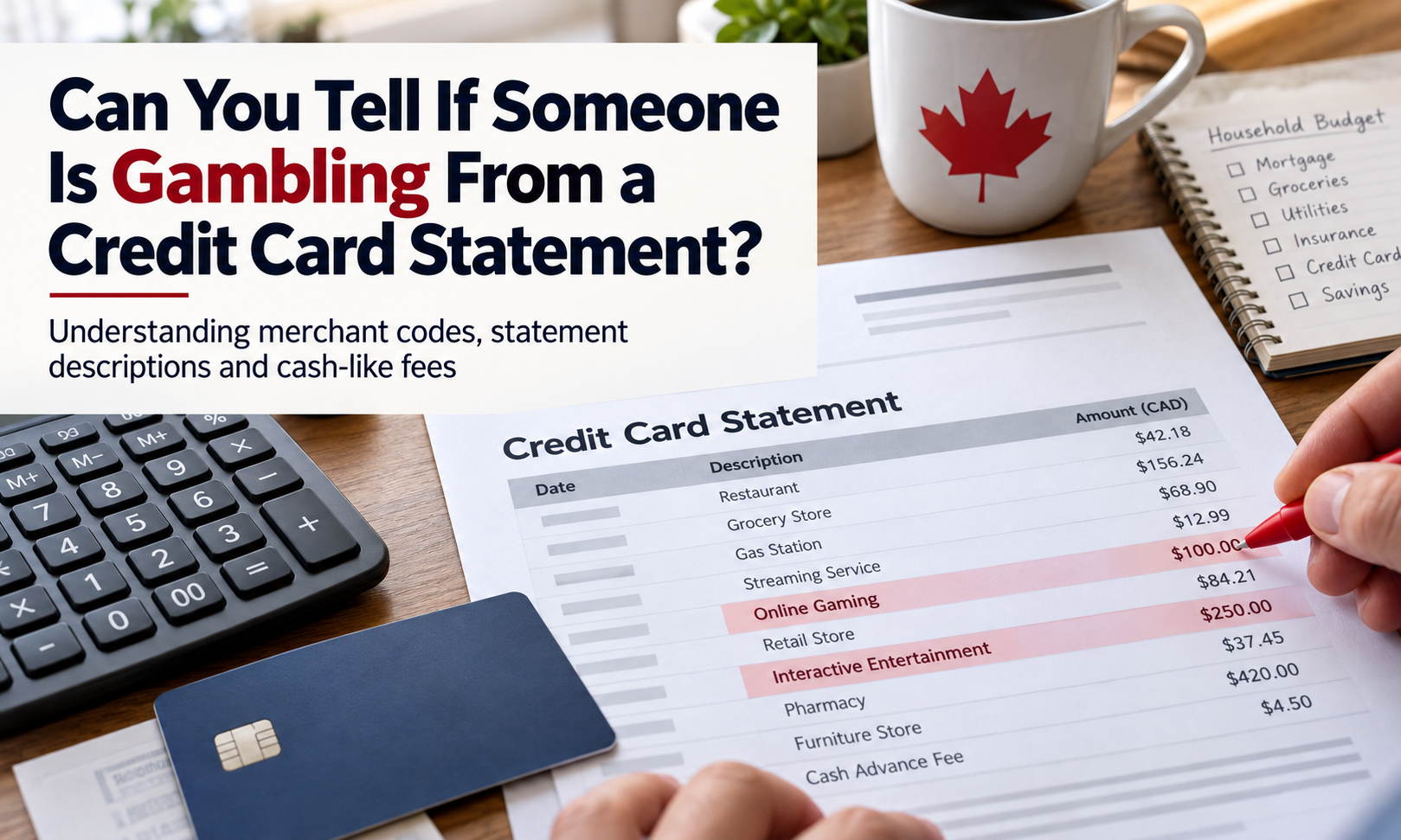
When couples share household finances, unexplained charges on a credit card can raise questions.
One question that sometimes comes up is whether you can tell from a credit card statement if someone has been spending money on gambling.
The answer is: sometimes, but not always from the statement description alone.
Behind the merchant name and dollar amount that appear on a credit card statement, payment networks and financial institutions use merchant category codes to classify different types of transactions.
That means a gambling transaction may be identifiable within the payment system even when the statement itself does not clearly say “casino,” “betting,” or “gambling.”
Understanding how these transactions are categorized can be helpful when reviewing household spending, particularly when credit card debt, unexplained charges, or cash-like transaction fees are affecting the family budget.
What Might Gambling Look Like On A Credit Card Statement?
A credit card statement will generally show information such as:
- The merchant or payment processor name
- The transaction date
- The amount charged
- Any applicable fees or interest
What it usually will not show is the numerical merchant category code attached to the transaction.
This means you should not expect to see something such as “MCC 7995” printed beside a charge.
Instead, the statement may display the name of the gambling operator, a related company, or a payment processor.
As a result, a gambling-related transaction may be obvious in some cases and much less obvious in others.
What Is Merchant Category Code 7995?
Credit card networks use Merchant Category Codes, commonly called MCCs, to classify businesses according to the type of goods or services they provide.
For example, a payment made to a casino or another gambling business may be assigned a gambling-related merchant category.
Visa uses MCC 7995 for certain betting and gambling transactions, including activities such as casino gaming, wagers, lottery tickets and other games of chance. Mastercard also identifies MCC 7995 as a gambling transaction category.
Other gambling-related merchant codes may also apply depending on the type of business and how the transaction is processed.
The important point for consumers is that the merchant category can travel with the transaction through the card-processing system even though the numerical code may not appear on the customer’s statement.
Can Your Bank Tell That A Transaction Is Gambling Related?
Financial institutions generally receive more transaction information than what appears on the customer-facing credit card statement.
That can include the merchant category associated with a purchase.
This classification helps card networks and issuers determine how different transactions should be processed.
However, a merchant category does not tell the bank everything about the cardholder’s circumstances.
It identifies the type of merchant involved in a particular transaction. It does not tell the bank why the payment was made, whether the person can afford it, or whether gambling has become a financial problem.
Gambling Transactions May Be Treated Differently From Regular Purchases
The Financial Consumer Agency of Canada explains that financial institutions often consider certain gaming transactions to be cash-like transactions.
These can include:
- Bets
- Casino gaming chips
- Lottery tickets
Cash-like transactions may be treated differently from normal credit card purchases.
Depending on the credit card agreement, they may:
- Begin accumulating interest immediately
- Carry a higher interest rate than regular purchases
- Be subject to an additional transaction fee
This means a $200 gambling transaction could ultimately cost more than a $200 regular retail purchase charged to the same credit card.
Consumers should check their own credit card agreement because fees, interest rates and transaction classifications can vary by issuer and card product.
Could Gambling Charges Be Hidden On A Statement?
A credit card statement is useful, but it does not always provide a complete explanation of every charge.
A transaction may appear under the name of a payment processor or a company name that is different from the name consumers commonly associate with the gambling website or business.
Other payment methods may also make gambling activity less obvious.
For example, money transferred through an intermediary, withdrawn as cash, or moved using another payment method may not appear as a clearly labelled gambling transaction.
Therefore, reviewing a credit card statement can sometimes reveal gambling-related spending, but it should not be assumed that every gambling transaction will be immediately recognizable.
Reviewing Credit Card Statements As A Couple
Regularly reviewing credit card statements can be an important part of managing household finances.
Ideally, both partners should understand:
- How much is being charged to shared credit cards
- What recurring transactions are being paid
- Whether balances are being carried from month to month
- How much interest and fees are being charged
- Whether there are unfamiliar or unexplained transactions
The same principle applies to gambling expenses as it does to shopping, subscriptions, food delivery or any other discretionary spending.
If money is leaving a household account or increasing shared debt, both partners should understand how that spending affects the family budget.
An unfamiliar transaction does not automatically mean someone is hiding gambling activity. Merchant descriptions can be confusing, and legitimate businesses sometimes appear under unexpected names.
If you do not recognize a transaction on an account you are authorized to access, contacting the card issuer can help clarify how the charge was processed.
Gambling And Credit Card Debt Can Become Expensive
Using credit for gambling can create an additional financial risk because the amount spent may be subject to fees and immediate interest.
Unlike a normal household purchase, money lost through gambling cannot be relied upon to come back.
Attempting to recover previous losses by continuing to gamble can also lead to additional spending and debt.
For households already managing:
- Credit card balances
- Mortgage or rent payments
- Rising grocery costs
- Vehicle expenses
- Childcare costs
- Other debts
additional gambling-related borrowing can put further pressure on the monthly budget.
This is why gambling should never be viewed as a dependable way to make money or solve financial problems.
What Banks Can See Is Different From What Gambling Operators Can See
Banks and gambling operators do not necessarily see the same information.
A card issuer may have access to information relating to the payment itself, including the amount, merchant information and transaction category.
A gambling operator can see activity taking place within its own platform.
In Ontario, the Alcohol and Gaming Commission of Ontario expects regulated internet-gaming operators to consider a number of behavioural indicators when identifying players who may be at risk of gambling-related harm.
These can include factors such as:
- Amounts wagered or lost
- Failed deposits
- Cancelled withdrawals
- Changes in gambling behaviour
- Certain higher-risk payment methods
This distinction is important.
A bank may be able to identify that a payment was made to a gambling-related merchant, but that transaction alone does not provide a complete picture of someone’s gambling behaviour or overall financial situation.
A Merchant Code Does Not Prove Someone Has A Gambling Problem
Merchant Category Code 7995 and other gambling-related classifications are payment-processing tools.
They are not a diagnosis.
A merchant category code cannot determine:
- Someone’s income
- Their household expenses
- Their savings
- Their debts
- Their financial obligations
- Whether a particular gambling expense was affordable
- Whether the person has gambling activity elsewhere
A single gambling-related transaction also does not establish that someone has a gambling problem.
What the transaction data can do is help identify the type of merchant that received the payment.
From a budgeting perspective, that can provide useful information when reviewing household spending and credit card costs.
The Bottom Line
So, can you tell if someone is gambling from a credit card statement?
Sometimes.
A gambling-related transaction may appear under a recognizable casino, betting company or payment processor name. Behind the statement entry, the card-processing system may also categorize the transaction using a gambling-related merchant category code.
However, the MCC itself is not normally printed on the customer-facing statement, and not every gambling transaction will necessarily be obvious from the merchant description alone.
For couples managing money together, regularly reviewing credit card statements can help identify unfamiliar spending, unexpected fees and transactions that may be putting pressure on the household budget.
Merchant category codes can help financial institutions understand what type of transaction they are processing.
For consumers, the bigger issue is understanding where household money is going, what it is costing, and whether credit is being used in a way that could create longer-term financial problems.