
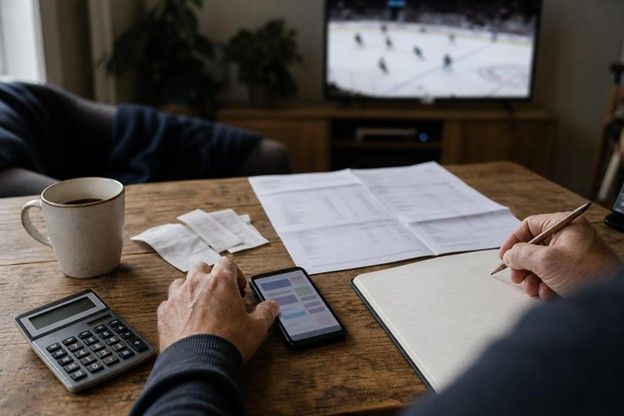
The mortgage payment is easy to spot on a bank statement. So are groceries, insurance and the electricity bill. Finding the small decisions that used up the rest of the paycheque takes a closer look.
A coffee bought on the way home usually leaves one purchase to account for. Spontaneous betting during a hockey game can leave its details spread across several records.
That scattered record helps explain why a seemingly minor expense can take some work to untangle, especially when reviewing a whole month of household spending.
The Wager You Remember May Differ From the Payment You See
A single gambling-related decision can leave records in more than one place.
Reviewing those records together helps distinguish money transferred, money lost, money returned, and money still available. Recording each amount once also stops the same money from being counted twice.
Suppose someone deposits $50 into a betting account, places $30 in bets, and receives $10 back in winnings. If there were no previous funds in the account, $30 would remain. The bank statement shows a $50 transfer, but the net gambling loss is $20. The deposit, the amount wagered, and the loss are distinct figures and should not be added together as a single expense.
For a household trying to understand a shortfall, those distinctions matter. They help explain the gap between the amount someone remembers spending and the money available for upcoming bills.
Following the Payment Through Each Account
Account-based services, including sites used to place a bet, can create separate records across a bank, payment provider and account history. A bank statement may display a payment service’s name, while that service’s history holds the details of the transaction.
Timing adds a complication, too. Pending transactions and reversals can make a monthly review harder to interpret, particularly when records update on different dates.
Match completed payments by amount and date across the relevant accounts. Keep temporary holds separate until they clear, and use the same start and end dates for the review. Check opening and closing balances when money carries over between months.
In Ontario, internet gaming is regulated by the Alcohol and Gaming Commission of Ontario. iGaming Ontario has a separate role in conducting and managing Ontario’s regulated online gaming market. The AGCO’s guidance for registered operators includes amounts wagered and lost, failed deposits and cancelled withdrawals among indicators of possible gambling harm. These details show how much activity can sit behind the transfers visible on a statement.
Small Amounts Become Clearer When You Add Them Together
Once the payments are matched, look at the total over several weeks. Hypothetical losses of $5 three times a week come to $780 over 52 weeks. At $10 twice a week, the annual figure reaches $1,040.
These examples make frequency worth examining alongside the size of each amount. A useful question for the review is how often an apparently occasional expense occurred.
Unplanned snacks, delivery charges and online purchases can accumulate in the same way. Adding them together shows how repeated decisions affect the money available for groceries, savings and debt repayments.
The Financial Consumer Agency of Canada recommends tracking everything spent for one or two months, including everyday purchases and bills.
Card Charges Can Increase the Cost
The next place to check is the credit card statement, where fees and interest may appear separately from the original payment.
FCAC’s guidance on how credit cards work explains that financial institutions often treat gaming transactions, including bets, as cash-like transactions. Interest then starts on the transaction date, usually at a higher rate than for ordinary purchases. A transaction fee may apply too.
Check the credit agreement or ask the financial institution how it classifies the payment. The classification, applicable interest rate and fees depend on the card issuer and its terms.
Record associated fees and interest separately, then include them in the overall cost. A series of small payments becomes more expensive when each attracts a charge, even before interest is added.
Use the Review to Change What Happens Next
After adding up past spending, consider what prompted it. Was the decision made while tired, stressed or distracted? The Office of the Superintendent of Bankruptcy recommends identifying moods linked to impulse purchases.
Its general advice also includes removing stored card details from digital wallets and keeping savings separate from everyday banking. Those steps introduce a pause between wanting to spend and making a payment.
For gambling-related spending, consider using account deposit or spending limits, taking a break, or seeking support if limits are difficult to maintain.
If spending is reduced, redirect the amount towards household bills, savings or debt repayment.
If gambling is becoming difficult to stop, or is affecting money, relationships, or wellbeing, support is available. In Ontario, ConnexOntario provides free, confidential information and referrals around the clock at 1-866-531-2600.
A thorough spending review brings the smaller decisions into view alongside the mortgage and grocery bill. From there, households can act on the patterns putting pressure on their finances and make more informed decisions about their household budget.
More From Canadian Budget Binder
- Can You Tell If Someone Is Gambling From a Credit Card Statement?
- What’s the Ideal Entertainment Budget for Your Monthly Income?
Let’s Talk About It!
Have you ever discovered that small, unplanned expenses were adding up to more than you realized? What helped you get your household spending back on track?
Share your budgeting tips in the comments below.
— Mr. CBB