


Retirement can feel far away until suddenly it is not. You may know the age you would like to stop working, but do you know what will actually come into your household each month, what will go back out, and how much breathing room will be left?
That is what retirement readiness is really about.
You do not need to hit one magical savings number to be “ready.” A Canadian household with a paid-off home, modest spending and a workplace pension may need something very different from a household still carrying a mortgage, vehicle payment or other debt.
The goal is to understand your own numbers, your own lifestyle and the risks that could change your plan.
This Canadian retirement checklist walks through the major decisions to review before leaving the workforce, including CPP, OAS, GIS, workplace pensions, RRSPs and RRIFs, monthly expenses, debt, housing, taxes, health costs, estate planning and more.
CBB Tip: Do not wait until your final month of work to start asking these questions. The earlier you spot a gap, the more options you may have to deal with it.
Are You Retirement Ready? Start With These Five Questions
Before getting into the details, see whether you can answer these five questions:
- How much retirement income do I expect each month?
- What will my realistic monthly expenses be?
- What debt, if any, will follow me into retirement?
- Where will I live, and can I afford that home long term?
- What would happen financially if my health, my spouse’s health or my living arrangements changed?
If you cannot answer all five yet, that is exactly what this checklist is for.
1. Decide What You Want Retirement To Look Like
Retirement planning is not only about investments. It is also about the life those investments are meant to support.
Think about what an ordinary week could look like once you are no longer working full time. Will you travel? Stay close to home? Help with grandchildren? Garden? Eat out more often? Volunteer? Work part time? Spend winters somewhere warmer?
Some retirement expenses may fall. You may spend less on commuting, work clothes or employment-related costs. Others can rise, including travel, hobbies, home maintenance and health-related costs.
Write down the lifestyle you actually want before trying to estimate the money required to support it.
2. List Every Source Of Retirement Income
Start with the money you reasonably expect to receive, not the maximum amounts advertised for government benefits.
- Canada Pension Plan (CPP) or Quebec Pension Plan (QPP)
- Old Age Security (OAS)
- Guaranteed Income Supplement (GIS), if eligible
- A workplace or employer pension
- RRSP or RRIF withdrawals
- TFSA withdrawals
- Non-registered investments
- Annuity income
- Rental or business income
- Foreign pensions
- Part-time or self-employment income
Service Canada keeps a record of your CPP contributions, and the Government of Canada’s Canadian Retirement Income Calculator can help you estimate retirement income from several sources.
If you are married or have a common-law partner, the federal calculator recommends that each person complete it separately and then review the results together.
Related CBB reading: CPP, OAS and GIS: How Much Can You Get in Canada?
3. Understand When CPP And OAS Can Start
Canada Pension Plan
Under current CPP rules, the standard starting age is 65, but you can begin as early as 60 or delay until 70. Starting before 65 permanently reduces the monthly payment, while delaying after 65 increases it. There is no additional increase for waiting beyond age 70.
As of October 2026, Service Canada states that CPP is reduced by 0.6% for each month it starts before age 65, up to a 36% reduction at age 60. It increases by 0.7% for each month it is delayed after 65, up to 42% at age 70.
That does not mean everybody should wait or everybody should start early. The timing decision depends on factors such as your cash flow, other income, planned retirement date and personal circumstances.
Official source: CPP: When to start your retirement pension.
Old Age Security
OAS can normally start at 65 and can be delayed as late as 70. Under current rules, delaying OAS increases the pension by 0.6% for each month you wait, up to 36% at age 70.
However, delaying OAS is not automatically better. The Government of Canada specifically notes that there is no benefit to delaying OAS if you are eligible for GIS, because GIS requires you to be receiving OAS.
Use the federal Old Age Security Benefits Estimator for an estimate based on your circumstances.
Official source: OAS: When to start your pension.
4. Check Whether GIS Could Be Part Of Your Plan
The Guaranteed Income Supplement is an income-tested benefit for qualifying lower-income OAS recipients who live in Canada.
Eligibility depends on your income and, where applicable, the income and benefit status of your spouse or common-law partner. Because GIS income thresholds and payment amounts can change, I would not build a retirement plan around an old dollar figure found in a blog post or social-media graphic.
Check the current Government of Canada GIS eligibility information when you are doing your calculations.
CBB Tip: If you expect to have a lower retirement income, GIS should be something you investigate before deciding when to start OAS or how to draw down other taxable retirement income.
5. Build A Real Retirement Budget
Knowing your expected income is only half of the calculation. Now estimate what retirement may actually cost.
- Mortgage or rent
- Property taxes and condo fees
- Home and tenant insurance
- Utilities
- Internet and mobile phone
- Groceries and household supplies
- Transportation
- Vehicle insurance, fuel and maintenance
- Prescriptions, dental care, vision care and other health costs
- Debt payments
- Clothing and personal care
- Gifts and family support
- Entertainment and hobbies
- Travel
- Home repairs and replacement costs
Do not create a retirement budget that covers only bare survival if that is not how you expect to live. If travel, hobbies, grandchildren or eating out matter to you, include realistic amounts.
Related: How To Estimate Your Canadian Retirement Budget.

6. Test-Drive Your Retirement Income Before You Retire
This is one of my favourite ways to pressure-test a retirement plan.
Once you have estimated your monthly retirement income, try living on approximately that amount for a few months while you are still working.
For example, if you expect your household to have $4,500 per month available after retirement, try running your household on roughly that amount now and direct the rest of your employment income to savings.
You may discover that the number feels comfortable. Or you may discover that groceries, property taxes, car repairs or other irregular costs were underestimated.
Finding that out while you still have employment income gives you more time to adjust.

7. Decide What Debt Will Follow You Into Retirement
Retiring with debt does not automatically mean retirement will fail, but debt payments reduce the income available for everything else.
- Mortgage
- Home equity line of credit
- Personal line of credit
- Credit cards
- Vehicle loan or lease
- Other loans
Then ask a practical question: Can my expected retirement cash flow comfortably carry these payments?
The important number is not simply your gross retirement income. It is what remains after taxes, housing, debt and essential living costs.
Related: 10 Debt-Free Living Tips To Consider Before Retirement.
8. Plan For Taxes, RRSPs And RRIFs
Retirement income does not all receive the same tax treatment, so your gross income and spendable income can be different.
If you have an RRSP, remember that it cannot remain an RRSP forever. Under current CRA rules, by the end of the year you turn 71 you generally need to withdraw the funds, transfer them to a Registered Retirement Income Fund (RRIF), or use them to purchase an annuity.
If you establish a RRIF, a minimum amount must be paid out each year beginning in the year after the RRIF is established.
Couples should also learn how pension income splitting works. Under current CRA rules, up to 50% of eligible pension income may be allocated to a spouse or common-law partner for tax purposes when the requirements are met.
Official source: Pension income splitting.
This is an area where a qualified financial planner or tax professional can help you compare withdrawal and tax scenarios that are specific to your household.
9. Keep An Emergency Fund In Retirement
Retirement does not eliminate emergencies.
Furnaces break, vehicles need repairs, dental work happens and appliances fail. If your entire retirement budget is committed before the month begins, one large expense can push you toward debt or force an untimely investment withdrawal.
Your emergency-fund target will depend on your circumstances, but the purpose stays the same: keep accessible money available for costs that are unexpected, urgent and necessary.
Related: Starter Tips For Building An Emergency Fund.
10. Leave Room For Inflation
A retirement budget that works at 65 may not look the same at 75 or 85.
Groceries, insurance, utilities, property taxes, rent, home repairs and other expenses can rise over time. Some retirement income sources are indexed, while others may not keep pace in the same way.
Instead of asking only, “Can I afford to retire next year?” also ask, “Does my plan have enough flexibility if my costs increase?”
11. Review Housing Before It Becomes An Emergency Decision
Your home may be both your biggest expense and one of your largest assets.
- Property taxes
- Insurance
- Utilities
- Roof, windows and major repairs
- Heating and cooling equipment
- Snow removal and lawn care
- Accessibility
- Transportation if you stop driving
- Proximity to family, medical care and groceries
You do not have to downsize simply because you retire. The point is to decide whether your current home still fits your finances, mobility and lifestyle over the long term.
If you would consider downsizing, renting, moving to a condo or relocating, investigate the real costs before assuming one option will automatically be cheaper.
12. Budget For Health, Dental And Care Costs
Canada has public health care, but that does not mean every retirement health expense is covered.
- Prescription medications
- Dental care
- Eyeglasses
- Hearing aids
- Physiotherapy
- Mobility equipment
- Home support
- Travel medical insurance
- Retirement-home or long-term-care costs
Coverage and programs vary across Canada, so check your provincial or territorial resources rather than assuming another province’s rules apply to you.
Related: Medical Expenses You May Be Able To Claim On Your Canadian Income Tax Return.
13. Review Your Will, Powers Of Attorney And Beneficiaries
A complete retirement checklist should include more than a budget.
- Will
- Power of attorney or equivalent provincial documents
- Beneficiary designations
- Workplace pension beneficiary information
- Life insurance
- Important account information
- Emergency contacts
- Funeral or end-of-life wishes
- Location of important documents
The exact legal documents and terminology vary by province and territory, so use the rules where you live and consider legal advice for estate-planning questions.
The Government of Canada’s Aging in Place checklist also encourages Canadians to plan for who could manage financial affairs if they become unable to do so and to make sure loved ones know where important documents are kept.
14. Ask What Happens If One Spouse Dies Or Needs Care
A retirement plan can look very different after the death of a spouse or if one partner moves into a retirement residence or long-term care.
- Which income sources continue?
- Which benefits change?
- Could the surviving spouse afford the home alone?
- Where are the important financial and legal documents?
- Who knows how bills and accounts are managed?
- Would either person need to relocate?
This is not an enjoyable conversation, but planning ahead can make an already difficult situation easier to manage.
15. Know The Rules If You Plan To Work While Collecting CPP
You can continue working while receiving CPP.
Under current rules, if you are between 60 and 65 and working while receiving CPP, you must continue making CPP contributions. Those contributions can create Post-Retirement Benefits that increase your retirement income.
From age 65 to 70, a working CPP recipient can generally choose whether to continue contributing. CPP contributions stop at age 70.
Official source: Working while receiving a pension.
16. Protect Your Retirement Money From Fraud
Retirement planning should also include a fraud plan.
Be cautious about urgent requests for money, unexpected government or bank messages, pressure to act immediately and anyone asking for passwords, banking information or your Social Insurance Number without a legitimate reason.
If a call, email or text seems suspicious, contact the organization using contact information you find independently rather than using the number or link in the message.
The Government of Canada maintains a current scams and fraud resource for retirees and older Canadians.
17. Look For Ways To Reduce Fixed Costs
A strong retirement budget is not only about increasing income. Reducing recurring costs can make the same income stretch further.
Review insurance, banking fees, subscriptions, telecommunications, transportation and shopping habits periodically.
- Senior Savings in Canada: How Discounts Work at 50, 55, 60 and 65
- Senior Discounts in Canada: A-Z Directory
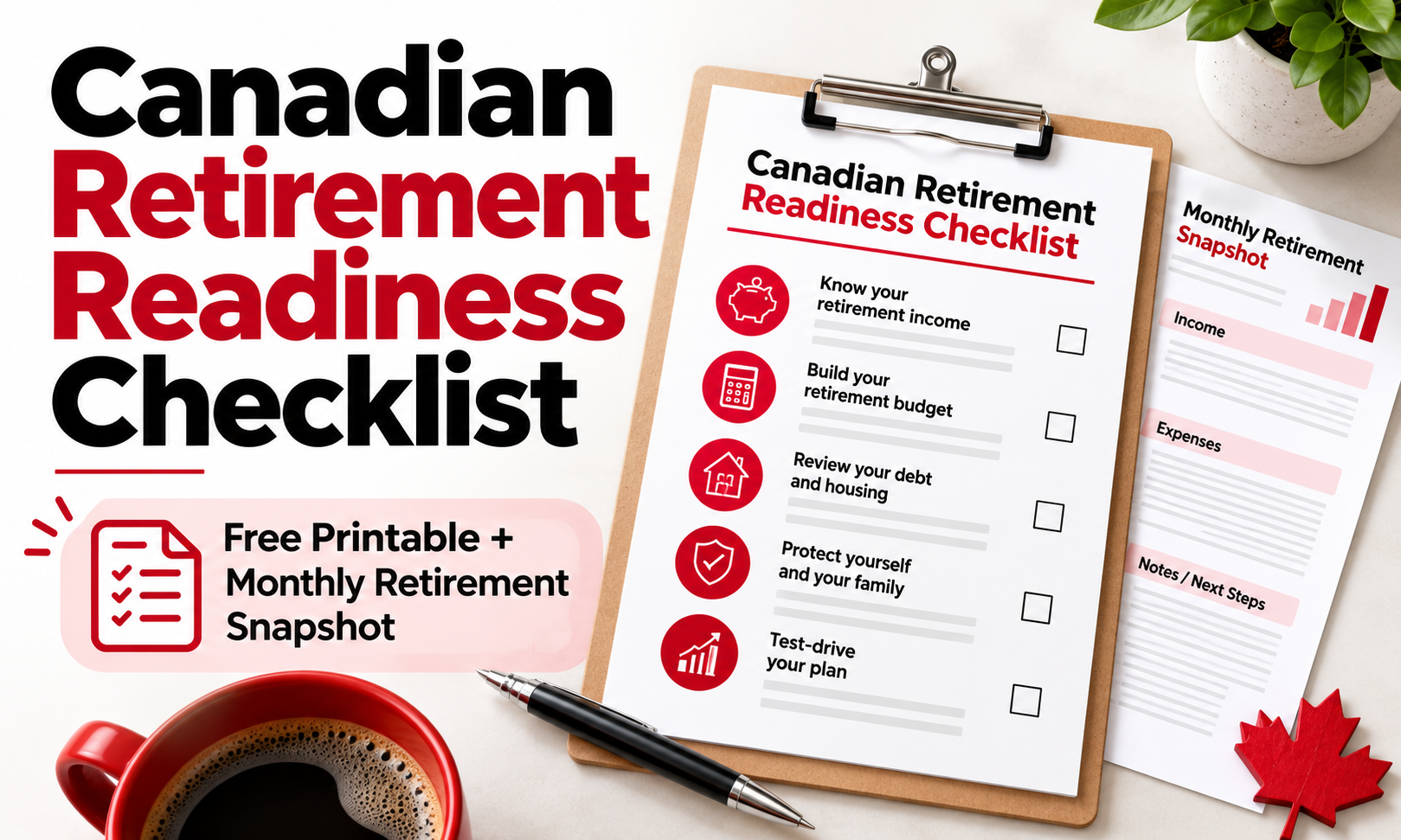
Free Canadian Retirement Readiness Checklist And Monthly Snapshot
I created a free two-page Canadian Budget Binder printable to go with this guide.
Page 1: Canadian Retirement Readiness Checklist
Work through your expected income, budget, debt, housing and planning items.
Page 2: Monthly Retirement Snapshot
Write down your estimated CPP, OAS, GIS, pension and other monthly income, compare that with your expected expenses, and calculate the difference.
At the bottom, write down the three things you most need to do before retirement. That turns the worksheet into an action plan rather than another piece of paper in a drawer.
FREE DOWNLOAD: Canadian Retirement Readiness Checklist + Monthly Retirement Snapshot
I keep this printable in the CBB Free Tools library so you can also browse the other budgeting and planning resources while you are there.
Review Your Retirement Plan Every Year
Your retirement plan is not a one-time calculation.
- Your income
- Your investments
- Your debt
- Your health
- Your marital status
- Your housing plans
- Your expected retirement date
- Government pension and tax rules
Even if retirement is still several years away, an annual review can help you catch problems early.
So, Are You Retirement Ready?
You do not need to know exactly what the next 30 years will look like.
- What will come in every month?
- What will go out every month?
- What is left after the bills are paid?
Then look beyond the monthly budget. Think about debt, taxes, housing, inflation, health costs, your spouse or partner, estate documents and the unexpected.
If your numbers work, that gives you useful information. If they do not work yet, discovering the gap before retirement gives you time to adjust your savings, spending, retirement date, housing plan or other choices.
Discussion: If you are approaching retirement, what concerns you most: monthly income, housing costs, health expenses, debt, taxes or something else?
Canadian Retirement Planning Resources
- Government of Canada: Learn and plan for your retirement
- Canadian Retirement Income Calculator
- Old Age Security Benefits Estimator
- Government of Canada Retirement Financial Checklist
This article is for general information and educational purposes. Retirement, tax and estate-planning decisions depend on your individual circumstances. Consider speaking with qualified financial, tax or legal professionals when you need advice specific to your situation.