

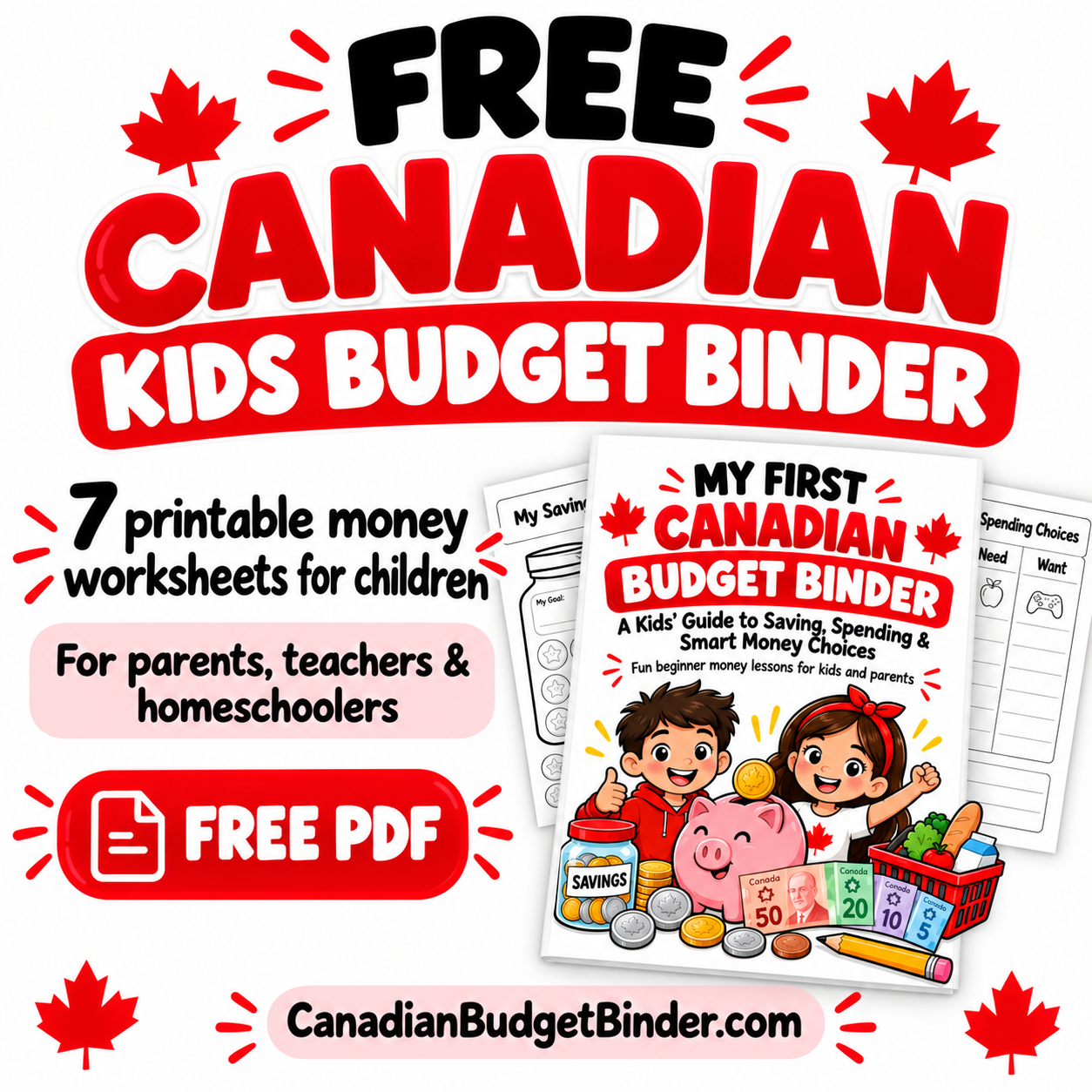

Teaching kids about money does not need to be complicated. Simple conversations about saving, spending, needs, wants and grocery prices can give children practical money skills they can use for years.
I created this free Canadian Kids Budget Binder as a simple, printable starting point for parents, grandparents, teachers and homeschoolers who want to introduce financial literacy in a way that feels useful and fun.
The printable package includes 7 pages and uses familiar Canadian money examples, beginner budgeting activities, a grocery-store challenge, money vocabulary, saving goals and a parent/teacher guide.
November is Financial Literacy Month in Canada, making it a natural time to start simple money conversations with children at home or in the classroom.
Free Canadian Kids Budget Binder Printable
This kids money kit was designed to be easy to use at home or in a classroom. You can work through all of the pages together, or print only the activities that match what your child is learning right now.
You can also browse the full collection of CBB printables on the Free Tools page.
What Kids Learn In The Money Worksheets
- Basic money vocabulary such as budget, save, spend, income, need, want, price, change, goal and sale.
- How to make a very simple first budget.
- How to decide between saving, spending and sharing.
- How needs and wants are different.
- How to compare grocery prices and stay within a shopping budget.
- Basic Canadian money facts and quick money math.
- How to set a savings goal and track progress.
The Financial Consumer Agency of Canada recommends starting money conversations early and using everyday situations, such as shopping, to help children understand financial choices. FCAC also encourages teaching the difference between needs and wants and helping children set savings goals. You can read more in the Government of Canada guide to teaching children about money.
What Is Included In The 7-Page Kids Budget Binder?
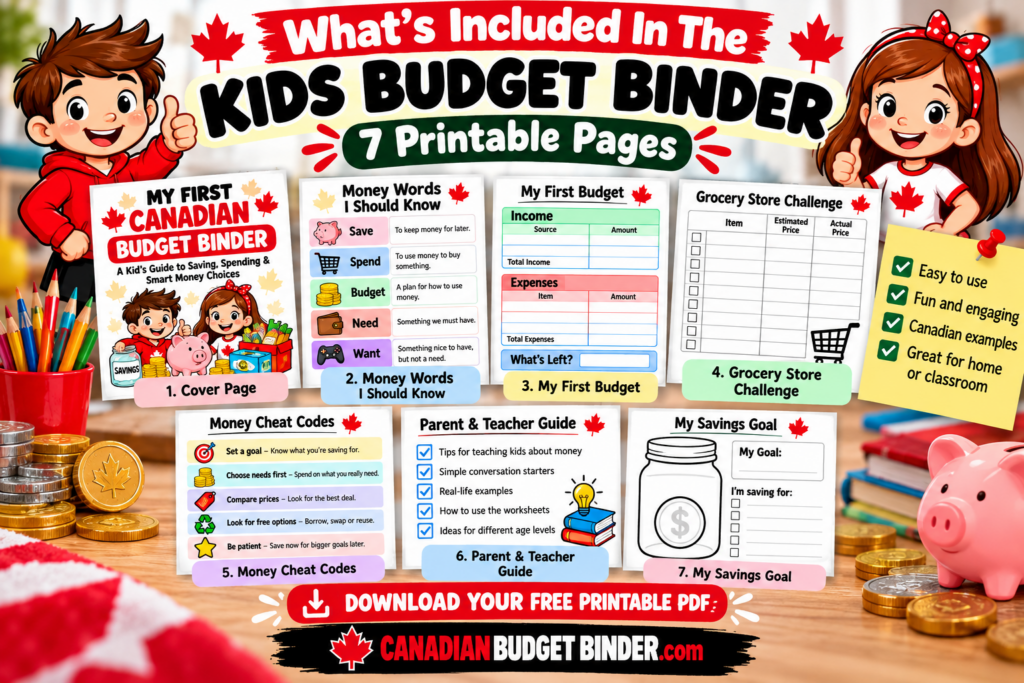
1. My First Canadian Budget Binder Cover
The cover gives kids their own money workbook and a place to write their name. That small detail helps make the activity feel personal instead of like another worksheet.
2. Money Words I Should Know
This page introduces ten beginner financial-literacy words using plain language and kid-friendly examples. It also includes Canadian money mini facts about the loonie, toonie and cents.
3. My First Budget
Kids start with a pretend $20 and decide how much to save, spend and give or share. They also choose what they are saving for and decide whether it is a need or a want.
A budget is simply a plan for money. FCAC describes budgeting as a way to manage what comes in, what is spent and what is saved. Starting with a small pretend amount keeps the lesson understandable for younger children.
4. Grocery Store Challenge
This is one of my favourite activities in the package because it connects budgeting with a real family task.
Kids pretend they have $25 to buy bread, milk, bananas, eggs and yogurt. They write down prices, estimate the total, calculate what they actually spent and see how much money is left.
Parents can take the sheet to the grocery store and let children look for prices, compare brands and spot sale items. It turns an ordinary grocery trip into a practical money lesson.
5. Money Cheat Codes
The Money Cheat Codes page gives kids quick facts they can remember, including 100 cents equals $1, four quarters equal $1, two loonies equal $2, five toonies equal $10, 50% off means half price and two items for $6 means $3 each.
It also reinforces smart habits such as checking prices, making a shopping list, comparing brands, looking for sales, putting needs before wants and saving first.
6. Parent And Teacher Guide
The adult guide gives parents and educators simple ways to use the worksheets without turning money into a complicated lesson. Start simple, use real money when appropriate, shop together, set a goal, ask questions and keep the activities short and positive.
7. My Savings Goal
The final page helps children choose something meaningful to save for, write down the cost, record how much they already have and calculate how much they still need. They can colour in a jar each time they save.
For more ways to make saving visual and fun, see the Loonie A Week Money Challenge.
How Parents Can Use The Kids Budget Binder At Home
- Choose one page instead of trying to teach everything at once.
- Use real examples from your family, such as a grocery purchase or something your child wants to save for.
- Let your child make choices and explain why they chose them.
- Repeat the activities later with different dollar amounts.
- Celebrate progress rather than expecting perfect answers.
One of the best places to start is the needs-versus-wants conversation. A child may understand the idea faster when you use examples from their own life: groceries versus candy, school shoes versus a new game, or replacing a broken backpack versus buying another one just because it looks different.
How Teachers And Homeschoolers Can Use These Worksheets
The package can work as a small financial-literacy activity, math extension, grocery-shopping lesson or discussion starter. The pages are intentionally short so they can be used individually instead of requiring a long unit.
- Use the vocabulary page before a money lesson.
- Use the first-budget page for addition and subtraction practice.
- Turn the grocery challenge into a flyer-price activity.
- Ask students to compare two brands and explain which is the better value.
- Use the savings tracker for a pretend class goal.
- Send the parent guide home so families can continue the conversation.
For another CBB discussion about introducing financial skills early, read Should Parents Teach Children Basic Money Skills?
Teaching Kids About Money At The Grocery Store
Grocery shopping gives children a chance to see budgeting in action. Instead of only telling them that prices matter, let them participate.
- Give them one or two items to find from the list.
- Ask which package costs less.
- Compare a name brand with a store brand.
- Talk about whether a sale is actually useful for your family.
- Let them add prices with a calculator.
- Ask what could be removed if the total goes over budget.
These are simple activities, but they teach children that a grocery budget involves choices. If your family is also working on grocery savings, you may find the CBB Free Tools and our larger Canadian Budget Binder printable collection useful.
Should Kids Get An Allowance?
There is no single allowance system that works for every family. Some parents connect allowance to chores, while others separate everyday family responsibilities from paid extra jobs.
FCAC notes that giving children pocket money can be one way to teach money management. The amount matters less than the learning goal. If you use an allowance, talk about what the child is expected to pay for and encourage them to divide money between spending and saving.
Older children may also benefit from tools designed for supervised money management. I previously reviewed the Mydoh app for parents and kids.
More Canadian Financial Literacy Resources For Kids
The Government of Canada points families toward several financial-literacy resources for children, including Bank of Canada Museum activities and age-based learning ideas. Another CBB resource you may enjoy is my review of I Am Money: Kids Financial Literacy Book.
Frequently Asked Questions
What age is the Canadian Kids Budget Binder for?
The activities are best suited to younger elementary-age children who are beginning to understand money, prices, saving and simple arithmetic. Parents and teachers can easily adjust the examples for the child’s age and ability.
Is the kids budget binder free?
Yes. The printable is part of the free Canadian Budget Binder tools collection. Visit the Free Tools page to access CBB printables.
Can teachers use the worksheets?
Yes. Teachers, homeschoolers and community groups may print copies for educational use with children. Please direct other adults to CanadianBudgetBinder.com to download their own copy rather than uploading or reselling the files elsewhere.
Do kids need real money to use the worksheets?
No. Most of the activities can be completed with pretend amounts. Real coins can make counting practice more hands-on when an adult is supervising.
Download The Free Canadian Kids Budget Binder
If you want to start teaching money skills without making the lesson overwhelming, download the free printable package and begin with one page. A five-minute conversation about a grocery price or savings goal can be more useful than a long lecture about money.
Discussion: What is the first money lesson you remember learning as a child, and what money skill do you most want children to learn today?
Please leavr your comments below and happy budgeting.
Mr. CBB