

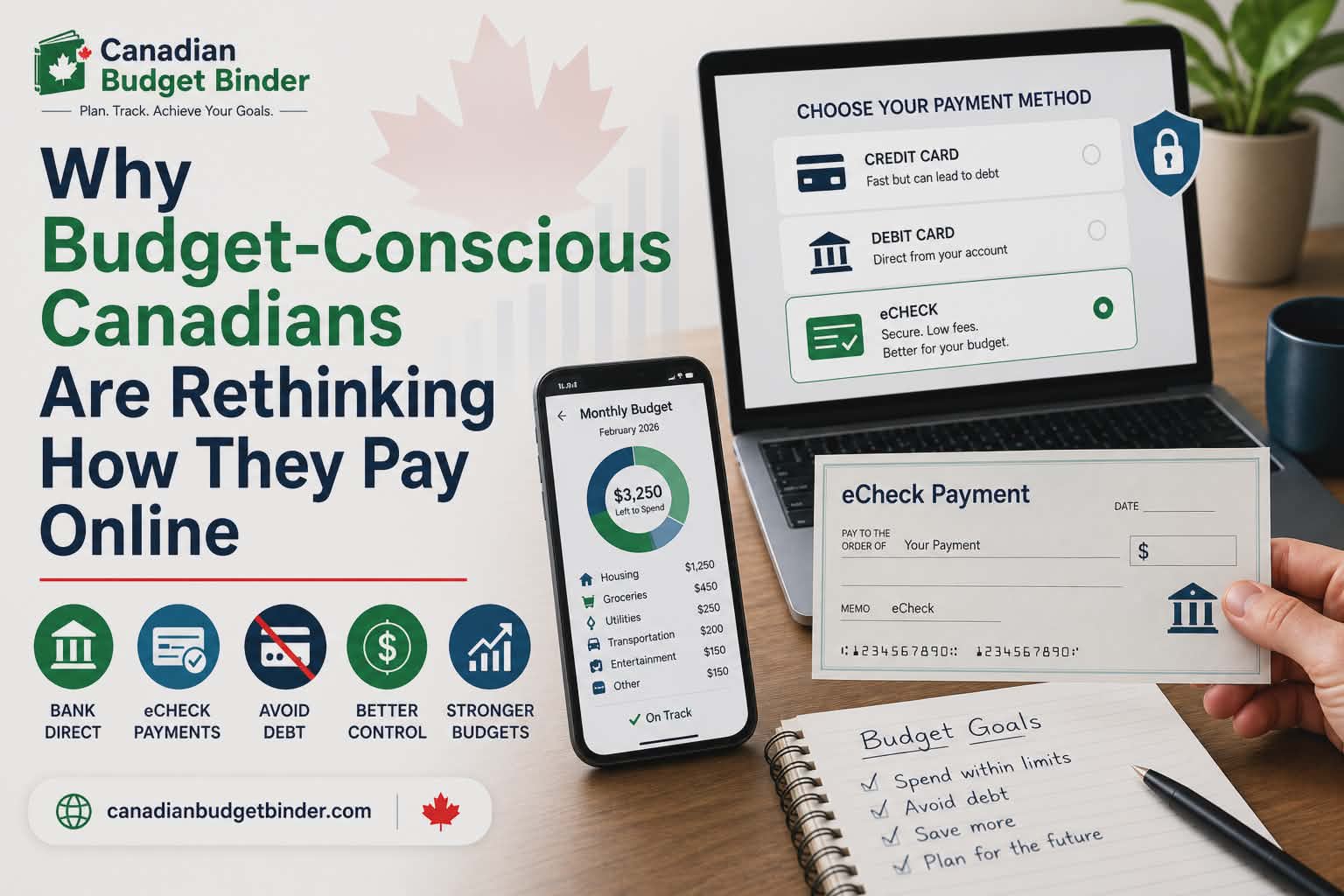

Canadians are paying closer attention to how money moves in and out of their accounts. Rising living costs, higher borrowing costs, and more frequent online transactions have brought payment options to the forefront. It is no longer just about convenience. The way you pay online now plays a direct role in how well you manage your budget.
If your balance feels tighter at the end of the month than it did a year ago, you are not alone. Small changes in spending habits are starting to show up everywhere, and how you choose to pay is part of that.
Recent figures underline the pressure. Canada recorded a C$25.55 billion deficit over the first eleven months of the 2025/26 fiscal year, up from C$19.27 billion a year earlier, according to Reuters. When costs rise at a national level, it tends to filter down into everyday decisions, even if it is not immediately obvious.
Payment Choices Are Becoming Part of the Monthly Budget
Online spending is not slowing down, but the way Canadians pay is evolving. Data from Payments Canada shows that transaction volumes and values have grown steadily in recent years, while credit cards in circulation have reached well over 100 million nationwide.
Alongside this, more households are becoming aware of the long-term cost of relying on credit. The Financial Consumer Agency of Canada notes that paying only the minimum on a credit card balance can significantly increase interest costs over time. Even relatively small balances can become expensive if they are left to run.
So what does that look like in practice? Instead of defaulting to credit cards, more Canadians are starting to think about how each payment option fits into their overall plan.
Why Credit Cards Are No Longer the Automatic Choice
Credit cards still offer flexibility and rewards. Most people use them every day without thinking twice. The issue is that it becomes harder to keep track of what is actually happening when transactions are spread across different apps, platforms and billing cycles.
It is easy to tap and move on. That is the appeal. But those small transactions add up quickly when they are not all visible in one place.
For households trying to stay within a monthly plan, that lack of visibility can create friction. It becomes more difficult to connect each purchase to a category or limit, especially when everything is delayed until the statement arrives.
This is where alternatives begin to come into play. Debit-based payments, prepaid options and direct bank transfers bring spending closer to available funds. For many people, that alone makes a difference.
Where eCheck Fits Into Online Spending Habits
One method that has quietly gained attention is the use of electronic cheques, also known as eChecks. These transactions draw funds directly from a bank account rather than relying on credit, making them easier to manage.
In some cases, you can see how this works in practice by looking at resources like Online casinos in Canada that accept eCheck, which give a clear sense of how the process is applied. The page explains how eChecks work, what fees you might expect, and how long transactions usually take. It also compares platforms that support this option, including details around deposit limits, processing times, and payouts.
In simple terms, an eCheck works like a digital version of a traditional cheque. You authorize a payment from your bank account, and the funds are transferred securely, usually within one to three business days. Fees tend to be low, and in some cases lower than card-based payments.
From a budgeting perspective, the appeal is straightforward. When money comes directly from your account, you get a more transparent view of where you stand at any given moment. There is less guesswork and less risk of carrying a balance into the next month.
The Budgeting Appeal Is Control, Not Convenience Alone
What makes alternative payment methods appealing is not just ease of use. It is the level of control they offer.
Think about how most online purchases happen now. A few taps, a saved card, and the transaction is done in seconds. There is very little pause in that process. It works well, but it also makes it easier to lose track of how often you are spending.
Methods that connect directly to your account introduce a small amount of friction. That is not necessarily a bad thing.
Key advantages include:
- spending stays tied to available funds
- transactions appear immediately in account records
- fewer interest charges compared to credit-based payments
- clearer tracking across categories such as entertainment or subscriptions
- reduced risk of carrying balances into the next month
These are small changes in behaviour, but over time they can add up.
Why Tools Still Play a Central Role
Payment options are only part of the picture. Budgeting tools and tracking systems still do most of the heavy lifting.
From simple trackers to more detailed apps, they give you a better sense of where your money is going.
Most people do not realize how scattered their spending is until they actually sit down and look at it. In many households, it is only when everything is written down that spending patterns really start to make sense. Once you do, patterns start to appear.
That same approach becomes even more useful when you apply it consistently. When you combine a structured payment approach with consistent tracking, it becomes simpler to manage categories such as groceries, utilities and discretionary spending.
For example, a detailed monthly breakdown like the one in a February 2026 home budget update shows how small adjustments build over time. Seeing everything in one place makes it easier to spot where changes can be made.
A Practical Way to Think About Online Payments in 2026
The conversation around payments is not about replacing one method with another. It is about choosing what works best for each situation.
Credit cards still have a place, especially for larger purchases or when rewards programs add value. At the same time, direct bank methods like eChecks offer clarity that supports day-to-day budgeting.
Over the long term, consistency is still what drives results. Simple financial ideas, like saving regularly and understanding how money grows, continue to provide a solid foundation. Even basic concepts of how money compounds over time, such as the Rule of 7, help put long-term decisions into perspective.
What is changing is the level of awareness around everyday decisions. Canadians are becoming more intentional about how they pay, not just how much they spend.
You do not need to overhaul everything at once. A few small changes, applied consistently, can make your finances easier to manage and easier to understand.