

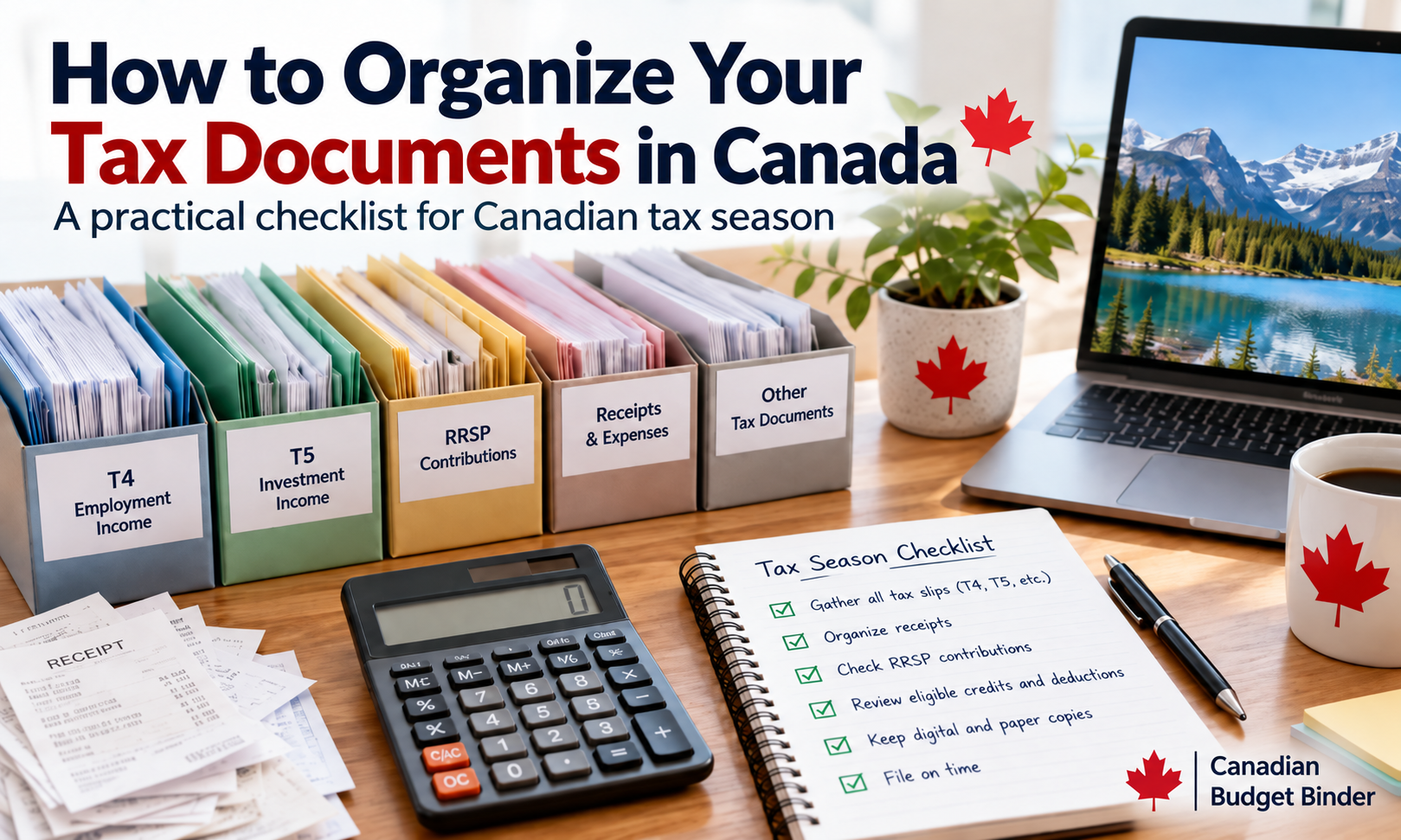

Tax season is much easier when your paperwork is organized before you need it. Instead of searching through drawers, email attachments, online accounts, and old folders, you can keep your tax documents in one place and know what you still need to find.
For Canadians, tax records can include employment slips, CPP and OAS slips, investment statements, medical receipts, charitable donation receipts, childcare expenses, self-employment records, rental-property records, and other documents that support information on your income tax return.
You do not need a complicated system. A labelled folder, a few categories, and a checklist can make a big difference.
Start With One Tax Folder for Each Year
Create one main folder for every tax year. You can use a physical folder, a secure digital folder, or both.
For example:
- Taxes [YEAR]
- Income slips
- CPP, OAS and EI
- Investments and retirement
- Medical
- Donations
- Childcare and family
- Employment expenses
- Self-employment
- Rental property
- Other supporting documents
Keeping each tax year separate prevents old receipts and current records from getting mixed together.
If you save documents digitally, use clear file names. A file named 2026_T4_EmployerName.pdf is much easier to find than document123.pdf.
Tax Documents Canadians May Need
The documents you need depend on your personal situation, so not every item below will apply to you. The goal is to know what you should be watching for throughout the year.
Income and Government Tax Slips
- T4 – employment income
- T4A – pension, retirement, annuity or other income
- T4A(OAS) – Old Age Security
- T4A(P) – Canada Pension Plan or Quebec Pension Plan benefits
- T4E – Employment Insurance benefits
- T5007 – certain workers’ compensation or social assistance benefits
- T3 – trust income
- T5 – investment income
- T5013 – partnership income, where applicable
- Other income records that may not arrive on a tax slip
The CRA notes that most slips such as T4, T4A and T5 are generally issued by the end of February, while some slips such as T3 and T5013 may not arrive until the end of March. You can review the CRA’s tax slips information for current details.
Investments, Savings and Retirement
- RRSP contribution receipts
- T4RSP or T4RIF slips, if applicable
- T4FHSA – First Home Savings Account Statement, if applicable
- T5008 securities transaction slips, if applicable
- Investment statements
- Records needed to calculate the adjusted cost base of investments, where applicable
- Foreign income or foreign-property records, where applicable
Do not rely on a tax slip alone when you have bought and sold investments. Keep purchase, sale, fee, and adjusted-cost-base records when they are needed to support the tax treatment of a transaction.
Organize Medical Receipts as You Go
Medical expenses are easy to lose track of because they may come from pharmacies, dentists, optometrists, specialists, clinics, insurance providers, and other sources throughout the year.
Keep your medical receipts together and include supporting information when necessary. The CRA may ask for receipts and proof of payment, and medical receipts should clearly identify the expense and the person receiving the service.
Examples of records you may want to keep include prescription receipts, dental and vision receipts, eligible medical-travel records, private health-plan information, and proof of any reimbursements you received.
You can also read my guide to medical expenses you can claim on a Canadian income tax return.
Keep Charitable Donation Receipts Together
If you donate to registered charities, save your official donation receipts in one place. For online donations, download the receipt when it arrives instead of leaving it buried in your inbox.
I also use a simple donation tracker so donations and receipts are easier to review at tax time.
Childcare, Family and Education Records
Depending on your household, you may also need to organize documents such as childcare receipts, tuition slips, student-loan interest records, support-payment records, adoption-related records, or other documents connected to a dependant.
If you pay for childcare, keep the receipts and provider information rather than trying to reconstruct the payments months later.
Employment Expenses
If you are eligible to claim employment expenses, keep the forms and supporting records required for your situation. These can include Form T2200, Form T777, receipts, invoices, travel records, monthly credit-card statements, and vehicle mileage records.
The CRA says employment-expense records should support the amounts claimed, including details such as receipts, invoices and, where applicable, vehicle-use records.
Self-Employment and Small-Business Records
If you earn self-employment or business income, record keeping becomes even more important. The CRA requires business owners to keep records that support both income and expenses.
Keep items such as:
- Sales invoices and income records
- Business bank statements
- Business credit-card statements
- Expense receipts organized by category
- Vehicle mileage records, if applicable
- Home-office expense records, if applicable
- Equipment and capital-asset purchase records
- GST/HST records, if registered
- Professional fees, software, advertising and supply receipts
If you run a business or side hustle, my Self-Employed Guide for Business Owners in Canada is another useful starting point.
Rental Property Records
Landlords should also keep rental-income records and supporting documents for expenses they claim. Depending on the property, that may include mortgage-interest information, property taxes, insurance, repairs, utilities paid by the landlord, property-management fees, and records for capital improvements. Mortgage principal is not deductible as a rental expense, although the interest portion may be relevant. Keep repair and maintenance records separate from capital-improvement records because they may receive different tax treatment.
Keeping repairs separate from larger improvements makes year-end review much easier.
Moving, Home and Property Documents
Keep supporting documents for eligible moving expenses when applicable. If you sell property, including a principal residence, keep the purchase and sale documents and other records that may be needed for tax reporting.
If you are planning a move, you may also find my moving budget and expense guide helpful for organizing the costs.
How Long Should You Keep Tax Documents in Canada?
This is one of the most important parts of tax organization.
The Canada Revenue Agency generally says to keep tax documents and supporting records for six years from the end of the last tax year they relate to, unless the CRA gives you permission to destroy them earlier. This applies even when you file electronically or do not have to send the supporting documents with your return.
The CRA may later ask for documentation to support income, deductions or credits you reported. It can also ask for more than an official receipt, including items such as bank statements or other proof of payment.
Keep a copy of your tax return and your Notice of Assessment or Notice of Reassessment as well.
There are situations where records need to be kept longer. For example, the CRA explains that certain records connected with long-term property or other historical information may need longer retention, and records for a return filed late generally have a different six-year starting point. See the CRA’s current guidance on how long to keep income tax records.
What If a Tax Slip Is Missing?
Do not assume that every slip will automatically be available online right away.
The CRA cannot provide a copy of a tax slip until the issuer has sent it to the CRA. If a slip is missing, the CRA recommends first contacting the employer, financial institution, pension administrator, or other issuer.
If the issuer has submitted the slip, you may be able to view it through CRA My Account. For Old Age Security, Canada Pension Plan and Employment Insurance slips, you can also use My Service Canada Account.
If you still cannot obtain a slip in time, the CRA provides instructions for estimating income using available records rather than simply leaving the income off your return. Review the CRA’s missing tax slip guidance before filing.
Do Not Rely Only on Auto-Fill My Return
Auto-fill My Return can be helpful, but it does not replace your own records. The CRA notes that some amounts still need to be entered manually, including items such as medical expenses, childcare expenses, moving expenses, rent paid where relevant, and slips that have not yet appeared in your CRA account.
That is another reason a year-round tax folder is useful.
Keep Digital Tax Records Secure
Tax documents contain sensitive personal and financial information. Store electronic records in a secure location, use strong account passwords, and avoid leaving tax files in unsecured shared folders.
If you scan paper receipts, make sure the digital copy is complete and readable before relying on it. Keep backups of important records so one damaged computer or lost device does not wipe out years of tax documents.
CBB Canadian Tax Organization Package
I created a free 4-page Canadian Tax Organization Package to make this process easier. It includes a master tax document checklist, employment/business/rental records, a tracker for documents you are still waiting for, and an after-you-file record page.
Free printable: Visit the CBB Free Tools & Printables library to preview and download the Canadian Tax Organization Package.
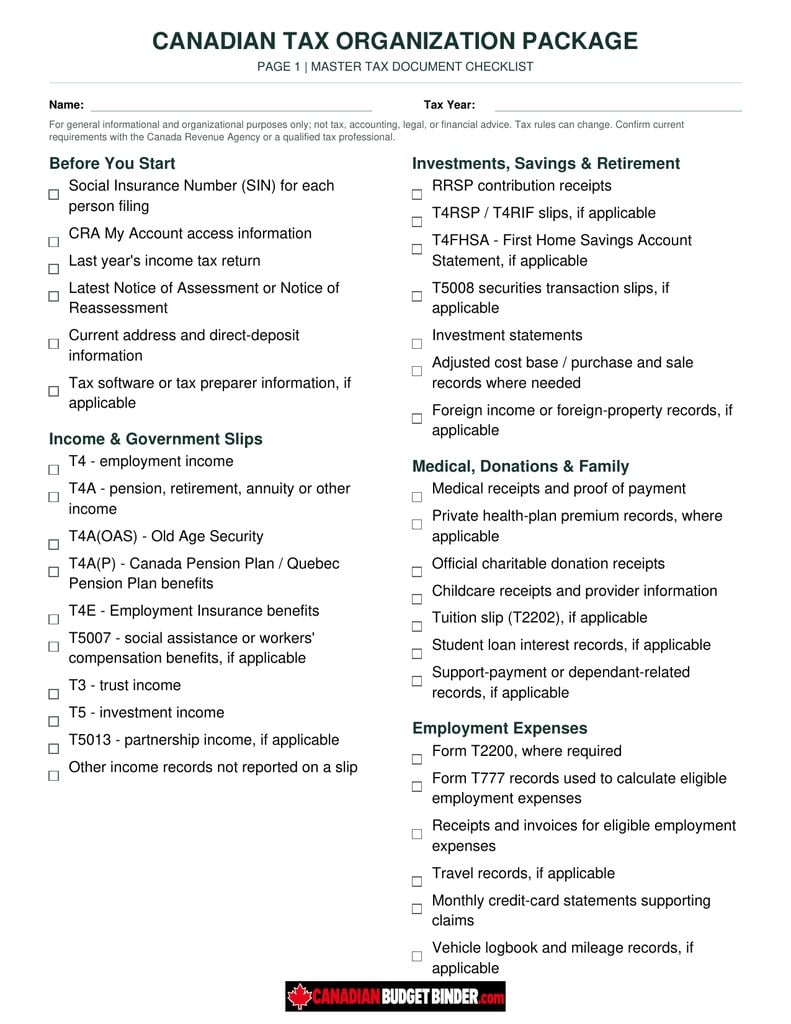
Before You Start
- Social Insurance Number
- CRA My Account access
- Last year’s tax return
- Latest Notice of Assessment or Reassessment
- Current address and direct-deposit information
Income and Government Slips
- T4
- T4A
- T4A(OAS)
- T4A(P)
- T4E
- T5007
- T3
- T5
- T5013, if applicable
- Other income records
Investments and Retirement
- RRSP contribution receipts
- T4RSP or T4RIF slips
- T4FHSA and FHSA contribution records, if applicable
- T5008 slips
- Investment statements
- Adjusted-cost-base records where needed
Deductions, Credits and Supporting Receipts
- Medical receipts
- Donation receipts
- Childcare receipts
- Tuition documents
- Student-loan interest records
- Form T2200 and T777 records, if applicable
- Employment-expense receipts and supporting records
- Moving-expense records
- Disability-related documentation, where applicable
Business and Property
- Self-employment income and expenses
- Business bank and credit-card statements
- Vehicle mileage log
- GST/HST records, if applicable
- Rental income and expense records
- Property purchase and sale documents
After You File
- Save a copy of your filed return
- Save your Notice of Assessment
- Keep supporting documents organized by year
- Do not destroy records before the required retention period has passed
If you are new to filing a return, read How to File Taxes for the First Time. You can also find more organizational tools in my CBB Free Tools & Printables library.
Make Tax Organization a Year-Round Habit
The best tax-filing system is the one you will actually use.
When a tax slip, receipt or statement arrives, put it in the correct folder immediately. Once a month, spend a few minutes reviewing your tax folder and filing anything that is sitting in your inbox or on the kitchen counter.
By tax season, most of the work is already done. You are not trying to remember what happened twelve months ago, and you are far less likely to overlook a receipt, income slip or supporting document.
Related CBB Tax and Organization Resources
- How to File Taxes for the First Time
- Medical Expenses You Can Claim on a Canadian Income Tax Return
- How to Create a Donation Tracker
- Self-Employed Guide for Business Owners in Canada
- Canadian Budget Binder Free Printables
How Do You Organize Your Tax Documents?
Do you keep your tax documents organized throughout the year, or do you gather everything together when tax season arrives? Do you prefer paper folders, digital folders, or a mix of both? Share what works for you in the comments.
Tax disclaimer: This information is provided for general educational and informational purposes only and is not professional tax, accounting, legal, or financial advice. Canadian tax rules, credits, deductions, forms, and CRA requirements can change, and individual circumstances vary. Always confirm current information with the Canada Revenue Agency and consult a qualified tax professional when needed. Canadian Budget Binder makes reasonable efforts to provide accurate information but cannot guarantee that all information will remain current or apply to every situation.