

Find government benefits, seniors discounts, housing assistance and practical ways to save money in retirement.
Retirement should be a time to enjoy life, but rising grocery prices, housing costs, prescription expenses and utility bills can make living on a fixed income challenging.
Whether you’re approaching retirement, already retired or helping an aging family member, knowing which financial assistance programs are available can make a difference.
This guide to seniors benefits in Canada brings together federal benefits, provincial and territorial programs, seniors discounts and everyday budgeting resources in one place. It covers all 10 Canadian provinces and three territories.
Last reviewed: November 2026. This is a living resource. Bookmark this page and check back for updates to benefits, programs, discounts and helpful Canadian Budget Binder guides.
Not every program is exclusively for seniors. Some provide assistance based on income, disability, housing costs or other circumstances.
Important: Government programs change. Eligibility, application deadlines, payment amounts and available funding should always be confirmed with the organization administering the program.
Need Financial Help Right Now?
If you’re struggling with groceries, rent, prescription drugs, electricity or heating costs, start with these resources.
- Canada Benefits Finder: Find federal government benefits that may apply to your circumstances.
- Guaranteed Income Supplement: Check whether you qualify for additional income if you receive Old Age Security.
- 211 Canada: Find local food assistance, housing support, community programs and other services.
- Provincial and territorial assistance: Use the directory below to find additional help.
The Canada Benefits Finder focuses on federal programs. Checking provincial and territorial assistance separately is important because some benefits are not listed there.
If you’re facing an eviction, utility disconnection or an urgent shortage of food, contact a local community agency or assistance program immediately rather than waiting for a regular benefits application to be processed.
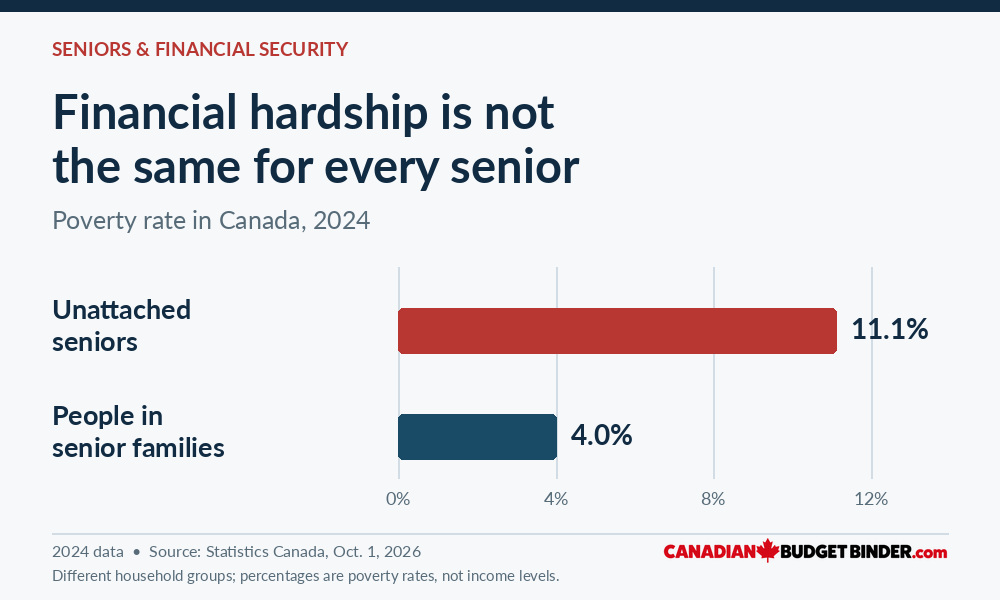
Why this matters: Statistics Canada reported that 11.1% of unattached seniors lived below the poverty line in 2024, compared with 4.0% of people in senior families. These are different household groups, and their circumstances can affect which financial supports are useful. Source: Statistics Canada, October 1, 2026.
Current 2026 Application Dates to Check
Checked November 19, 2026. These details are time-sensitive; confirm the latest information with each program before applying.
- Nova Scotia Seniors Care Grant: 2026 assistance of $750 per eligible household; applications close December 1, 2026.
- New Brunswick Low-Income Seniors’ Benefit: Applications for the 2026 payment close December 31, 2026.
- Newfoundland and Labrador Home Heating Supplement: The maximum 2026 supplement increased to $1,000; applications close January 15, 2027.
Before Applying for Seniors Benefits
Depending on the program, you may need proof of age, proof of residency where you are applying, your most recent income tax return or Notice of Assessment, information about pension or household income, proof of rent or property taxes, and details of eligible medical expenses. Some federal programs also have specific Canadian residency requirements.
Some programs enrol eligible residents automatically. Others require an application, annual renewal or additional documentation.
Tip: File your income tax return every year, even if you don’t owe income tax. Many income-tested benefits rely on tax information.
Canadian Budget Binder does not process government benefit applications or collect Social Insurance Numbers, banking information or personal tax documents.
Seniors Benefits by Province and Territory
Select your province or territory to explore programs that may help with retirement income, housing, prescriptions and everyday expenses.
- Alberta
- British Columbia
- Manitoba
- New Brunswick
- Newfoundland and Labrador
- Northwest Territories
- Nova Scotia
- Nunavut
- Ontario
- Prince Edward Island
- Quebec
- Saskatchewan
- Yukon
Alberta Seniors Benefits
Alberta offers several financial and healthcare programs for eligible seniors.
- Alberta Seniors Benefit: Financial assistance for qualifying lower-income seniors.
- Dental and Optical Assistance for Seniors: Help with approved dental and vision expenses.
- Special Needs Assistance for Seniors: Assistance with certain essential household and healthcare expenses.
- Seniors Property Tax Deferral Program: A repayable loan allowing eligible homeowners to postpone qualifying property taxes.
Worth knowing: Alberta’s property tax deferral is a loan, not a grant. Interest applies, and repayment obligations should be reviewed carefully.
British Columbia Seniors Benefits
British Columbia provides income supplements, rental assistance, prescription coverage and property tax deferral.
- Senior’s Supplement: Additional income for eligible lower-income seniors.
- Shelter Aid for Elderly Renters (SAFER): Rental assistance for eligible residents aged 60 and older.
- Fair PharmaCare: Income-based assistance with eligible prescription drug costs.
- Property Tax Deferment Program: A loan program for eligible homeowners.
Worth knowing: BC changed its interest rules for new property tax deferrals beginning in 2026. Newer deferrals accrue compound interest, while older deferrals follow different terms. If your income has fallen significantly since retirement, ask Fair PharmaCare about an income review.
Manitoba Seniors Benefits
Manitoba offers income assistance, prescription coverage and rental support.
- 55 PLUS: Financial assistance for qualifying lower-income residents aged 55 and older.
- Manitoba Pharmacare: Income-based prescription drug assistance.
- Rent Assist: Rental assistance for eligible households.
- Efficiency Manitoba: Energy-saving programs and support for qualifying residents.
Worth knowing: Eligibility for 55 PLUS depends on income and other circumstances. Confirm current thresholds directly with Manitoba. For the 2026/27 Pharmacare benefit year, families whose income has dropped by more than 10% in the 2026 calendar year can request a deductible adjustment. See Manitoba’s Pharmacare guidance and ask about the projected-income worksheet before applying.
New Brunswick Seniors Benefits
New Brunswick offers income assistance, prescription coverage, property tax deferral and housing-related support.
- New Brunswick Drug Plans: Information about seniors prescription coverage and enrolment.
- Low-Income Seniors’ Benefit: A 2026 annual payment of $629 for qualifying residents receiving GIS, the federal Allowance or the Allowance for the Survivor; an application is required.
- Seniors Property Tax Deferral: Eligible homeowners may defer qualifying annual increases in property taxes on their principal residence; deferred amounts and interest create a lien.
- NB Power: Energy efficiency programs and assistance information.
Worth knowing: New Brunswick may send prescription coverage application information before age 65. Receiving that information does not necessarily mean coverage is active; eligible residents may still need to apply. Property tax deferral is a debt, not a grant.
Newfoundland and Labrador Seniors Benefits
Newfoundland and Labrador provides income support, prescription assistance, heating supplements and housing-related programs.
- Seniors’ Benefit: Income-tested assistance delivered through the provincial tax system.
- 65Plus Prescription Drug Plan: Prescription coverage for qualifying seniors receiving OAS and GIS.
- Home Heating Supplement: Seasonal assistance with qualifying heating costs.
- Home Repair Program: A forgivable-loan program for qualifying low-income homeowners needing essential repairs. The former Home Energy Savings Program was combined with this program in fall 2026.
- Home Modification Program: A forgivable-loan program to help qualifying homeowners make accessibility modifications.
Worth knowing: The 65Plus Prescription Drug Plan generally uses federal benefit information to identify eligible residents, but additional information or an application may sometimes be required. The Home Heating Supplement has separate eligibility, documentation and application rules.
Northwest Territories Seniors Benefits
The Northwest Territories offers financial, healthcare, heating and housing assistance.
- Senior Citizen Supplementary Benefit: Additional income for eligible lower-income seniors.
- Extended Health Benefits: Assistance with qualifying healthcare expenses.
- Seniors Home Repair: Health-and-safety-related home repairs for qualifying older homeowners, with seasonal intakes.
- Seniors Aging in Place: Assistance for qualifying residents aged 60 and older with minor adaptations or efficiency improvements.
- Senior Home Heating Subsidy: Assistance with eligible heating costs.
Worth knowing: Some programs have seasonal application periods, income limits and funding restrictions. Verify deadlines before applying, especially for home repairs or heating assistance.
Nova Scotia Seniors Benefits
Nova Scotia provides assistance with household expenses, property taxes, prescription drugs and home repairs.
- Seniors Care Grant: Assistance with qualifying household and healthcare expenses.
- Property Tax Rebate for Seniors: A rebate for eligible homeowners.
- Seniors’ Pharmacare: Prescription coverage for qualifying residents.
- Housing Nova Scotia: Home repair and accessibility programs.
- Efficiency Nova Scotia: Energy efficiency programs.
Worth knowing: Some housing assistance programs require approval before renovations or repairs begin. Do not assume completed work will be reimbursed. Seniors’ Pharmacare may involve premiums or co-payments.
Nunavut Seniors Benefits
Nunavut offers income support, heating assistance, property tax relief and housing programs.
- Senior Citizen Supplementary Benefit: Additional income for qualifying seniors; the territorial payment is tied to eligible federal benefits.
- Seniors Fuel Subsidy: Heating fuel assistance for eligible senior homeowners.
- Ikajuuti LED Program: Qulliq Energy Corporation offers free energy-efficient LED lightbulbs to Elders and seniors aged 55 and over at community distribution events. It is not a direct electricity-bill subsidy.
- Nunavut Property Tax Relief: Eligible homeowners aged 65 and older may apply annually for relief on a principal residence.
- Elders Housing Program: Counselling and potential assistance with maintaining a home or finding appropriate housing; confirm current intake with Nunavut Housing.
- Nunavut Housing Corporation – Homeownership Programs: Ask about current aging-in-place and home-repair assistance.
Worth knowing: The Seniors Fuel Subsidy and senior property tax relief have annual application requirements. Current Elders Housing application options and funding availability should be confirmed directly with Nunavut Housing.
Ontario Seniors Benefits
Ontario offers income supplements, prescription and dental assistance, property tax relief and electricity support.
- Guaranteed Annual Income System (GAINS): Additional income for eligible lower-income seniors.
- Ontario Drug Benefit: Prescription coverage for eligible residents.
- Ontario Seniors Dental Care Program: Dental assistance for qualifying lower-income seniors.
- Senior Homeowners’ Property Tax Grant: Assistance for eligible homeowners.
- Ontario Electricity Support Program: Ongoing electricity bill credits.
- Low-income Energy Assistance Program: Emergency help with qualifying overdue electricity or natural gas bills.
Worth knowing: GAINS eligibility is generally assessed through federal income and benefit information. OESP provides ongoing electricity-bill credits, while LEAP helps in eligible emergencies. OESP’s regular credits range from $35 to $75 a month; certain qualifying households may receive $52 to $113. Eligibility depends on household size and after-tax income, not age alone. Read our family’s experience with the Ontario Electricity Support Program and check the Ontario Energy Board’s current eligibility and application information before applying.
Prince Edward Island Seniors Benefits
Prince Edward Island offers prescription coverage, housing assistance, home repairs and independent living support.
- Seniors Drug Program: Prescription assistance for eligible residents aged 65 and older.
- Seniors Independence Initiative: Assistance with qualifying services that help seniors live independently.
- PEI Home Renovation Programs: One application assesses qualifying residents aged 60 and older for Seniors Home Repair and Seniors Safe @ Home assistance.
- Seniors Housing: Rental housing and related assistance for eligible residents.
Worth knowing: The Seniors Independence Initiative can help eligible residents aged 65+ pay for approved housekeeping, meal preparation, transportation, medical-alert, communication and seasonal home-maintenance services. Since April 15, 2026, applicants no longer need three months of bank statements; they instead complete an asset declaration. Review PEI’s current application instructions. Home renovation assistance requires approval before work begins.
Quebec Seniors Benefits
Quebec administers its own pension system and offers several income, housing and healthcare programs.
- Québec Pension Plan: Retirement income for eligible contributors.
- Revenu Québec: Tax credits, including the Solidarity Tax Credit.
- Senior Assistance Tax Credit: A separate refundable, income-tested credit for eligible Quebec residents aged 70 and older or qualifying spouses; check the tax-year eligibility rules.
- Housing Assistance: Information about rental and housing programs.
- Home-Support Tax Credit for Seniors: A refundable tax credit for qualifying home-support expenses.
- RAMQ: Public prescription drug insurance information.
Worth knowing: The Québec Pension Plan has different rules from CPP, including retirement timing. At age 65, review how Quebec’s prescription insurance rules apply before changing private coverage.
Saskatchewan Seniors Benefits
Saskatchewan provides income assistance, prescription coverage, seniors housing and property tax deferral.
- Seniors Income Plan: Financial assistance for qualifying lower-income seniors.
- Seniors Drug Plan: Reduced costs for eligible prescriptions.
- Seniors Housing Program: Rental housing for some applicants aged 55 and older, subject to eligibility and local housing availability.
- Seniors Education Property Tax Deferral Program: A repayable loan covering eligible education property taxes for qualifying homeowners.
- SaskPower: Energy efficiency and assistance information.
Worth knowing: Seniors housing availability depends on local conditions and program requirements. Meeting the age threshold does not guarantee immediate housing. Education property tax deferral is a loan, not a grant.
Yukon Seniors Benefits
Yukon offers income assistance, utility support and healthcare coverage.
- Yukon Seniors Income Supplement: Additional income for eligible lower-income seniors.
- Pioneer Utility Grant: Utility assistance for qualifying seniors, including certain renters.
- Seniors Pharmacare and Extended Health Benefits: Assistance with approved prescription drugs, dental care, vision care and other eligible healthcare expenses.
Worth knowing: The Pioneer Utility Grant requires an annual application. Although Yukon describes certain seniors healthcare enrolment as automatic, the government also sends application paperwork. Complete any forms required to establish or confirm coverage.
Federal Retirement Benefits for Canadian Seniors
Provincial programs can provide valuable assistance, but federal retirement benefits are an important foundation.
Canada Pension Plan (CPP)
The Canada Pension Plan provides retirement income to eligible contributors. You can generally begin receiving CPP between ages 60 and 70. Starting before age 65 reduces the monthly payment permanently. Delaying after age 65 increases the payment up to age 70. Your decision should consider your financial needs, retirement income and personal circumstances.
Old Age Security (OAS)
Old Age Security is a federal pension generally available beginning at age 65 to people who meet residency and other requirements. Some eligible people are enrolled automatically, while others need to apply. You may choose to delay OAS for a higher monthly payment, but you cannot receive GIS while your OAS pension is deferred.
Guaranteed Income Supplement (GIS)
The Guaranteed Income Supplement provides additional income to eligible lower-income seniors receiving OAS. Eligibility depends on income, marital status and other factors. File your income tax return annually so your eligibility can be assessed. If your income has dropped because you stopped working or retired, ask Service Canada whether your GIS can be recalculated using estimated current-year income.
The Allowance and Allowance for the Survivor
Some lower-income Canadians aged 60 to 64 may qualify for federal assistance before age 65. The Allowance may be available to eligible people whose spouse or common-law partner receives GIS. The Allowance for the Survivor may be available to qualifying widowed people who meet the program’s conditions. Both have separate eligibility and application rules.
Couples Living Apart for Medical Reasons
If spouses or common-law partners must live apart for reasons beyond their control, such as one person entering long-term care, Service Canada may be able to calculate certain income-tested benefits using individual incomes. Contact Service Canada to ask whether a reassessment applies.
Seniors Discounts Across Canada
Government benefits aren’t the only way to save money. Some grocery stores, pharmacies, retailers, restaurants, transportation providers and service businesses offer discounts for older customers. Qualifying ages vary: a discount might begin at 50, 55, 60 or 65. Before paying, ask whether a seniors discount is available and whether identification, membership or a particular shopping day is required.
- Senior Discounts in Canada: A–Z Directory: Browse businesses and discount opportunities.
- Senior Savings in Canada: How Discounts Work at 50, 55, 60 and 65: Understand different qualifying ages and how to compare offers.
A seniors discount isn’t always the lowest price. Compare the final cost with sale prices, loyalty offers and other available discounts.
Housing, Rent and Property Tax Assistance
Housing expenses can take up a large share of retirement income. Depending on your location, assistance may include rent supplements, affordable seniors housing, property tax grants, tax rebates, home repair assistance and property tax deferral.
- Grant: Financial assistance that generally doesn’t require repayment when all conditions are met.
- Rebate: A refund of part of an eligible expense.
- Refundable tax credit: A tax-based benefit that may result in a payment even when no income tax is owed.
- Forgivable loan: A loan that may not need to be repaid if all conditions are satisfied.
- Property tax deferral: A debt that postpones eligible property taxes and may accumulate interest.
Never assume that a deferred property tax bill has been forgiven. Before applying, ask about interest, repayment, liens, eligibility and what happens if you sell your home.
Prescription Drug, Dental and Vision Savings
Healthcare costs can be difficult to manage on a fixed income. Provincial and territorial programs may assist with prescriptions, dental care, vision care, medical equipment and other eligible expenses. Depending on the program, you may encounter premiums, deductibles, co-payments or restrictions on covered services.
Has Your Income Dropped Since Retirement?
Some drug plans use income information from an earlier tax year. If you’ve recently retired or experienced a significant income reduction, ask whether an income review or deductible adjustment is available.
Canadian Dental Care Plan
The federal Canadian Dental Care Plan may help eligible Canadians who meet its income, tax-filing, residency and dental insurance requirements. Not every dental expense is necessarily covered. Co-payments and additional charges may apply. If you have access to private dental insurance, confirm the federal eligibility rules before making changes. Cancelling an existing plan does not automatically make someone eligible for the Canadian Dental Care Plan.
Electricity, Heating and Utility Assistance
Electricity and heating bills can rise sharply during Canadian winters. Depending on where you live, assistance may include monthly electricity bill credits, emergency help with overdue utility bills, heating fuel supplements, free or subsidized home energy improvements, and income-based energy efficiency programs.
Regular bill credits and emergency financial assistance are not interchangeable. If you’re struggling to pay a utility bill, contact your provider promptly to ask about payment arrangements and available assistance.
Affordable Internet, Television and Mobile Services
Rogers Connected for Success: Eligible lower-income customers, including qualifying seniors receiving the Guaranteed Income Supplement (GIS), can apply for reduced-cost internet, internet-and-TV bundles and mobile services where Rogers service is available. Read our Rogers Connected for Success guide for an introduction, and check Rogers’ current plans and GIS eligibility instructions for current offers and requirements.
Connecting Families Initiative: This separate federal initiative offers discounted home internet through participating providers. Seniors who receive at least 80% of the maximum GIS may qualify. An invitation letter from the Government of Canada containing an access code is required. See the official Connecting Families Initiative for eligibility and registration. Compare available plans, taxes and service coverage before switching.
Transportation Savings for Seniors
Transportation costs can include public transit, fuel, parking, taxis and trips to medical appointments. Check with your local transit agency for seniors fares, reduced-cost passes and accessible transportation services. Some communities offer volunteer drivers or transportation support for medical appointments. Residents in remote areas may qualify for medical travel assistance when necessary healthcare is unavailable locally.
Everyday Ways to Save Money in Retirement
You don’t need to eliminate everything you enjoy to make your retirement budget work.
- Review subscriptions and recurring monthly expenses.
- Compare grocery prices using unit pricing.
- Plan meals around food already in your kitchen.
- Ask about seniors discounts before paying.
- Compare banking fees and insurance renewal costs.
- Use public libraries and community recreation programs.
- Set aside money for irregular expenses, including car repairs and property taxes.
- Review your benefit eligibility every year.
Canadian Budget Binder also offers Free Budgeting Tools and Printables, including a Retirement Readiness Checklist.
A realistic budget should support both your essential expenses and the things that make retirement enjoyable.
Protect Yourself From Financial Scams
Scammers may target older Canadians with fake government benefit notices, urgent payment demands or fraudulent investment opportunities.
- Never share banking passwords or one-time verification codes.
- Don’t click unfamiliar links promising unexpected government payments.
- Verify government notices using official websites or published phone numbers.
- Be suspicious of requests for gift cards or cryptocurrency.
- Speak with someone you trust before making a large unexpected transfer.
If you suspect fraud, contact your financial institution promptly and report the incident to the Canadian Anti-Fraud Centre.
Frequently Asked Questions About Seniors Benefits in Canada
Do all Canadian seniors qualify for financial assistance?
No. Eligibility varies by program and may depend on age, income, residency, household circumstances or other requirements.
Can I receive CPP, OAS and GIS together?
Yes. Some eligible seniors receive all three. However, CPP income can affect the amount of income-tested benefits such as GIS.
Should I file taxes if I don’t owe anything?
Yes. Filing annually is important because many benefits and refundable tax credits depend on your tax information.
Are there financial assistance programs before age 65?
Yes. Some programs begin at ages 55 or 60, while others have different eligibility requirements.
Are seniors discounts mandatory in Canada?
Generally, businesses decide whether to offer age-based discounts and establish their own terms.
Where can I get help applying for benefits?
Contact the government department administering the program. You can also use 211 Canada to find local assistance services.
Trusted Canadian Government and Community Resources
- Canada Benefits Finder
- Canada Pension Plan
- Old Age Security
- Guaranteed Income Supplement
- Canadian Dental Care Plan
- 211 Canada
- Canadian Anti-Fraud Centre
Final Thoughts
Saving money in retirement isn’t just about cutting expenses. It’s also about knowing which benefits, discounts and community resources are available to you.
A program you qualify for could help reduce the cost of prescriptions, housing, electricity, transportation or everyday necessities.
Start with the federal benefits you’re eligible for, review the programs available in your province or territory, and revisit your eligibility when your income or circumstances change.
You worked hard for your retirement. Make sure you’re not overlooking assistance that could help you enjoy it.
Bookmark This Hub and Check Back for Updates
Government benefits, eligibility rules, deadlines and seniors discounts can change. Bookmark this permanent Seniors Money-Saving Hub and return whenever you need information about financial assistance in Canada. We review this resource periodically and add relevant new guides as they are published, including retirement budgeting, housing and downsizing, healthcare costs, free worksheets and fraud prevention.
Want more practical ways to save? Visit the Canadian Budget Binder Free Resources Library to find our email newsletter signup and useful money-saving resources. Newsletter emails share our latest content; they are not individual alerts for every government benefit change.
Research review updated November 19, 2026.
This article provides general educational information. Program rules, funding, payment amounts, deadlines and eligibility can change. Always confirm current details with the administering government or organization before applying.
Canadian Budget Binder does not administer government benefits or provide individualized financial or legal advice.