


Learn why having emergency savings and a budget is crucial. Find out how to be prepared for unexpected expenses and avoid creating debt
Preparing For Unexpected Expenses
For a good reason, we’ve talked about emergency savings and the budget over the years here at Canadian Budget Binder.
You need savings for unexpected expenses that pop up.
Small or large savings are essential to keep stress levels down so you aren’t creating debt.
Debt is created because one doesn’t have the cash to pay for a service or product that they need.
Just this month, as you will read down a bit further, we purchased a product for our home and required emergency services, which were paid from our projected expenses account.
The reality is that things happen whether it’s this year or the next, and being prepared for expenses with some savings in the bank is much better than creating debt.
As I wrote about the other day, some people don’t mind carrying debt as they see it as a number on a piece of paper, and others like us despise it.
I don’t mean mortgages, student loans, and car payments because most people carry debt to pay off some of the most significant debts most people will ever have.
I’m talking about all the little things we should save up for before putting them on credit, especially if it’s an emergency.
You never know what will pop up, so it’s better to be prepared by saving even a few dollars a week or month than nothing at all.
Discussion: Have you had an emergency where you had to put the expense on credit?
Where Our Money Went
We got out and about this month with a trip to the Home Show at the Direct Energy Center in Toronto.
The excursion was mainly to research house upgrades and get ideas for renovations and the kinds of new products out there.
Tickets for the Home Show were free from a friend, but we had to pay for parking, although that’s nothing new in Toronto.
The wife splurged, and it’s unusual for her to do so, on a brand new hair styling kit for half price, but the results were phenomenal.
I do have to mention that my wife doesn’t go to the hair salon and gets the odd trim a couple of times per year.
We also bought a much-needed Central Vacuum system, which I will install once we receive the shipment.
The deposit has been paid, but the total amount will probably be due next month.
We negotiated a great deal on the system, and I’ll likely write a review on the product, including how the installation went.
I have started attacking projects around the house that need completing.
This has increased our home maintenance category for this month, although I haven’t managed to venture outside yet.
I’m unsure what projects are in the yard, as it’s far too soggy.
I have set goals for April to include all of my outdoor maintenance.
Unexpected Expenses
The furnace decided to go wrong overnight during the month, and we woke up in a relatively cold house.
Luckily enough for us, the service call only lasted one hour, and the problem was fixed with no parts.
There’s another reason our projected expenses account works: we instantly have the money to pay for these expenses.
Our clothing budget took a hit, too, mainly due to our footwear purchase because of leaking soles.
I definitely got my investment out of my last couple of pairs of shoes, but now that the weather is getting warmer and wetter, I thought investing in some new ones would be best.
We picked out two new pairs of shoes and got a 30% discount on top, which was great.
I bought a new pair of casual shoes to wear when I go out or dress up and a pair of walking shoes.
The wife bought a pair of walking shoes and dress shoes as well.
We have also been a little under the weather lately, which is unlike us.
I’m not sure if it’s a seasonal thing that everyone else has.
Our healthcare/prescriptions are a little higher than usual because of this, although our benefits company covers a percentage of them.
Besides that, I’m still working my two jobs, although the new job is seasonal and will resume in September.
Discussion: How did you make out with your budget for March?
Free Budget
I’m currently offering two versions of our budget, and the reason behind it is simple.
Firstly, read the disclaimer because what you do with it is your own business, so if you mess it up, you need to sort that out.
I have not closed off any cells, so you can make all the changes you like to the budget to reflect your lifestyle, which the fans wanted.
Although I would love to help every fan with their budget, I cannot. However, I am always willing to answer any emails you send me, so don’t be shy.
This was, after all, meant to be our budget, and although I would love to customize it for every fan who wants to use it, I’m afraid I cannot.
I’m not selling this budget or hoping to make any money, so enjoy this free budget.
I hope it works for you as much as it does for us.
Canadian Budget Binder Budget Spreadsheet

You can download the free budget spreadsheets here.
- Budget 1– You can use the pre-existing categories or your own if you wish, and you can use projected expenses. Please read all notes left around the budget for tips.
- Budget 2-Everything is pre-set, so you have to use the pre-defined categories. This budget will generate year-end budget figures, whereas the other won’t, but you must use the categories already in this budget. If you change anything, you will mess up the formulas and year-end figures. Please read all notes left around the budget for tips.
I’m always open to feedback, but be polite, as you don’t want to hurt my feelings. Get started, and don’t procrastinate. Please test it out for a month and see how it goes. There is never any harm in trying something new in life.
You either love or hate it; that is a fact with anything.
Our Budget Plan
How we budget our monthly expenses: I often have fans ask me how to budget money and what we do to save so much, but the reply is that it’s not about the money. It’s about the process involved.
We don’t permanently save as much money as we would like every month, but most importantly, we are not going into debt because we are budgeting our money.
One of the most important things we did for our finances was that we never let the budget deter us from reaching our goals.
Budgeting Mini-Series
Below are links to the budgeting series I wrote while designing our spreadsheet.
I’m not a financial planner/advisor, so I can’t tell you how you should budget, but I can show you how we budget our numbers.
Like everyone else, I’m just a regular guy; some might call me a budget or numbers nerd.
Please take the time to read through the budgeting series. I hope you take something away from the information.
- How We Designed Our Budget Step 1– Gathering All the information
- How We Designed Our Budget Step 2– Categories
- How We Designed Our Budget Step 3– Tracking Receipts
- How We Designed Our Budget Step 4- Note-taking
- How We Designed Our Budget Step 5– 5S Organization
- How We Designed Our Budget Step 6– Who Does What and When?
- How We Designed Our Budget Step 7– Balancing Our Budget
- How We Designed Our Budget Step 8– Knowing our Coupon Savings
- How We Designed Our Budget Step 9– Reading Our Bills
- How We Designed Our Budget Step 10– Projected Expenses
Budget Percentages March
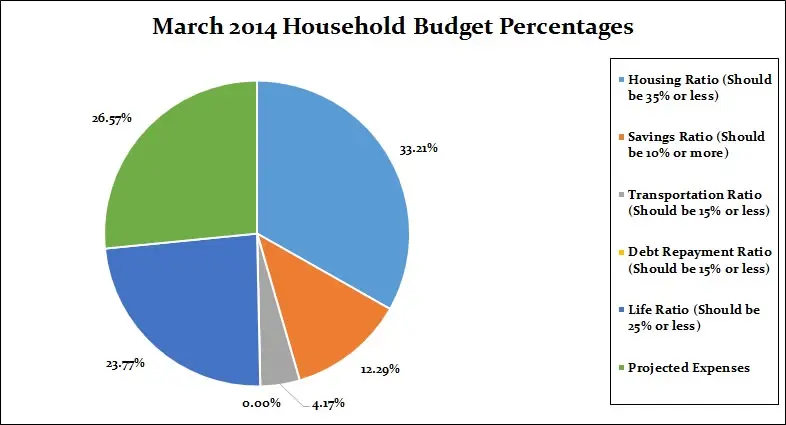
Our savings of 12.29% include savings and investments.
Our projected expenses this month are at 26.57%, which now consists of some increases due to overspends explained in the 2013 year in review.
The total March 2014 Household Budget Percentages come to 100%.
Budget Percentages
Expenses Breakdown
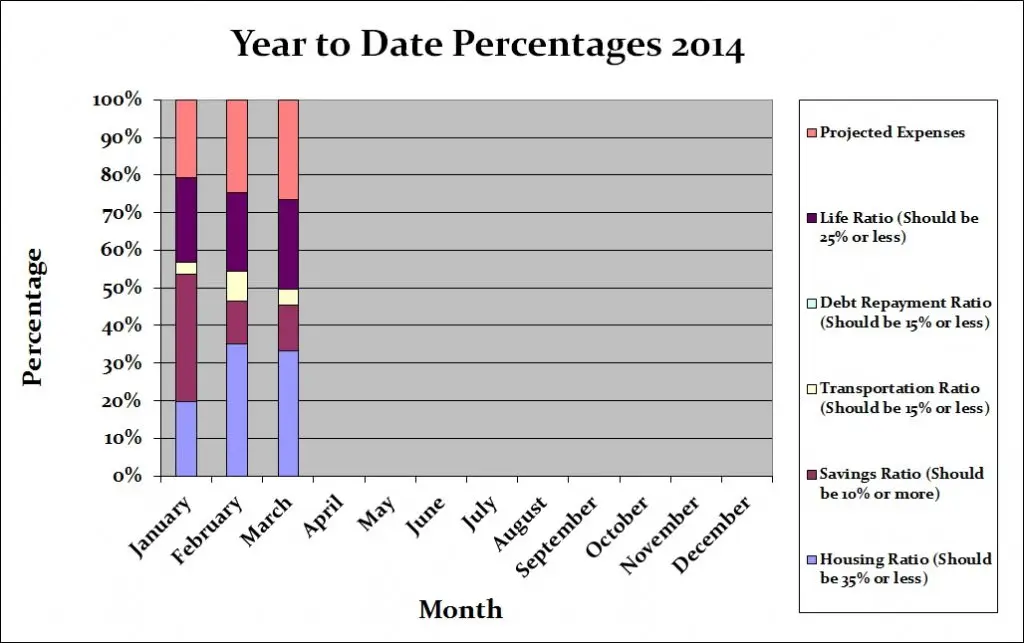
This is simply a breakdown of our expenses, which has helped us understand where all our money goes.
I appreciate that you enjoy this budget update each month, but I hope you view this as an educational tool rather than comparing your financial numbers, as we are all unique.
Sometimes, we wish we had more money to budget with, but we understand that we only have what we earn, and if we want more, we need to earn more.
Spending less than we earn and budgeting our money has been the easiest way for us to pay down debt and save money.
- Chequing– This is the bank account from which all of our debt is paid.
- Emergency Savings Account– This is a high-interest savings account.
- Regular Savings Account– This savings account holds our projected expenses.
- Monthly Budget Total: $5352.51
- Monthly Net Income Total: $7004.11
- Total Coupons Used: includes every discount attained during the month = $0
- Projected Expenses: These are expenses we know we will pay for throughout the year = $1860.68
- Total Expenses Paid Out: $5091.05
- Total Expenses Paid Out: Calculated is $7004.11 (total net monthly income) – ($52.38 (cash savings) + $1860.68 (projected expenses)) = $5091.05
- Actual Cash Savings Going Into Emergency Savings: Calculated is $7004.11 (total monthly net income) – $5091.05 (actual expenses paid out for the month) + $1860.68 (projected expenses) = $52.38
Saving Money
What are Projected Expenses? – We project expenses throughout the year so we have the money saved.
PE A projected expense is money automatically saved each month, so it is ready when the bill comes in, or you need it, as shown in the example below.
We review our projected expenses at the beginning of the year to set up our yearly budget and adjust as we go along if a new projected expense arises and needs to be added to the budget.
Sometimes, also remove a projected expense, so keeping an eye on your costs is essential.
This has happened on many occasions but it is bound to happen as we can’t predict everything we will have to pay for over the year.
The critical part for us is that we are saving for these expenses, and we no longer have to stress about taking money from our savings to pay for them.
To learn more about projected costs, read Step 10 in my budgeting series.
When we spend the money in a projected expense category, we move that money to our chequing account to pay for that incoming expense.
We pay money into the projected expenses account continually throughout the year, even when bills come due as it’s revolving.
As one bill gets paid, the money continues to come in from the other categories all year.
So, the $1860.68 gets paid into the projected expense account every month, no matter what.
It seems easier to track our money this way, but you can do what works best for you.
Projected Expense Example
If, for example, our clothing category was a projected expense, we would have a budget of $50 per month for the two of us.
If we spend $30 on clothes for the month, we need to pull $30 from the projected expenses account to pay for this expense, or move only $20 to projected expenses for the month and leave the $30 in your chequing account.
As I mentioned above, it’s up to you how you do it.
I’m hoping to put together a projected expenses spreadsheet to track the expenses all year; otherwise, you need to do that to ensure you don’t overspend what you haven’t saved or will save over the year.
It’s a relatively straightforward process and becomes a lifestyle change for your finances, but the most crucial part is that the money is available and saved, potentially less stress.
This means we should have $600.00 per year to spend on clothing.
We have to track that expense as we spend it manually, but hopefully, for our 2014 budget, I can incorporate that into our spreadsheet so it tallies the numbers up as we go along.
That way, we can know exactly what we’ve spent as an ongoing total.
March 2014 Budget Numbers
Below, you will see two tables.
One is our budget, and the other is our actual budget for March.
This budget represents two adults and no children and includes all our investments.
Budget March 2014
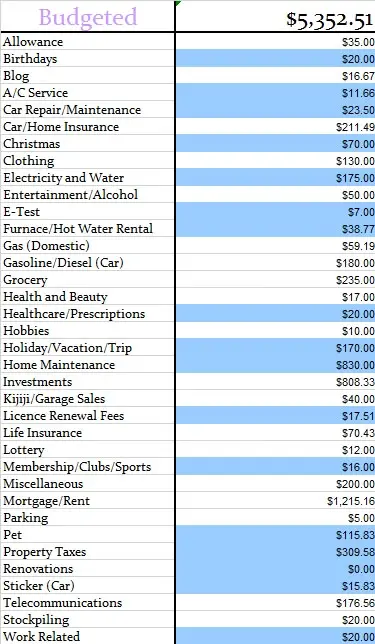
If it is highlighted in blue, it is our projected expense.
You will also see that our budget does not include emergency savings, as this is factored in at the end.
Actual Budget Expenses March 2014
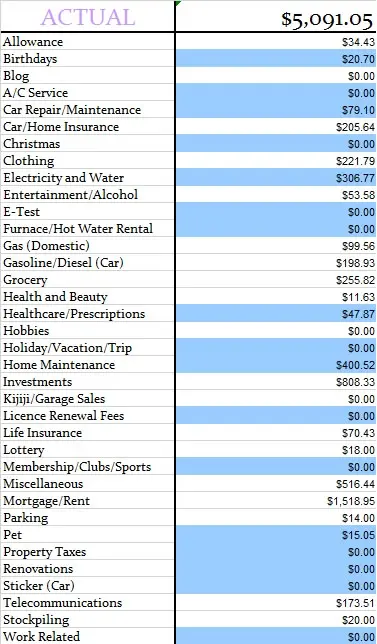
You will notice we didn’t put the amount going to emergency savings as we have in the past into the actual budget, which was $52.38.
March 2014 Goals
Sometimes, I think I am too optimistic about numbers, but if I don’t reach them, I try harder the next month.
Stay positive, and that’s all you can do apart from bringing the best you can to your readers.
- Start garden seedlings- Pass.
- Complete projected expenses tracking sheet for budget-Fail
- Reach 2600 Twitter Followers-Pass
- Reach 6260 Facebook Followers-Pass
- Reach 1620 Pinterest Followers-Pass 1718
- Reach 1225 Blog Followers- Pass
- Read a chapter in my personal finance blog-Fail
- Help a new blogger with a task or question-Fail
- Get moving with renovations when I can find time-Pass
- Start Spring cleaning-Pass
- Update budget spreadsheets on blog-Pass
- Connect with a new blogger-Pass
- Reach 1500 Followers on Facebook for The Free Recipe Depot-Pass
April 2014 Goals
- Get the backyard cleaned up.
- Finish front yard reno with a few plants, rocks
- Swap out winter tires
- Hang two flat screens in spare bedrooms
- Complete projected expenses tracking sheet for budget
- Reach 2700 Twitter Followers
- Reach 6265 Facebook Followers
- Reach 1750 Pinterest Followers
- Reach 1230 Blog Followers
- Read a chapter in my personal finance blog
- Help a new blogger with a task or question
- Get moving with renovations when I can find time
- Continue Spring cleaning
- Connect with a new blogger
- Reach 1550 Followers on Facebook for The Free Recipe Depot
Monthly Budget Updates
If you missed our budget updates from the start of the year, I will list them here each month.
That’s all for this month. Check back at the beginning of May 2014 to review our April 2014 budget to see how we made out with our numbers and if any changes were made.
Related articles
- How To Overcome Laziness And Save Money In 5 Steps
- A Payday loan cost me double the time
- A Man’s Ego and his Budget
- Tic Toc…. That’s the sound of your debt clock
- Family Finances: Somebody Is Watching You
- What My Life Is Like With Terrible Credit
- How I Reduced Our Grocery Budget From $1100 To $600 In 6 Months
- There And Back Again: A Spenders Financial Journey
- How to stop the debt explosion before it stops you
That’s good that you were able to cover the unexpected. People laugh when I let certain parts of my budget accrue; for example, I have “travel” as a monthly expense even though I don’t travel every month, but it’s good to know I’ll have a little extra put away when I need it.
Expect the unexpected. It really is inevitable. My last major emergency fund raid was last year when I had to get a tooth extraction and dental implant. Spending $2,000 on my mouth did not make me happy (I definitely cried when I heard the price), but at least I was prepared financially.