



Estimated reading time: 10 minutes
Editor’s Note: This Canadian Budget Binder article was originally written by contributor Katrina, a horticulture graduate with more than 10 years of landscaping and greenhouse experience. We’ve updated the information about goat rental in Canada because this unusual landscaping option has changed considerably since Katrina first wrote about it. Her original landscaping project, advice, and personality have been preserved throughout the article.
Have you ever looked at an overgrown property and wondered where you would even begin?
Landscaping can become expensive quickly, especially when you start pricing plants, soil, mulch, stone and labour.
When a Canadian Budget Binder reader asked me to help give her property a facelift, the first thing I wanted to do was figure out what we could reuse.
I love landscaping, but I also love finding ways to improve a property’s appearance without unnecessary spending.
And yes, eventually we’re going to talk about goats.
Budget Landscaping Starts With What You Already Have
One mistake I often see is assuming that a landscaping project must begin at the garden centre.
Before buying anything, walk around your property.
You might be surprised by what you already own.
We found rocks scattered throughout the front and back of this property, so instead of buying decorative stone, we gathered them and brought them to the front.
Using the same rocks in one area gave the garden a more uniform appearance and cost us nothing.
If you like using stone in your landscaping, Katrina also shared how to build a rock garden with weed prevention.
Plants were another story.
I’ve lost count of how many plants I’ve moved over the years because they were originally planted in the wrong location.
Sometimes a garden doesn’t need more plants.
It needs the plants that it already has moved to better locations.
Remember that those little plants you bring home from the garden centre are going to grow.
If you stuff a garden bed full because you want it to look finished immediately, you may be digging half of it up again in a couple of years.
Give your plants room to mature.
Sometimes Moving Something Is Enough
I also noticed that the garden shed wasn’t in the most functional location.
There was nothing particularly wrong with the shed.
It was just in the wrong place.
Moving it completely changed the feel of the backyard.
There was only one small problem.
We had to move it!
I knocked on the neighbour’s door and asked their teenage son whether he could give us an extra set of hands.
Five minutes later, the shed was moved.
Cost: nothing.
Sometimes, improving your yard has less to do with buying new things and more to do with looking at what you already own differently.
Before replacing something, ask yourself whether it could be moved.
Reuse Soil When You Can
The lawn needed overseeding and topdressing.
Instead of buying a large amount of topsoil, we reused suitable soil from an area that had been dug out for the front patio.
We only needed to buy five smaller bags of soil to finish the job.
Obviously, you want to make sure any soil you reuse is appropriate for what you’re doing.
But if perfectly usable material is already sitting on your property, it doesn’t make much sense to pay someone to haul it away and then pay again to replace it.
Mulch Can Save Work Later
Mulching is one of my favourite ways to make a flower garden look finished while also reducing some of the maintenance.
A good layer of mulch can help retain moisture and suppress weeds.
It can also give a garden bed a much cleaner appearance.
The question is whether you should buy mulch in bulk or in bags.
There isn’t one answer that works for everyone.
If you have a pickup truck or trailer and need a large amount of bulk mulch, it may be the economical choice.
But don’t forget to consider delivery fees if you can’t pick it up yourself.
For our project, we didn’t have access to a truck.
Bagged mulch made more sense.
It was also easier to move the bags around the property than to unload a large pile of loose mulch into wheelbarrows.
The lesson here applies to mulch, soil, gravel, sand, and other landscaping materials:
Do the math based on your situation.
A bulk price isn’t a bargain if transportation wipes out the savings.
Check Facebook Marketplace and Kijiji Before Buying New
One of the easiest ways to save money on landscaping is to look for materials that other homeowners no longer want. You can also check out my guide to finding free landscaping supplies for more ideas.
Facebook Marketplace, Kijiji, and neighbourhood groups can be great places to find:
- Patio stones
- Interlocking bricks
- Lumber
- Garden edging
- Planters
- Rocks
- Soil
- Perennial plants
- Shrubs
- Garden tools
The homeowner wanted a small seating area at the front of the property.
Luckily, I found a pile of interlocking bricks for only $30.
Those bricks gave us enough material to build a roughly 50-square-foot patio.
That was one of my favourite finds from the project.
There is something satisfying about turning someone else’s unwanted landscaping materials into something useful.
Be Careful With Free Plants
We also found free and inexpensive plants through online listings.
Free plants can be fantastic for a landscaping budget, but don’t grab everything simply because it costs nothing.
More plants aren’t always better.
Think about the mature size of anything you bring home.
You also want to inspect plants and soil before bringing them onto your property to avoid introducing pests, diseases, or unwanted weeds into your garden.
A bargain isn’t much of a bargain if it creates another problem.
Now About That Goat Rental…
I originally started thinking about renting a goat after Mr. CBB joked in another article about renting one to keep the lawn under control.
I had to laugh.
Then I discovered that renting goats for vegetation control was actually a real thing.
At the time I wrote this article, I struggled to find Canadian companies offering the service.
Well, things have changed.
CBB UPDATE: YES, YOU CAN RENT GOATS IN CANADA
Goat rental is now available in parts of Canada.
You may also see the service described as:
- Goatscaping
- Targeted grazing
- Prescribed grazing
- Goat grazing
- Vegetation management
This isn’t usually the case of someone dropping off one goat in your backyard and returning a week later.
Professional targeted-grazing operations may include a managed herd, temporary fencing, transportation, monitoring, and experienced handlers.
For example, Ontario-based Goats at Work offers goat rental and targeted grazing in Simcoe County and surrounding areas.
The company says its service can be used for overgrown residential properties, fence lines, invasive vegetation, steep slopes, and areas that may be difficult for conventional machinery to reach.
So yes, Canadian goats are officially employed.
I hope they get good benefits.
What Is Goatscaping?
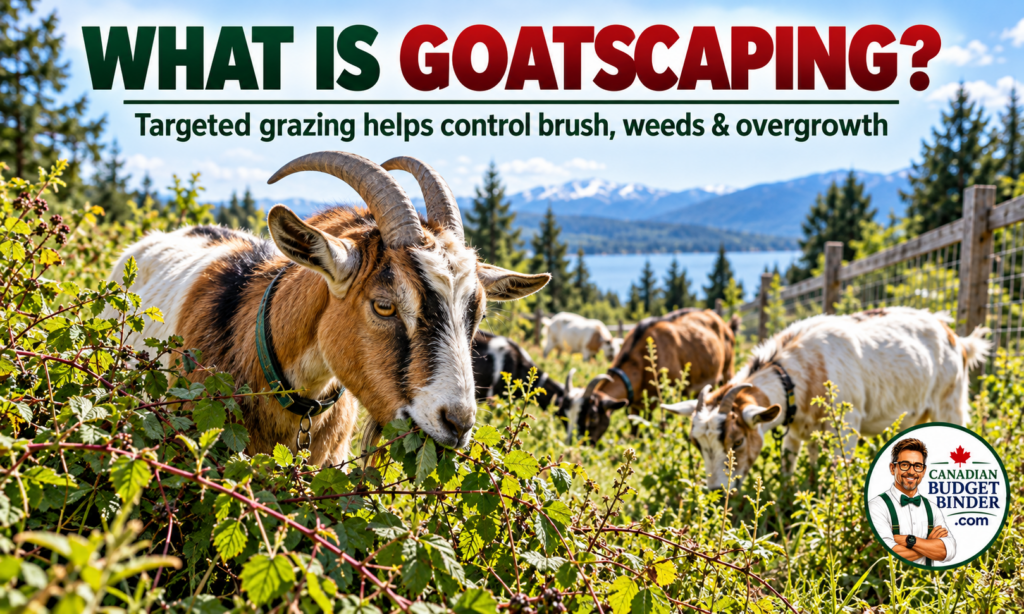
Goatscaping is a catchy name for using goats to manage unwanted vegetation.
The more formal terms are targeted grazing or prescribed grazing.
Goats are browsers, meaning they will eat many types of leaves, weeds, woody plants, and brush.
That can make them particularly useful in areas where running a lawnmower isn’t practical.
Depending on the property and the operator, goats may be used to help control vegetation such as:
- Buckthorn
- Wild parsnip
- Garlic mustard
- Phragmites
- Poison ivy
- Thistles
- Brush
- Woody vegetation
A professional operator should assess the property first because goats don’t necessarily know which plants you paid $80 for at the garden centre.
If you want to keep it, make sure the goats can’t eat it.
Even Canadian Cities Are Using Goats
This isn’t only something being done on private farms.
Canadian municipalities are using targeted goat grazing as another vegetation-management tool.
The City of Toronto began prescribed goat grazing at Don Valley Brick Works Park in 2024.
Following the initial project, Toronto moved to a yearly rotational grazing model.
The City says prescribed grazing can help control invasive or incompatible plants and woody vegetation while offering potential benefits such as reduced reliance on mechanical equipment, lower noise, and less soil disturbance.
Calgary has also been using goats for vegetation management at Nose Hill Park.
In 2026, approximately 600 goats were scheduled to graze a defined section of the park to help manage invasive plants and excess vegetation.
Six hundred goats.
Now THAT would get the neighbours talking.
How Much Does Goat Rental Cost In Canada?
There is no standard goat-rental price across Canada.
The cost depends on the property and the company providing the service.
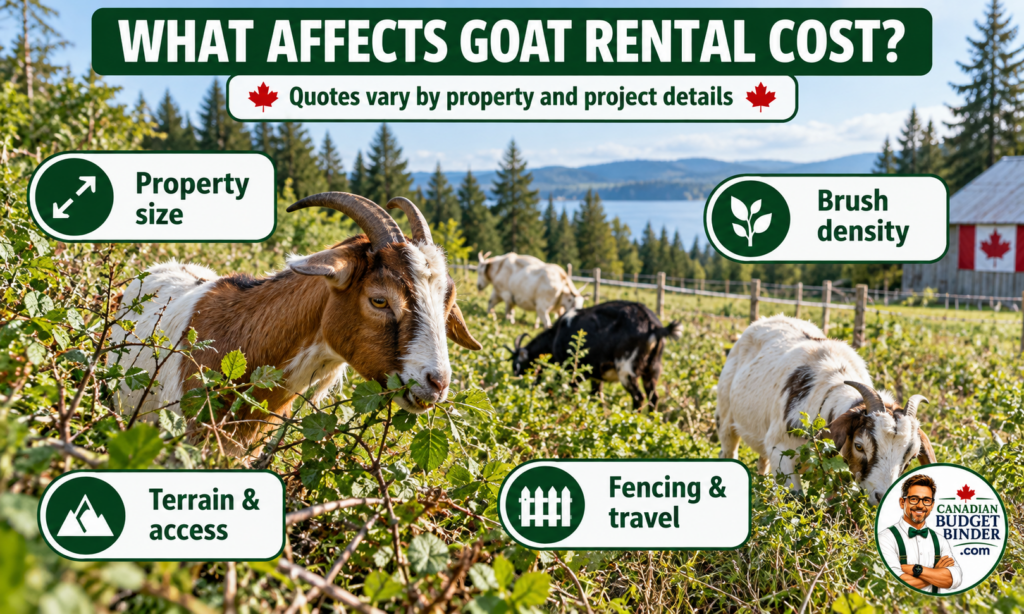
Factors may include:
- Property size
- Amount of vegetation
- Type of vegetation
- Terrain
- Accessibility
- Temporary fencing requirements
- Travel distance
- Number of goats required
- Length of the project
- Supervision and animal-care requirements
One Ontario company currently lists smaller residential projects starting around $700, with larger acreage projects priced on an individual basis.
Treat that only as an example.
It is not an average Canadian goat-rental price.
If you’re interested, contact an operator in your area to request an assessment and a written quote.
Is Goat Rental Really Budget-Friendly?
This is where the budget part becomes interesting.
Renting goats won’t automatically be cheaper than doing the job yourself.
If you’ve got a little patch of weeds that you can pull yourself in an hour, I’m not sending you out to hire a herd of goats.
But imagine a property covered in dense brush, invasive vegetation, or slope growth, where equipment is difficult to use.
Now you have to compare the complete cost.
That might include:
- Landscaping labour
- Equipment rental
- Fuel
- Brush cutting
- Herbicides
- Transportation
- Waste removal
- Disposal costs
That is where targeted grazing may be worth investigating.
Get more than one quote and compare the total cost of each option.
Sometimes the frugal solution isn’t the one with the lowest advertised price.
It’s the solution that gets the entire job done for the best overall value.
Should You Buy A Goat?
The original version of this article joked that perhaps you could find a goat for sale and skip the rental fee.
We’re going to leave that one in the CBB history books.
A goat isn’t a landscaping tool that you park in the garage when the weeds are gone.
Owning livestock means ongoing responsibility for appropriate food, water, shelter, fencing, veterinary care, and animal welfare.
Municipal rules may also restrict livestock on residential properties.
Unless you’ve genuinely planned to own and care for goats, buying one just because the backyard is overgrown probably isn’t a budgeting strategy.
It’s a new member of the family.
Going Green Paid Off
If you’re working on the front of your property, these budget curb appeal landscaping ideas may also help.
In the end, we didn’t need goats for this particular landscaping job.
I did the hard work myself.
What made the biggest difference wasn’t spending a pile of money.
It was being creative.
- We reused rocks.
- We moved existing plants.
- We relocated the shed.
- We reused soil.
- We searched for second-hand landscaping materials.
- We found interlocking bricks for $30.
- We used free and inexpensive plants where they made sense.
The homeowner wasn’t interested in making the property look like something from the pages of a landscaping magazine.
She wanted it to look tidy, welcoming, and affordable.
That’s what we achieved.
Landscaping doesn’t have to destroy your budget.
Start with what you have, reuse what you can, look for second-hand materials, and spend money only where it makes a meaningful difference.
And if the property really is out of control?
Apparently, calling in the goats is now an option in Canada, too.
Would you rent goats to clear an overgrown property if the price was competitive with traditional landscaping?
I’d love to know what you think.
Post Contribution
Katrina is a Canadian Budget Binder contributor who is as passionate about personal finance as she is about gardening. Katrina is a horticulture graduate with more than 10 years of experience in landscaping and greenhouse production.
About the goat … Goats are very practical in areas that are rocky, steep or hilly. Trucks and tractors can’t get everywhere! I know there are places in California that use goats in areas like this as a means of fire prevention from the dried out grass in Summer.
Another consideration : Compact soil. Trucks, tractors etc really compact the soil. ( This is really bad for you non gardeners). If you used tractors, you may then need to pay someone to aerate your soil.
Finally, Mr. CBB …. Goats poop. If you don’t mow the lawn then you get to shovel goat poop!
~ Christie
I’ve read lots about goats the past couple of days. The photo in the post is one of many I have from my trip to Portugal. I guess you can’t win right? You either mow or scoop lol.. Thanks for dropping by Christie!
Wow, impressive before and after. Well done. And though the goat is a novel and fun idea, those prices are NUTS!
Oh come Jacob.. just think with being a new dad again the goat might come in handy 😉 have a good one mate
Thanks Jacob, I had a great time doing it. How about raising your own goat? You gain a family pet and a lawn mower! 😉
I’ve always joked about renting a sheep! 🙂 I think a push mower would be an easier way to keep your lawn in check in an environmentally friendly way than renting a goat – but not as much fun!
The goats have been used a lot on abandoned properties where taking a push mower in can even be risky because you have no idea what is in the grass/weeds. I agree too though that watching the goats do their work would be more enjoyable! 🙂
This looks awesome Katrina!!! I can’t believe how much better it looks now!!! You hit a point that I get to argue with hubby about…. he likes things to look nice and full right away!!!!! I read the tags to see how big the plant will get so I can space them better…….. drives him nuts!!! It can be a real trick to hold him back…..I still remember planting one of the raised beds, there were 2 daylilies, 3 shasta- Alaska, a Lupine and 3 little Sweet Williams. I had them all nicely spaced to allow for growth… first thing out of his mouth when he saw it…. “Are you sure you got enough plants??? We can get more plants if you want… do you want to get more plants..wecangetmoreplantsdoyouwanttogetmoreplants…” I finally told him No…once I could get a word in edgewise…. give them a month or two…they will grow….He was clearly not happy about waiting. The Shastas alone had been 4″ pots and I had spaced them in a loose triangle about 15-18 inches apart, 6 weeks later they were one big clump a couple of feet across and 3 ft high…. My daylilies are huge right now. They, along with the shastas have been divided once already and need it again. He has finally learned to wait for things to grow….. I think……
Thanks Christine, it was a fun job to do! If your husband wants them to look full right away tell him he’s the one who can go out in a few months and start transplanting! 😉
Katrina… I’m not sure the plants would appreciate that!!!! There are some very good reasons why he is not allowed in the garden besides the fact he will over plant!!! His idea for overcrowding in plants is to rip everything out by it’s poor roots!!!! He’s not subtle at all that boy….. I don’t even dare to let him loose to weed without supervision!!!
I must note an error…Mary was very much involved in this project, she wouldn’t quit! A remarkable woman 🙂
Wow ! Awsome job !!! You are very talented. Hey ! I’m in U.S.A. Maby I need to start a rent a goat business . That’s some serious money they make. 😀
Thank you Donna!! It’s crazy money! I love how they only work from 9-5! lol
I would love, love, love a goat, but my husband won’t let me have one. All the dogs I want, but no goats! Maybe I could talk him into it if we could rent them out and make some money!
That and tell him no mowing the lawn and automatic fertilization….. you can’t go wrong with a goat , it’s like money in your pocket!!! 😉
Amazing job on the landscapting. Looking at the before and after pictures, its hard to believe its the same yard. The greas looks beautiful.
I particularly liked the backyard improvements shown in the first 2 pictures.
My wife and I did the landscaping on our yard too.
Yet, because we live in an arid area, we did just the opposite of you. We removed the grass and most of the vegetation from the yard and replaced it with decorative rocks, in order to reduce water use. And, we channeled runoff water from the roof to few trees and bushes that we have.
Thank you Terry. You have to adapt to your climate, it certainly makes it easier! Great use of your rainwater too 🙂
Great tips. I love reusing materials to gain something. There is nothing wrong with that. I think the pictures show that a lot of things can be done. I have heard about renting a goat, but I don’t think I would need that at my house.
I don’t think I would need one either, but what a great idea for abandoned properties where you wouldn’t want to take a machine in because you don’t know what’s in the grass? Goats do not eat everything, as many say but they could cut back the grass to expose the refuse and avoid damage to mowers. This property didn’t require goats and was a pleasure to do. Thank you for reading 🙂
That looks great! It reminds me that I need to go tend my flower garden this weekend.
Thank you. Weekends passed now lol, how did the gardening go?
Thank you submitting your article to my blog carnival. I’ve included it in today’s post:
Friday Blog Carnival Time
Love the renting goats part!
Thanks for letting me know. I normally add the link in tomorrow’s post. 🙂
Nice landscaping job! I don’t think I’ll be renting a goat any time soon but it’s pretty cool that there are people out there doing that. Definitely an outside-of-the-box idea.
I guess it’s the best of both worlds lol..
Thank you 🙂 I first read about the goat rentals about a year ago and that it was I thought!