


Estimated reading time: 9 minutes
Discover the potential income tax penalty relief available for late filers in Canada. Find out the due dates for filing your income tax return.
Don’t Forget Your Income Tax Return Has A Due Date
There are consequences when filing a late income tax return in Canada, and unfortunately not everyone knows the potential added costs.
However, I discovered that there is a potential income tax penalty relief for Canadians who are struggling financially or have circumstances beyond their control.
Your income tax return is typically due on or before April 30th of the tax year or by June 20th if you are a business owner or self-employed.
If the due date falls on a Saturday, Sunday, or public holiday, as long as your income tax return is postmarked for the next day, they will accept that as arriving on time.
However, whether you are self-employed or not, if you have a balance to pay the CRA, you must file your return by the April 30th due date.
If you’re worried about owing the government, you should also worry about how they feel about people who don’t complete their income tax return by the due date.
Come January; everything drops on Canadians like a tonne of bricks regarding finances.
We are working with a new budget, increased costs, and preparing the dreaded income tax return.
Related: 5 Best Methods To File Your Income Tax Return In Canada
Penalty For Late Filing Of Income Tax Return
What happens if you file your income tax return late in Canada?
Penalties and Interest are two words that spring to mind and that you’ll get to know on an intimate level.
Even filing a late income tax return by one day is still considered late in the eyes of Revenue Canada (CRA), so it’s important to know what penalties you may face.
The CRA charges compound interest based on prescribed interest rates the day after your income tax return is due.
For example, the overdue remittance rates for January 1st, 2020, to March 31st, 2020, for unpaid taxes, CPP contributions, and employment insurance premiums will be 6%.
An overdue remittance rate is a rate that the taxpayer must pay to the CRA for outstanding amounts owed to the CRA.
Late Income Tax Return Penalty Example
The penalty is 5% of your 2019 balance owing, plus 1% of your balance owing for each full month your return is late, to a maximum of 12 months.
If the CRA charged a late-filing penalty on your return for 2016, 2017, or 2018 your late-filing penalty for 2019 may be 10% of your 2019 balance owing, plus 2% of your 2019 balance owing for each full month your return is late, to a maximum of 20 months.
So, when you’re late, you are technically getting hit with a financial cost based on how much you owe them.
Let’s look at this example of a late filing penalty of a 2018 Assessment where the claimant had to repay social benefits.
That means that because they were late filing and due to a reassessment, they were found to not qualify for social benefits and had to repay them.
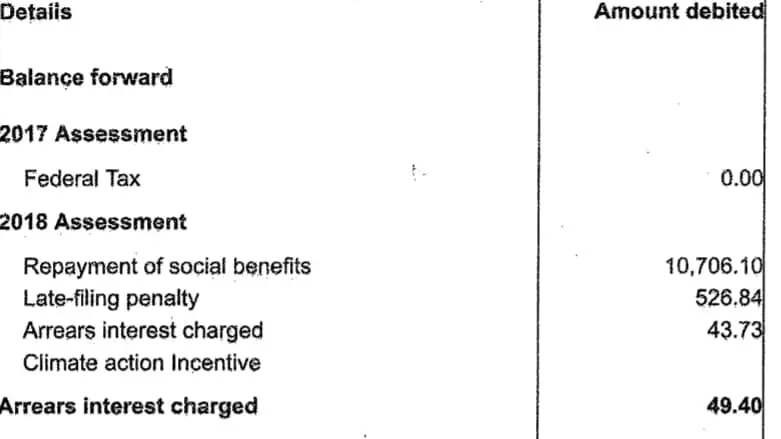
As you can see from this real example above, the CRA charged this person a late filing fee of almost 5% on the $10,706.10, which amounted to $526.84.
On top of that, they charged interest on the arrears that were owed of $49.40.
You can clearly understand from this example that a late filing penalty can be costly to you, as would be not filing at all.
Perhaps you might learn from this example that they can take it back just because they give you money when an error is found.
This is why I always suggest not rushing out and spending your income tax return immediately unless you have savings to back it up in case of mistakes.
The person charged the interest and late payment fees in the above CRA statement is looking into the taxpayer relief program.
Not Filing Income Tax Return
If you missed filing taxes, that’s one thing, but not filing your income tax return is another.
There’s something about messing with the government and taxes in Canada that people should avoid, and not filing your taxes is one of them.
There are limited acceptable reasons for not filing an income tax return in Canada.
One of the top reasons some Canadians might not file their income tax return is that they are worried about what they must repay the government.
There’s a fear that something terrible will happen, so they choose to avoid the situation, which only worsens it.
A friend of my wife’s once told her that he had not filed his income tax return in 7 years, which floored her.
She’d heard of people filing a late income tax return, but not simply avoiding filing was scary for her.
At one point, she was wondering whether he wanted advice from her about what to do, and frankly, she wasn’t sure.
For example, if you fail to file your income tax return for a few years and have taxable income over $500, the CRA will consider that failure to report income.
The federal and provincial or territorial penalties are each equal to the lesser of:
- 10% of the amount you failed to report on your return for 2019
- 50% of the difference between the understated tax (and overstated credits) related to the amount you failed to report and the amount of tax withheld related to the amount you failed to report
You should file your income tax return on time to work with Revenue Canada if you have to pay them back.
Reporting A False Statement On Your Income Tax Return
The penalties are steep for failing to report income to the CRA.
However, if you voluntarily admit to lying or making an error, they may waive the penalties.
The penalty is equal to the greater of:
- $100
- 50% of the understated tax and/or the overstated credits related to the false statement or omission
There are ways you can negotiate paying back any money owed to the government at tax time without fees or fines.
Taxpayer Relief Program
If you cannot meet your tax obligations due to circumstances beyond your control, you can talk with Revenue Canada in hopes they waive or reduce your penalties or interest charges.
You only have 10 years to apply for taxpayer relief for the tax year or fiscal period.
When filing for relief under the Taxpayer Relief Program, you must explain facts and circumstances that show your inability to file your income tax return on time.
To do so, you must fill out a form RC4288 request to explain your situation for your late income tax return to Revenue Canada.
Telling Revenue Canada that you didn’t know how to file your income tax return or weren’t aware of a due date won’t sit well.
However, if your house caught on fire or there was a death, Revenue Canada will look at these circumstances and perhaps forgive your late income tax return.
You must provide a fire report and insurance documents if your late income tax return is due to a fire.
In the event of a death or other natural circumstances, you must provide evidence for your claim.
Related: Information you must include with your income tax penalty relief form.
Circumstances Beyond Your Control
Other circumstances that you might apply for Taxpayer relief might fall under:
- Financial Hardship
- CRA errors such as processing, incorrect data provided by CRA
- Natural or human-made disasters, such as a flood or fire;
- Civil disturbances or disruptions in services, such as a postal strike;
- Severe illness or accident; and
- Serious emotional or mental distress, such as a death in the immediate family.
What constitutes financial hardship?
CRA looks at how financial hardship affects the individual and assesses their circumstances.
Payment of the accumulated interest would cause a prolonged inability to provide basic necessities (financial hardship) such as food, medical help, transportation, or shelter; consideration may be given to cancelling all or part of the total accumulated interest.
When writing a financial hardship letter to the CRA, it’s essential first to find out what they require for documentation.
A simple phone call to the CRA at 1-800-959-8281 may clear up any questions.
Can The CRA Waive Fees and Penalties?
The Canada Revenue Agency (CRA) administers legislation that gives the Minister of National Revenue discretion to:
- Cancel or waive penalties or interest
- Accept certain late, amended, or revoked income tax elections
- Issue a refund or make an adjustment to refund or reduce tax payable beyond the normal three-year period for an individual, a graduated rate estate, and for certain tax years, a testamentary trust
This legislation is commonly called the taxpayer relief provisions.
How Do I File A Late Income Tax Return?
There is nothing exceptional to do but file your income tax return as you normally would.
The CRA will time-stamp the tax return and assess it based on when it arrives.
Either way, if it’s late, it’s late.
Analysis of Filing A Late Income Tax Return
- Submit your income tax return on time.
- Use the Free E-file program from the CRA or other credited income tax return programs for accuracy.
- Face potential penalties and interest if you owe money and are late filing.
- Penalties may arise if you lie or omit information from your income tax return.
- You may have fees waived if you qualify for the taxpayer relief program.
- Always file your income tax return, whether you owe money or not, to avoid interest and penalties.
Once the CRA receives your request for taxpayer relief, the approval or denial of your request, many factors will be considered.
Don’t assume you won’t get approved.
It won’t hurt to fill out an application for the taxpayer relief program, but most of all, file your income tax return on time.
Discussion: Have you ever dealt with Revenue Canada and filing a late income tax return? What was the outcome?
Share your comments or experiences below, and I’ll respond to you.