



Estimated reading time: 18 minutes
A frozen bank account after death can leave a surviving spouse unable to access money when they need it most.
One Canadian Budget Binder reader found out the hard way when her father-in-law died, and her mother-in-law suddenly discovered that the money her husband had saved was not immediately available to her.
She was grieving the loss of her husband.
There were funeral expenses to deal with.
Household bills still needed to be paid.
And although there was money sitting in the bank, some of it was effectively out of reach while the family worked through the estate process.
The experience caused weeks of stress, phone calls, and financial uncertainty.
When I originally shared this reader’s story in 2018, it made Mrs. CBB and me look closely at our own bank accounts and estate planning.
Years later, this article continues to attract Canadian readers searching for information about a frozen bank account after death.
That’s why I’ve completely updated it.
Banking procedures, provincial laws, and estate rules can differ depending on where you live and how an account is owned.
The important lesson from this widow’s story, however, hasn’t changed:
You don’t want your spouse learning how your finances work after your funeral.
Frozen Bank Account After Death Left A Widow Without Her Savings
The CBB reader who originally contacted me was helping her mother-in-law after her husband died.
Her mother-in-law was retired and living on a relatively small government pension.
The couple did not keep all their savings together.
Her husband controlled much of the savings and transferred money into a joint chequing account when household expenses needed to be paid.
According to the reader:
“My mother-in-law was not the best with saving money which is why they had separate bank accounts. The only access she had was to the joint chequing account to pay for bills each month.”
Her father-in-law would transfer money into that account for expenses such as the mortgage and house insurance.
Then he died.
The savings held in his name did not simply become available to his widow merely because she was his wife.
The family now had to deal with the financial institution and the estate.
At the same time, they were grieving and trying to arrange a funeral.
The reader told me:
“We didn’t have to worry so much about this as my father-in-law’s funeral was being paid out of other savings. Since my mother-in-law was retired and only earning a small amount of government pension the money in that savings account would be a huge help for her.”
Fortunately, this family had other resources.
Not everyone does.
Imagine discovering several days after your spouse dies that money you expected to use for groceries, utilities, a mortgage, or funeral costs cannot immediately be withdrawn.
That’s the financial shock this article was originally about.
Can You Pay The Bills If Your Spouse’s Bank Account Is Frozen?
Death does not stop the bills.
- The mortgage or rent is still due.
- Property taxes continue.
- Utilities have to be paid.
- Insurance premiums may continue to come out of accounts.
- Groceries still have to be purchased.
And then there may be thousands of dollars in funeral and other immediate expenses.
If most of the household savings were controlled by the person who died, the surviving spouse could suddenly have a cash-flow problem even when the family technically has money.
That’s what makes a frozen or restricted bank account so frustrating.
The money may be there, but that doesn’t necessarily mean you have the legal authority to use it.
What Happens To A Bank Account When Someone Dies In Canada?
There isn’t one rule that applies to every Canadian bank account.
What happens depends on factors including:
- Whether the account was held solely or jointly
- The terms of the account agreement
- The financial institution
- The province or territory
- Whether there is a valid will
- Who has authority to administer the estate
- Whether probate or another court document is required
Once a financial institution learns that an account holder has died, an account held solely by that person may be restricted while the bank determines who has authority to manage the funds.
This protects the estate and its beneficiaries.
Unfortunately, it can also create financial pressure for the surviving family.
What Happens To A Bank Account Held Only In The Deceased Person’s Name?
If a chequing or savings account was held solely in the deceased person’s name, being married to that person does not automatically give the surviving spouse unlimited access to the account.
The money may have to be handled as part of the deceased’s estate.
The executor or other legally authorized estate representative will generally need to provide documentation to the financial institution.
Depending on the circumstances, the bank may also require probate or another court-issued document establishing the person’s authority.
This is an important distinction.
Being the spouse and being legally authorized to administer an estate are not necessarily the same thing.
Does A Joint Bank Account Get Frozen When Someone Dies?
This part of the original article needed an important update.
I previously wrote too broadly that a joint bank account would remain available because of the right of survivorship.
It isn’t always that simple.
The Financial Consumer Agency of Canada says that in many cases, joint accounts include a right of survivorship. This can allow the surviving account holder to become the account owner after the other account holder dies.
However, FCAC specifically advises Canadians to ask their financial institution what happens when one joint account holder dies. In some circumstances and provinces, the survivor may not be able to access the funds immediately.
So don’t assume that because two names appear on an account, everything will automatically work the way you expect.
Ask your bank.
It’s much easier to have the conversation while both account holders are alive.
Quebec Joint Bank Accounts After Death
Quebec has different rules that are particularly important for couples to understand.
In Quebec, a joint account is frozen when one of the account holders dies.
However, Quebec law now provides additional protection for certain spouses and former spouses who jointly hold a demand deposit account, such as a chequing account.
The surviving co-holder or the liquidator of the succession may submit a written request to release the survivor’s share of the account balance.
If the spouses haven’t previously declared different percentages, their shares are generally considered equal for this purpose.
The Quebec government says these measures were introduced specifically to help prevent surviving spouses from being left unable to cover everyday expenses such as groceries and mortgage payments.
That’s another reason I don’t recommend relying on a single blanket statement about joint accounts across Canada.
Does The Executor Need Probate Before The Bank Releases Money?
Not necessarily.
This was another part of my original 2018 article that needed correcting.
I previously made it sound as though an executor always had to obtain probate before money could be released.
That’s too absolute.
The Ontario government states that probate is not always required to administer an estate.
Whether it is necessary depends largely on the assets involved and whether the financial institution or other organization holding those assets requires a Certificate of Appointment of Estate Trustee.
A bank may require probate in one estate but not in another.
If you’re the executor, one of your first questions should therefore be:
What documents does this financial institution require before I can deal with this account?
Don’t spend money applying for probate solely because someone told you that every estate requires it.
Find out what is actually required.
What Documents Does A Bank Need After Someone Dies?
Every financial institution can have its own requirements.
As one current example, TD tells estate representatives that providing a death certificate, the will, and personal identification can begin the estate-settlement process. Additional documentation may be required depending on the estate.
You may be asked for documents such as:
- Proof of death
- The will, if there is one
- Identification for the executor or authorized representative
- Court or probate documentation where required
- Information about estate assets
- Funeral or other estate-related invoices
Call the bank’s estate department before going to the branch and ask exactly what to bring.
That may save you another frustrating trip during an already difficult time.
Can Funeral Costs Be Paid From A Frozen Bank Account?
This was one of the biggest worries in the original widow’s story.
How do you pay for a funeral when the deceased person’s money is sitting in an account you can’t access?
It may be possible for a financial institution to use estate funds to pay certain immediate expenses before the estate is fully settled.
For example, TD currently tells executors and authorized representatives to bring funeral and certain household bills to their estate appointment. TD says immediate financial needs, such as funeral costs, may be paid from estate funds.
That doesn’t mean every bank follows the same procedure.
However, before putting a funeral on a credit card or borrowing thousands of dollars because you think the deceased person’s money is completely unavailable, ask the financial institution:
Can the funeral invoice be paid directly from estate funds?
The answer could make an enormous difference to a family already under financial pressure.
The Widow’s Family Had A Financial Saving Grace
There was one positive surprise in the CBB reader’s story.
Her mother-in-law discovered that her husband had quietly created a financial cushion.
He had saved money in case something happened.
That emergency money became extremely important after his death.
It was, quite literally, her saving grace.
This is where estate planning and emergency savings overlap.
An emergency fund isn’t only for a broken furnace, car repair, or job loss.
Your household needs to be able to continue operating if one spouse suddenly dies.
Ask yourself:
If I died tonight, how much money could my spouse actually access tomorrow?
- Not how much money do we own.
- Not how much is in our investment accounts.
- Not how much equity is in the house.
How much usable cash could the surviving person access?
That’s a very different question.
A Power Of Attorney Ends When You Die
Here’s another point that catches families by surprise.
Having power of attorney over someone’s finances while they’re alive doesn’t mean you continue to have that authority after they die.
Ontario states clearly that powers of attorney end when the person dies.
After death, authority over estate assets transitions to the estate administration process.
That’s why a power of attorney and a will serve two different purposes.
A power of attorney can give someone authority to manage certain matters while you are alive.
A will sets out your wishes for your estate after death and can name the person you want to administer it.
You may need both as part of a proper estate plan.
Be Careful Adding Your Adult Child To A Joint Bank Account
Parents sometimes add an adult child to a bank account because they want help paying bills or believe it will make transferring the money easier after death.
That decision should not be made casually.
The Supreme Court of Canada’s Pecore v. Pecore decision dealt with a father who placed assets into joint accounts with his adult daughter.
The Court confirmed that when a parent gratuitously transfers property into a joint arrangement with an independent adult child, questions can arise as to whether the parent intended the remaining funds to be a gift to the child or should form part of the parent’s estate.
In those circumstances, a rebuttable presumption of resulting trust can apply, and evidence of the parent’s actual intention becomes important.
Translated into normal language:
Putting your child’s name on your account doesn’t necessarily guarantee that the child owns the money after you die.
Other beneficiaries may challenge it.
If you’re considering adding an adult child solely as an estate-planning strategy, speak with a lawyer first.
What Happens If There Is No Will?
A frozen bank account can become even more complicated when the deceased person did not leave a valid will.
Someone may need to obtain legal authority to administer the estate.
The exact process and inheritance rules depend on the province or territory.
For example, Ontario explains that when someone dies, the estate trustee administers the estate, and that probate may be needed depending on the assets and circumstances.
Dying without a will doesn’t necessarily mean that everything automatically goes to the government.
But it does mean that provincial intestacy rules, rather than your own instructions in a will, determine how your estate is handled and distributed.
That can create extra work at exactly the wrong time.
How Long Can A Bank Account Stay Frozen After Death?
There’s no Canada-wide answer, such as seven days, 30 days, or 90 days.
The timeline depends on the estate.
Factors can include:
- Whether there is a will
- Whether probate is required
- The financial institution
- The assets involved
- Whether the documents have been provided
- Whether the estate is complicated
- Whether anyone challenges ownership or the will
In the original CBB reader’s case, the family was told that the bank employee handling the estate had many other estate files to process.
That made an already frustrating situation feel even worse.
Current TD estate guidance also notes that the time required to settle an estate can vary based on its complexity and whether probate is required.
This is precisely why families shouldn’t plan on having immediate access to every dollar after a death.
Separate Bank Accounts Aren’t Necessarily The Problem
Mrs. CBB and I have used separate banking arrangements during our marriage.
When I moved to Canada from the UK, part of my reasoning was to establish my own Canadian financial history.
Over the years, I’ve also heard from many CBB readers who keep some or all of their finances separate.
- Some couples prefer independence.
- Some divide household bills.
- Some have blended families.
- Some married later in life with assets they want to keep separate.
There isn’t anything automatically wrong with that.
The danger is having separate finances without an estate plan.
The surviving spouse should know:
- Where the accounts are
- How the accounts are owned
- Which bills come from which account
- Where emergency money is kept
- Where the will is
- Who the executor is
- Which financial institutions need to be contacted
- Where insurance and investment information is stored
The goal doesn’t have to be making every account joint.
The goal is to make sure your family isn’t completely lost when you’re gone.
Don’t Make Everything Joint Just To Avoid Probate
After hearing this reader’s story in 2018, Mrs. CBB and I reviewed the structure of our own bank accounts.
That was a good thing.
However, today, I would be careful about telling every Canadian family to make every asset joint simply to avoid probate.
Joint ownership can have consequences.
A joint owner may have access to the money while you’re alive.
Adding a child can lead to disputes about who owns the money after death.
There may also be creditor, tax, family-law, or estate consequences depending on the situation.
The federal government itself recommends that you understand both the benefits and risks before opening or changing a joint account.
Estate planning should be based on your family’s circumstances, not a shortcut someone told you about online.
Questions To Ask Your Bank Before Your Spouse Dies
Nobody likes talking about death.
I’d rather have an uncomfortable banking conversation today than leave Mrs. CBB trying to figure everything out while grieving.
Understanding what can cause a bank account to freeze after death can help your family prepare for an emergency.
Consider asking your financial institution:
- What happens to this account if I die?
- What happens if my spouse dies?
- Is this account set up with a right of survivorship?
- Could the surviving account holder continue accessing the money?
- What happens to an account held only in my name?
- What would my executor need to provide?
- When would your bank require probate?
- Can funeral bills be paid from estate funds?
- Are there special rules in my province?
- Is there anything about our current setup that could cause difficulty for my spouse?
Write the answers down.
Don’t rely on remembering them ten years from now.
Create An Emergency Financial Binder
Your spouse or executor shouldn’t have to search the house looking for account statements and insurance paperwork after your death.
Keep important financial information organized.
That may include:
- Bank and investment information
- Insurance policies
- Mortgage information
- Credit cards and debts
- Contact information for your lawyer
- Location of your will
- Funeral wishes
- Pension information
- Important passwords or instructions for accessing them securely
- Recurring household bills
- Information your executor will need
This is one of the reasons I created the CBB Emergency Binder.
Having the information doesn’t remove grief.
It simply removes some of the unnecessary confusion.
Also read my Ultimate Guide To Planning Your Death – Executor Resource and How Much Does A Funeral Cost In Canada?
A Frozen Bank Account Shouldn’t Leave Your Spouse Broke
The widow whose story inspired this article had money.
Her husband had saved.
The problem was that some of the money wasn’t immediately accessible when she needed it.
That’s what makes this story so important.
Being financially secure on paper doesn’t automatically mean the surviving spouse will have enough accessible cash tomorrow morning.
You don’t need to obsess about death.
- You do need a plan.
- Talk to your spouse.
- Talk to your bank.
- Have an updated will.
- Understand your joint and individual accounts.
- Know what your executor will need.
- Keep emergency savings accessible to the household.
Finally, organize your financial documents and get professional estate advice when your situation requires it.
Don’t wait until someone dies to discover how your bank accounts work.
The widow in this story learned that lesson during one of the worst periods of her life.
Hopefully, sharing her experience means another Canadian family won’t have to learn it the same way.
Discussion: Have you ever dealt with a frozen bank account after the death of a spouse, parent, or family member in Canada? What happened, and what do you wish you had known beforehand?
This article is intended for general Canadian financial education and is not legal, tax, or financial advice. Estate law varies by province and territory, and financial institutions may have different policies. Speak with your financial institution and a qualified estate professional about your circumstances.
March CBB Home Budget Update
Hey CBB Friends,
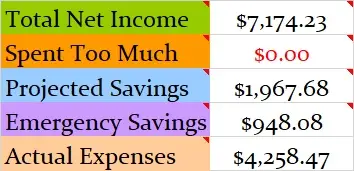
Our net income hovers around the same amount each month, which is neither good nor bad.
I’m so happy that I’m not doing the hours I used to, even though they paid off for me.
We made a few trips to play centres for our little guy, and daycare is going great.
Planning for his arrival in junior kindergarten might not be as challenging as we thought; however, I’m sure panic may set in once he sees the classroom.
Any tips from parents out there would be great! Perhaps I could create blog posts based on all of your recommendations.
My allowance was over budget this month, all because of the beer. For some reason, likely stress, I’ve been drinking more beer, so I’ve cut that out until summer.
My allowance can’t take it, and luckily, Mrs. CBB pointed out that drinking isn’t going to calm the stress of everything. She’s right.
Have a great week, everyone!
Our FREE Simple Budgeting Series
Do you want to learn to budget as we do?
Please take the time to read through our budgeting series and Budgeting in the New Year.
I hope this information helps you avoid common budgeting mistakes.
- How We Designed Our Budget Step 1– Gathering All the Information
- How We Designed Our Budget Step 2– Budget Categories
- How We Designed Our Budget Step 3– Tracking Receipts
- How We Designed Our Budget Step 4- Note-taking
- How We Designed Our Budget Step 5– 5S Organization
- How We Designed Our Budget: Step 6 – Who Does What and When?
- How We Designed Our Budget Step 7– Balancing Our Budget
- How We Designed Our Budget Step 8– Knowing our Coupon Savings
- How We Designed Our Budget Step 9– Reading Our Bills
- How We Designed Our Budget Step 10– Projected Expenses
Budget Percentages March 2018
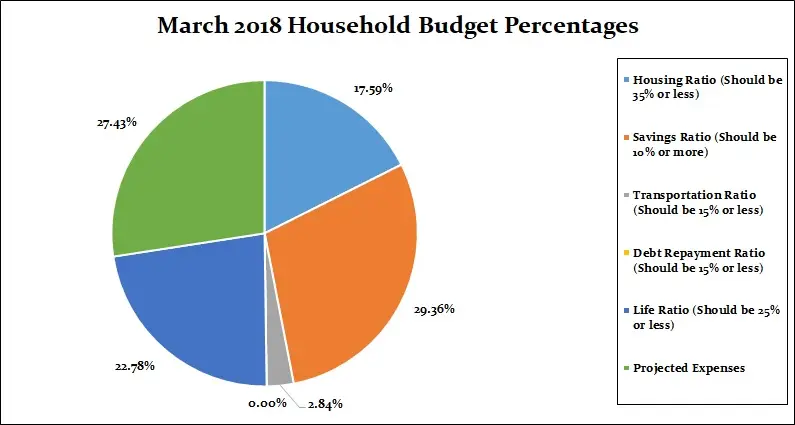
Our savings of 29.36% include investments and projections for this month, based on an income of $7174.23.
We set aside money for projected expenses that must be paid in the coming months.
The other categories were typical, even if the Life Ratio is slightly high and close to the maximum.
Budget Percentages Month By Month
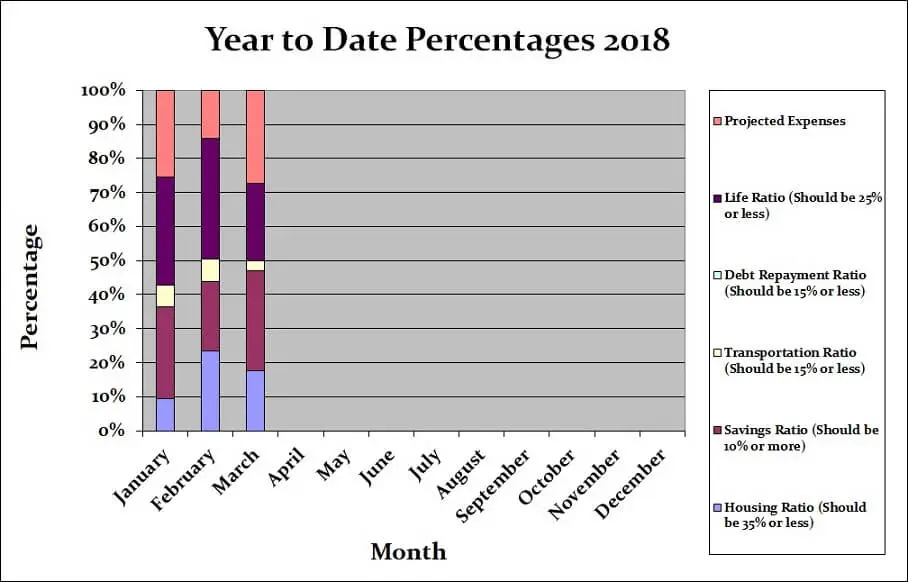
Breaking Down Expenses
Below is a breakdown of our expenses, which helps us understand where our money goes.
Since May 2014, we’ve been mortgage-free, so we’ve put so much of our money into savings, investments, and renovations.
I appreciate that you enjoy this monthly budget update.
Still, I hope you view this as an educational tool rather than as a way to compare your financial numbers, as our situations are unique.
Spending less than we earn and budgeting have been the easiest ways to pay debt and save money. It may be different for you.
- Chequing – This is the bank account from which all of our debt is paid.
- Emergency Savings Account– This is a high-interest savings account.
- Regular Savings Account– This account holds our projected expenses.
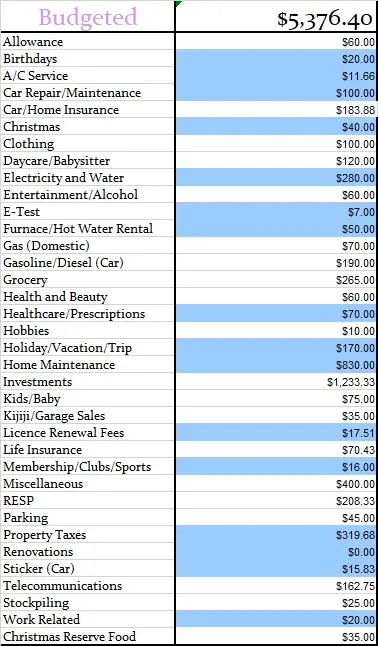
- Monthly Budgeted Total: $5,376.40
- Net Income Total: $7,174.23
- (Check out our Ultimate Grocery Guide to see where our grocery money goes)
- Projected Expenses: These are expenses we know we will pay for throughout the year = $1,967.68
- Expenses Paid Out: $4,258.47
- Total Expenses Paid Out: Calculated is $7,174.23 (total net monthly income) – $1,967.68 (projected expenses) – $948.08 (savings into the emergency fund) = $4,258.47
- Actual Cash Savings going into Emergency Savings: Calculated is $7,174.23 (total monthly net income) – $4,250.47 (actual expenses paid out for the month) – $1967.68 (projected expenses) = $948.08
Budget Results
It’s time for the juicy category numbers to see how we made our monthly budget.
Below are two tables: our monthly budget and our actual budget for March 2018.
This budget represents two adults and a toddler, plus retirement investments.
Budget colour chart
If highlighted in blue, that means it is a projected expense.
You will also see that our budget does not include emergency savings, as they’re factored in at the end.
Monthly Budget for March 2018
Actual budget expenses for March 2018
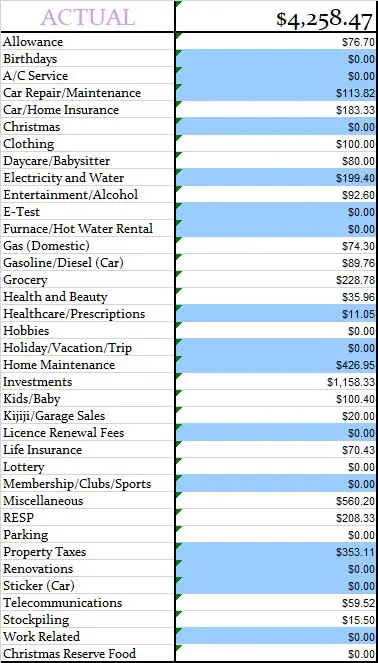
That’s all for this month; check back at the beginning of April 2018 to see how we made out with our March budget.
Happy Budgeting CBB’ers!
I have a few ten thousand dollars worth of silver bars at home in case this ever happens. You never know.
I’m going through this problem now we were common law 4o years he left no will filed through courts but due to COVID taking long time to get proceed. In process for 8 months now
Ah, that’s tough Pam I’m sorry. A legal will really does make a big difference. What happens once the courts get it?