

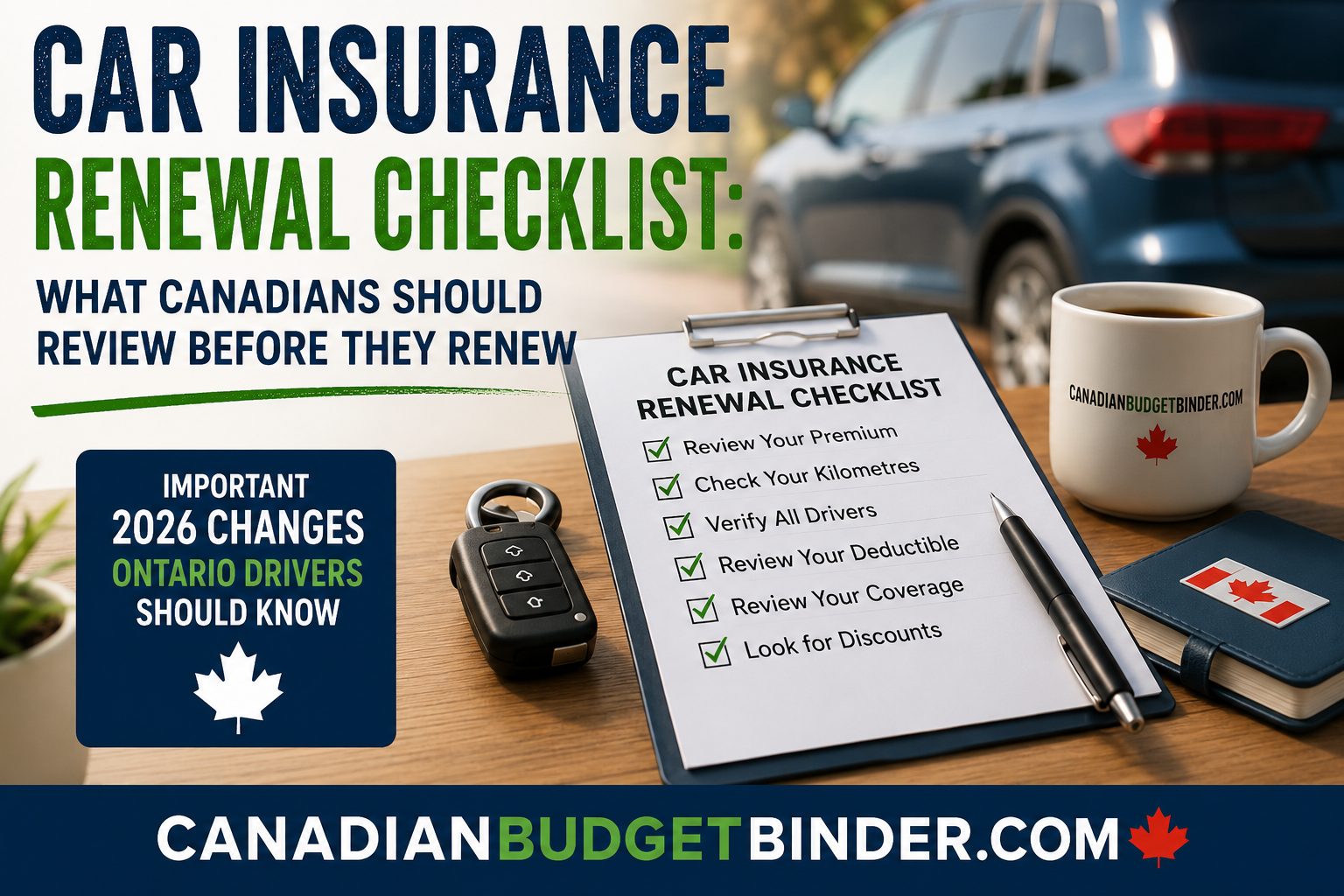

A car insurance renewal checklist can help you catch outdated information, unnecessary coverage and missed discounts before you automatically renew your policy.
For Canadian drivers, taking a few minutes to review the details can also help ensure you compare insurance quotes fairly and carry the coverage you actually need.
Your insurance needs can change from year to year. You may be driving fewer kilometres, working from home, driving a different vehicle or have changes to the people who regularly use your car.
Your renewal is a good opportunity to make sure your policy still reflects your life today.
Here are some of the most important things to review before renewing your car insurance in Canada.
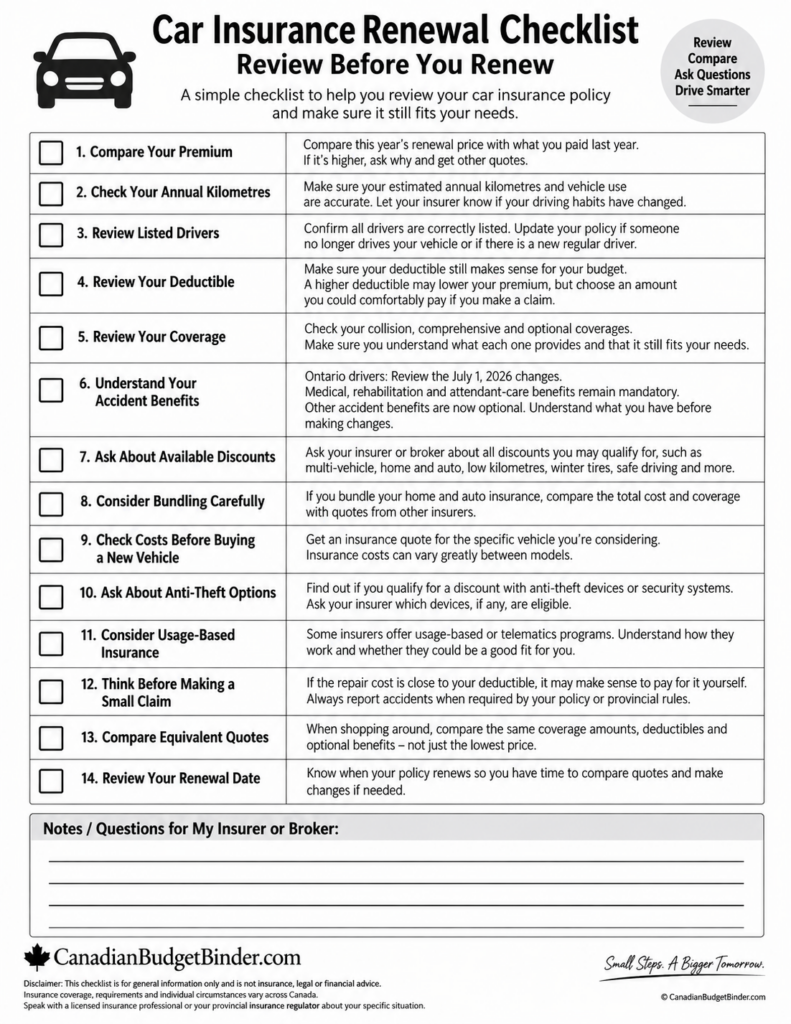
FREE Car Insurance Renewal Checklist Printable
I created a simple Car Insurance Renewal Checklist you can print and keep in your Budget Binder. Use it before your next renewal to review your premium, annual kilometres, listed drivers, deductible, coverage, discounts, and any questions you want to ask your insurer or broker.
Print a copy, check off each item as you review your policy, and keep your notes together for your next renewal.
Download the FREE Car Insurance Renewal Checklist PDF
1. Compare Your New Premium With Last Year
Start with the number most people notice first: your premium.
Compare your upcoming renewal price with what you paid during the previous policy term.
If the premium has increased, don’t assume there is nothing you can do.
Ask your insurer or broker why the cost changed and whether any changes to your circumstances, coverage or discounts could affect the price.
It can also be worthwhile to get quotes from other insurance companies.
Make sure you’re comparing equivalent coverage, though. A cheaper quote isn’t necessarily a better deal if it comes with a much higher deductible or less protection.
2. Check Your Annual Kilometres
Has the amount you drive changed?
Perhaps you now work from home, commute fewer days each week, are retired, have changed jobs, or simply don’t drive as much as you once did.
Your insurer should have an accurate estimate of your annual kilometres and how the vehicle is used.
Don’t intentionally underestimate your driving just to get a lower premium. The information on your application and policy should accurately reflect your situation.
If your driving habits have legitimately changed, let your insurer know.
3. Make Sure All Drivers Are Correctly Listed
Review everyone listed as a driver on the policy.
Someone who no longer regularly drives your vehicle may still be listed, or there could be a new regular driver who needs to be added.
Providing accurate driver information is important.
Trying to lower your insurance costs by leaving out someone who regularly drives the vehicle can create serious problems if you later need to make a claim.
Tell your insurer when household or driver circumstances change.
4. Review Your Deductible
Your deductible is the portion of an eligible claim that you agree to pay before your insurance covers the remaining amount.
Choosing a higher deductible can sometimes reduce your premium.
For example, increasing a deductible from $500 to $1,000 may lower the insurance cost because you are accepting more financial responsibility if you make a claim.
However, don’t choose a deductible you couldn’t comfortably pay after an accident.
The potential premium savings should outweigh the additional amount you would have to pay out of pocket.
Related: I’ve also written about our own experience paying a $500 auto insurance deductible after a preventable accident, which is a good reminder to choose a deductible you could realistically afford if you had to make a claim.
5. Review Your Coverage
Your insurance needs can change as your vehicle gets older or your financial circumstances change.
Review your collision, comprehensive, and optional coverages and make sure you understand what each one provides.
Don’t remove coverage simply because it lowers the premium.
Consider the financial impact if your vehicle were damaged, stolen, or written off and you had to cover more of the loss yourself.
The goal is to find an appropriate balance between cost and protection.
6. Ontario Drivers: Understand The July 1, 2026, Auto Insurance Changes
Ontario drivers have another important reason to review their policies.
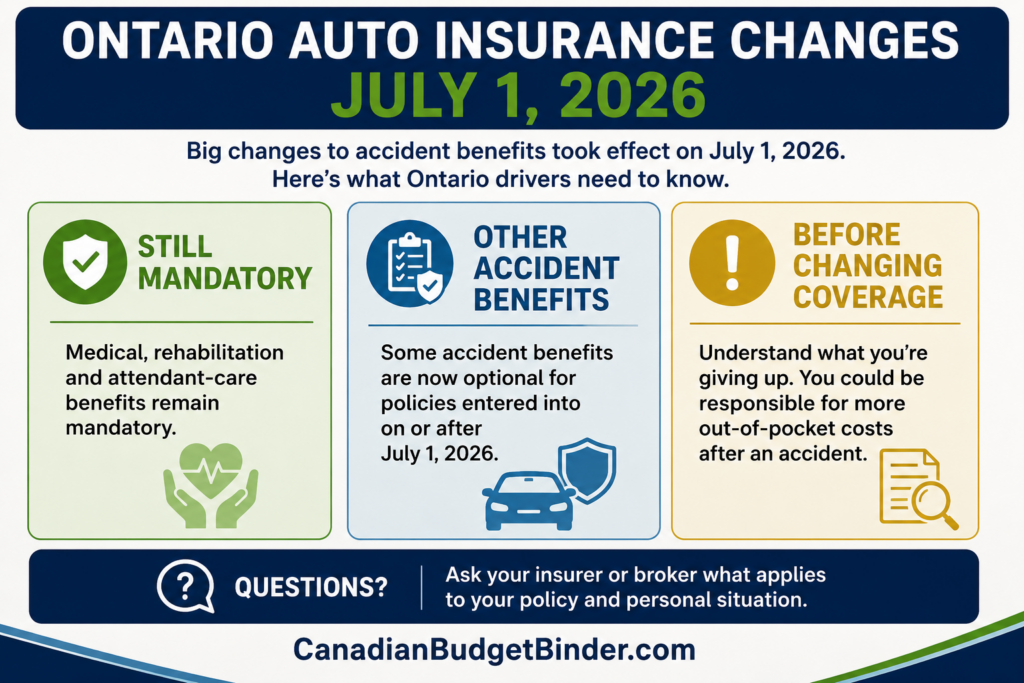
Changes to Ontario’s Statutory Accident Benefits took effect July 1, 2026.
Medical, rehabilitation, and attendant-care benefits remain mandatory.
Other accident benefits, including benefits such as income replacement, non-earner, caregiver, lost educational expenses, expenses of visitors, damage to personal items, death and funeral benefits, dependant care, housekeeping and home maintenance, and indexation can now be optional depending on the policy and coverage selected.
For new policies entered into on or after July 1, 2026, only medical, rehabilitation and attendant-care benefits are mandatory accident benefits.
Existing Ontario customers should also pay close attention at renewal and understand what coverage they currently have before making changes.
Don’t remove an accident benefit simply because doing so lowers the premium. Consider your household income, employment benefits, existing health or disability coverage and how you would manage financially after a serious collision.
Ontario drivers can review the current options directly through the Financial Services Regulatory Authority of Ontario:
Speak with your insurer, agent, or broker if you’re unsure how the changes apply to your policy.
Ontario drivers can review the current accident-benefit options on the Financial Services Regulatory Authority of Ontario website.
7. Ask About Every Discount Available
Don’t assume your insurer has automatically applied every discount you qualify for.
Ask your insurer or broker to review the available discounts on your policy.
Depending on the company and your circumstances, discounts may be available for things such as:
- Multiple vehicles
- Combining home and auto insurance
- Low annual kilometres
- Usage-based insurance
- Anti-theft equipment
- Safe driving
- Driver training
- Group or membership programs
- Winter tires
In Ontario, insurance companies are required to offer a winter-tire discount, although the amount and eligibility requirements may vary by insurer.
Ask exactly what you qualify for rather than assuming.
8. Compare Bundling Carefully
Putting your home, tenant or condo insurance and auto insurance with the same company may qualify you for a multi-policy discount.
But don’t automatically assume bundling is cheaper.
For example, one insurer might offer:
Auto insurance: $1,900
Home insurance: $1,200
Total: $3,100
Another company’s bundled quote might be:
Auto insurance: $1,750
Home insurance: $1,100
Total: $2,850
The bundle looks better in that example, but every household will receive different quotes.
Compare the total cost and coverage across all policies rather than focusing only on the advertised discount.
9. Check Insurance Costs Before Buying Your Next Vehicle
The price of the vehicle isn’t the only cost to consider when car shopping.
Insurance premiums can vary considerably between vehicles.
Factors insurers may consider include:
- Vehicle value
- Repair costs
- Theft risk
- Safety features
- Claims history for that model
- Replacement-part costs
Before buying a vehicle, get an insurance quote for the specific model you’re considering.
Two similarly priced vehicles can have very different insurance costs.
Related: Before buying another vehicle, make sure you account for more than the purchase price. Read How To Budget For Car Maintenance Costs to plan for repairs, maintenance, and other ongoing vehicle expenses.
10. Ask About Anti-Theft Protection
Vehicle theft remains an important insurance consideration.
Some insurers may provide discounts for qualifying anti-theft technology or security systems.
That might include certain immobilizers, tracking systems, or alarms.
However, don’t spend money on an aftermarket system solely because you assume it will reduce your insurance premium.
Ask your insurance company which devices, if any, qualify before purchasing one.
11. Consider Usage-Based Insurance Carefully
Some insurers offer usage-based or telematics insurance programs.
These programs may use an app or device to collect information about driving behavior.
Depending on the program, information could include:
- Speed
- Hard braking
- Rapid acceleration
- When you drive
- How frequently you drive
- Distance travelled
Safe driving behaviour may qualify some drivers for a discount.
Before enrolling, understand how the program works, what information is collected, and how that information may be used.
12. Think Before Making A Small Claim
Insurance is there when you need it, but not every small repair necessarily needs to become an insurance claim.
If damage costs only slightly more than your deductible, you may decide that paying for the repair yourself makes more sense.
However, don’t avoid reporting an accident when your policy, insurer or provincial rules require you to do so.
If you’re uncertain, contact your insurer and ask about your responsibilities and options.
13. Compare Equivalent Insurance Quotes
One of the biggest mistakes when shopping for insurance is comparing premium prices without comparing the underlying coverage.
Before switching insurers, compare:
- Third-party liability coverage
- Collision coverage
- Comprehensive coverage
- Accident benefits
- Deductibles
- Optional endorsements
- Exclusions
- Available discounts
- Claims service
- Annual cost
- Monthly payment costs or fees, if applicable
A lower premium may simply mean you’re buying less coverage.
Compare apples to apples.
14. Remember That Auto Insurance Differs Across Canada
Auto insurance isn’t identical across Canada.
Requirements, mandatory coverage and the way insurance is purchased differ by province and territory.
For example, Ontario uses private insurers, while British Columbia, Manitoba and Saskatchewan require mandatory coverage through government insurers. Quebec uses a combination of public and private insurance.
Drivers should always check the current rules where they live.
The Insurance Bureau of Canada provides a province-by-province overview of mandatory auto insurance requirements:
Your Car Insurance Renewal Checklist
Before you automatically renew, check:
✓ Compare this year’s premium with last year’s premium
✓ Update your annual kilometres and vehicle use
✓ Confirm all listed drivers are correct
✓ Review your deductible
✓ Review collision, comprehensive and optional coverage
✓ Understand your accident benefits
✓ Ask about all available discounts
✓ Compare equivalent quotes from other insurers
✓ Review your home-and-auto bundle
✓ Make sure your vehicle information is accurate
✓ Ask about qualifying anti-theft discounts
✓ Confirm your policy still fits your financial situation
Looking For More Ways To Save On Car Insurance?
We’ve previously covered additional ways Canadian drivers can save on their vehicle insurance.
Read: 12 Ways To Save Big Money On Car Insurance
That older CBB guide focuses primarily on reducing insurance costs, while this car insurance renewal checklist focuses on reviewing your current policy before you renew.
The Cheapest Car Insurance Isn’t Always The Best
Saving money matters, particularly when household expenses continue to rise.
But your goal shouldn’t necessarily be to buy the cheapest insurance policy you can find.
Your goal should be to pay a competitive price for coverage that would actually protect you financially if something went wrong.
A policy that costs slightly more may provide substantially better protection.
Before reducing coverage, increasing a deductible or removing an optional benefit, understand exactly what you’re giving up.
Final Thoughts
Using a car insurance renewal checklist once a year can help you stay on top of your coverage, driving information, and insurance costs.
Don’t automatically assume last year’s policy is still the best option.
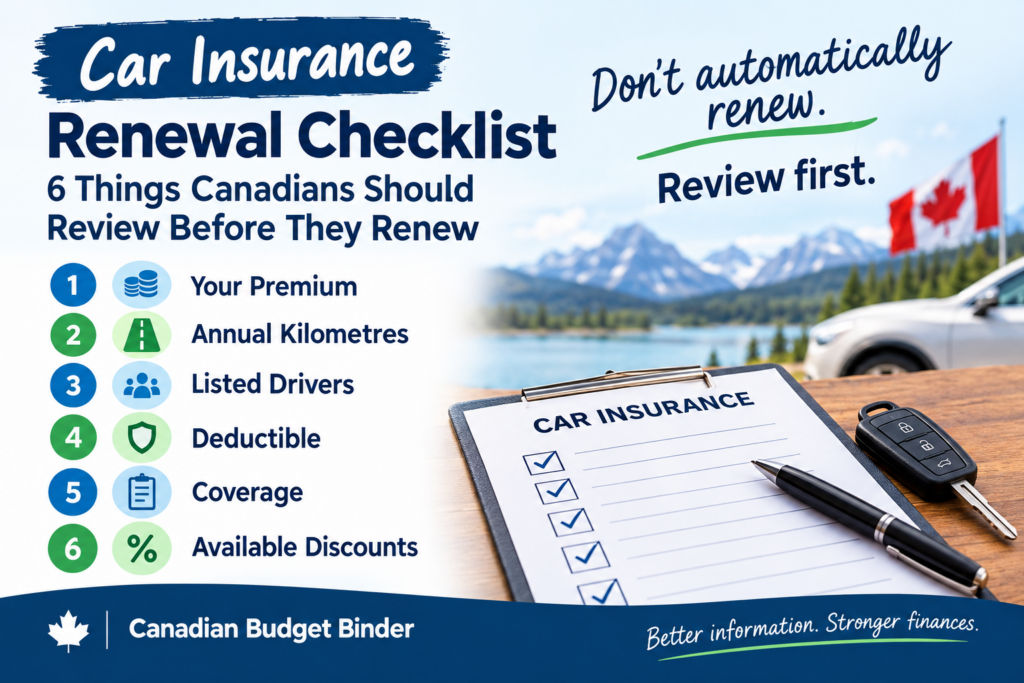
Review your premium, kilometres, drivers, deductible, and coverage. Ask about discounts and compare quotes using the same coverage amounts.
For Ontario drivers, the July 1, 2026, accident-benefit changes make it particularly important to review your policy.
A few minutes spent understanding your insurance now can help you make a more informed decision before you renew.
Discussion: What do you check when your car insurance renewal comes in? Have you ever found an error, missed a discount, or had a big price increase when you reviewed your policy?
Let us know in the comments — your experience might help another Canadian reader.
Disclaimer: This article is for general information only and is not insurance, legal, or financial advice. Insurance coverage, requirements and individual circumstances vary across Canada. Speak with a licensed insurance professional or your provincial insurance regulator about your specific situation.
Mr. CBB