

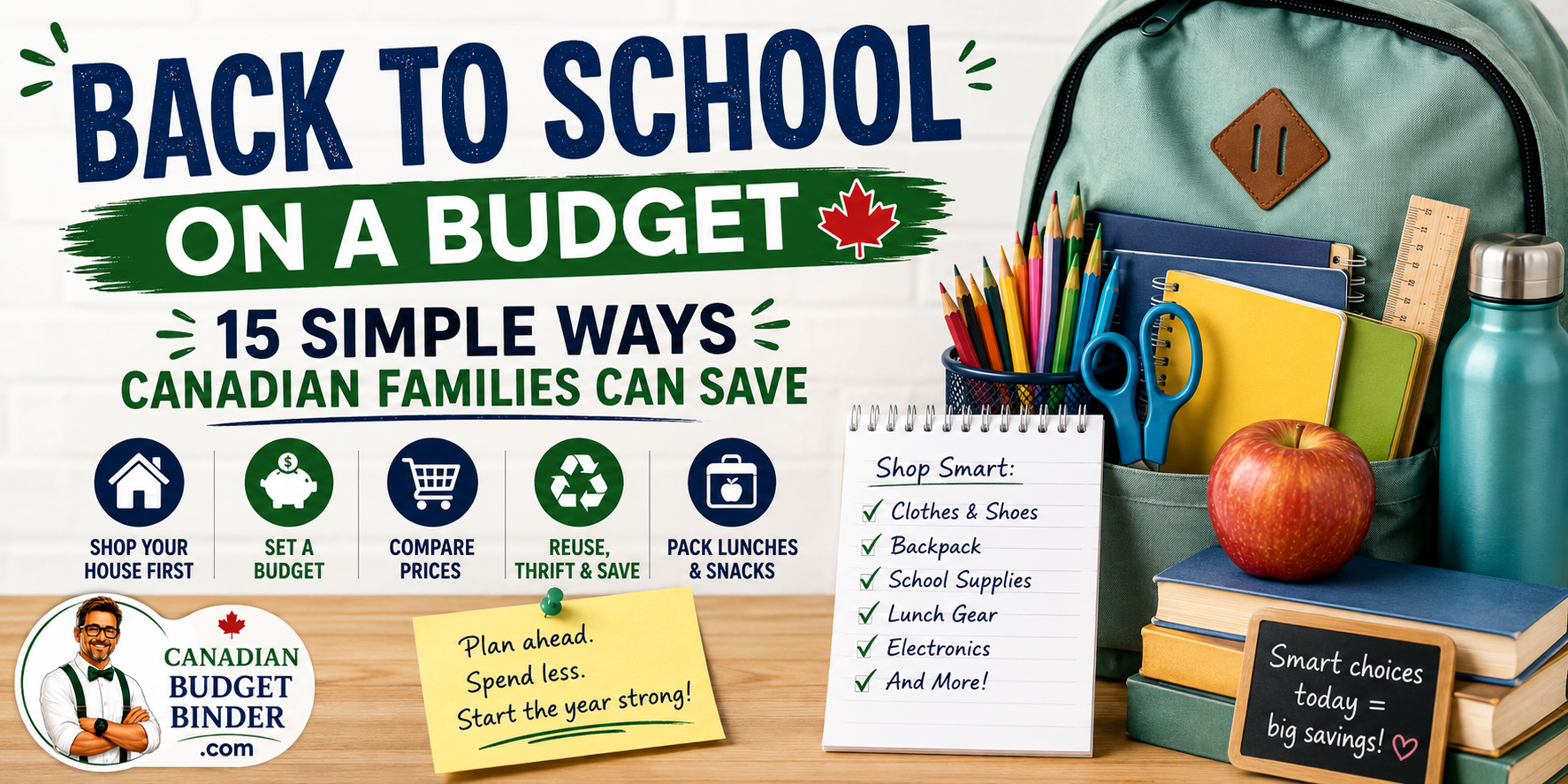

Back-to-school season can be exciting for kids, but it can also put plenty of pressure on the family budget.
New shoes, clothes, backpacks, lunch bags, water bottles, school supplies, and lunches can quickly turn into a sizeable bill — especially when you have more than one child heading back to class.
The good news is that starting a new school year doesn’t necessarily mean starting with everything new.
Before heading to the stores, take a look at what your family already owns, decide what actually needs replacing, and set a back-to-school budget.
Here are 15 practical ways Canadian families can save money on back-to-school shopping without taking the fun out of starting a new school year.
Looking for even more ideas? I also have an Ultimate Back-To-School Savings Guide with additional money-saving ideas for students and families.
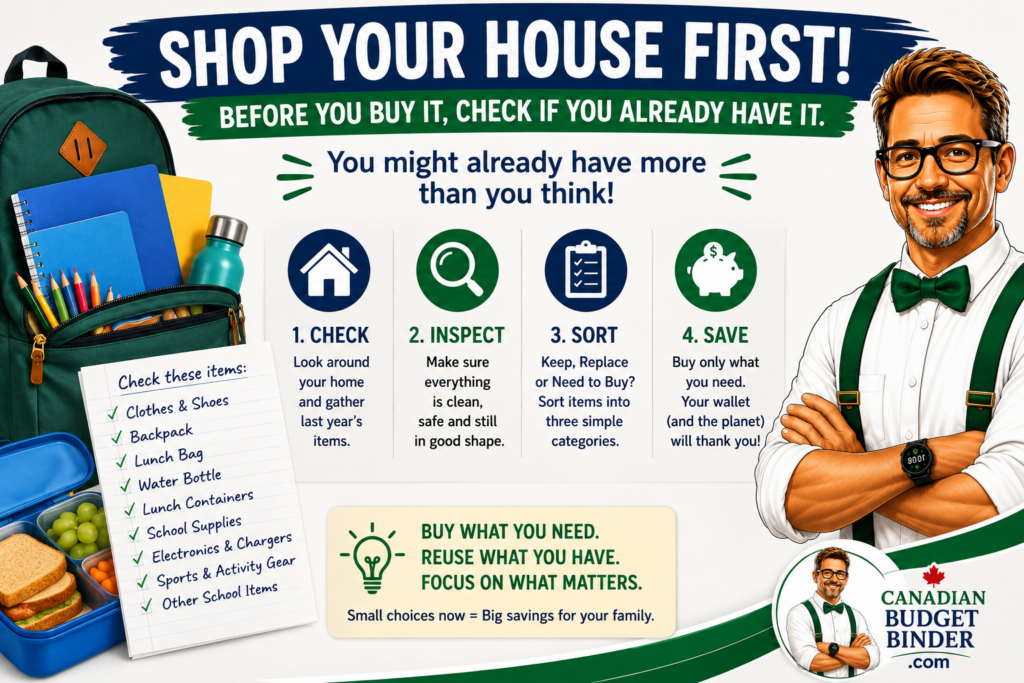
1. Shop Your House Before You Shop The Stores
Before buying anything, do a back-to-school inventory.
Gather last year’s school supplies, backpacks, lunch bags, reusable containers, water bottles, and other school gear.
Then go through your child’s closet and footwear.
Separate everything into three categories:
Keep: It fits and is still in good condition.
Replace: You own it, but it is worn out, broken, or no longer fits.
Need: You don’t already own the item, and your child needs it for school.
You may be surprised by how much you can cross off the shopping list without spending anything.
CBB Tip: Use the free CBB Back-To-School Inventory Checklist below to make this job easier.
2. Does Everything Need To Be New Every September?
There’s nothing wrong with buying your kids new clothes, shoes, or school supplies for September.
For many families, choosing a new outfit, a pair of shoes, or a backpack is part of the excitement of starting another school year.
But you don’t have to replace everything simply because September has arrived.
If last year’s backpack is still in great condition, why not use it?
The same goes for lunch bags, pencil cases, scissors, rulers, binders, reusable water bottles, and clothing that still fits.
One compromise is to let your child choose one or two special new items while reusing everything else that still works.
Back-to-school budgeting isn’t about taking something away from your children. It’s about deciding where your family’s money will make the biggest difference.
3. Set A Back-To-School Budget Before Shopping
Decide how much your household can comfortably spend before entering a store or filling an online shopping cart.
Create categories such as:
- Clothing
- Footwear
- Backpack
- Lunch bag and reusable containers
- School supplies
- Electronics or specialty items
- School fees or activities
- Miscellaneous expenses
Having one overall spending limit is helpful, but breaking it into categories makes it easier to see where the money is going.
If you spend more than expected in one category, you’ll know you may need to spend less somewhere else.
Canadian Budget Tip
The Financial Consumer Agency of Canada distinguishes between unexpected emergencies and occasional expenses, such as school supplies.
Back-to-school costs are predictable. We know they’re coming every year, which makes them something families can try to include in their regular budget rather than automatically relying on emergency savings or credit.
Use the free CBB Back-To-School Budget Planner below to compare what you planned to spend with what you actually spent.
4. Make A School Supply List — And Stick To It
School supplies can be inexpensive individually, which makes it easy to toss extra items into the cart.
A few dollars here and a few dollars there can add up.
Use the list provided by your child’s school or teacher when available and compare it with what you already have.
Before shopping, check drawers, desks, and cupboards for leftover notebooks, pencils, pens, erasers, rulers, binders, and other supplies.
Avoid buying multiples just because something is on sale unless you know your family will use them.
A bargain isn’t much of a bargain if it sits untouched in a cupboard.
5. Don’t Buy The Entire Wardrobe In August
You don’t necessarily need to purchase an entire fall and winter wardrobe before the first day of school.
Check what fits now and concentrate on immediate needs.
Kids grow quickly, and buying too far ahead can sometimes mean clothing gets little use before it’s outgrown.
Waiting also allows you to spread clothing expenses over several pay periods instead of putting the entire cost into August or September.
You may also find better prices later in the season.
6. Know About Children’s Clothing And Footwear Tax Relief
Here’s a Canadian back-to-school money-saving detail that’s easy to overlook.
Some provinces that use the HST provide a point-of-sale rebate on the provincial portion of the tax for qualifying children’s goods.
For example, in Ontario, qualifying children’s clothing and footwear receive a rebate of the 8% provincial portion of the HST. That means the retailer generally collects only the 5% federal portion on qualifying purchases.
There are rules and exclusions.
Qualifying children’s clothing is based on designated children’s sizes, and footwear has eligibility requirements. Certain items designed exclusively for sports or recreational activities, such as soccer cleats, skates, and ski boots, don’t qualify for the children’s footwear rebate.
Nova Scotia and Prince Edward Island also provide point-of-sale rebates on qualifying children’s clothing and footwear.
Check the current Canada Revenue Agency rules for your province and the item you’re buying.
7. Spend More Where Durability Matters
The cheapest option isn’t always the least expensive over time.
For items that receive heavy daily use — such as shoes, backpacks, and winter gear — consider both durability and price.
For example, an inexpensive backpack that needs replacing several times may ultimately cost more than a slightly more expensive one that lasts for several school years.
That doesn’t mean you need designer brands.
Look for a reasonable combination of price, construction, comfort, and the amount of use the item is likely to receive.
8. Check Thrift And Consignment Stores
Second-hand shopping can be particularly useful for children’s clothing because kids often outgrow items before wearing them out.
Consider checking:
- Thrift stores
- Children’s consignment shops
- Online marketplaces
- Local buy-and-sell groups
- Community clothing swaps
- Friends and family with older children
You may find clothing, backpacks, and other school items in excellent condition for much less than the cost of buying new.
Related: I’ve also shared more ideas for saving on back-to-school clothes by shopping at thrift and second-hand stores.
Safety Tip For Buying Used
Saving money is important, but so is product safety.
Health Canada recommends checking whether second-hand products have been recalled or banned before buying them.
Be especially cautious with products where condition and safety matter, including electronics, chargers, helmets, and certain children’s products.
For electrical products that plug into an outlet, Health Canada recommends looking for recognized Canadian certification marks such as CSA, cUL, or cETL.
9. Sell What Your Kids Have Outgrown
Back-to-school season is also a good time to clear out closets.
Clothes and shoes that no longer fit your child may still have plenty of life left.
Consider selling good-quality items through consignment stores or local marketplaces and putting the money toward this year’s school expenses.
If selling isn’t worth your time, passing usable items along to another family or donating them keeps them in circulation.
10. Compare Prices Instead Of Shopping At One Store
Convenience can cost money.
Before buying everything at the first store you visit, compare:
- Weekly flyers
- Store apps
- Online prices
- Loyalty offers
- Coupons
- Clearance sections
That doesn’t mean driving across town to save 25 cents on pencils.
Concentrate your comparison shopping on higher-cost items where the savings make the extra effort worthwhile.
Also, compare the final price rather than becoming distracted by a large percentage-off sign. A sale price at one retailer isn’t automatically lower than the regular price at another retailer.
11. Be Careful With Bulk School Supplies
A giant package isn’t automatically the cheapest choice for your family.
Check the unit price when possible and consider how much your household will realistically use.
Bulk purchases can work well if you have several children or know you’ll use the supplies throughout the year.
Otherwise, buying only what you need may leave more money available for other back-to-school expenses.
12. Give Last Year’s Backpack And Lunch Bag A Second Look
Backpacks and lunch bags can look pretty rough by June.
That doesn’t always mean they’re finished. Our son has used the same lunch box for three years, and his backpack finally retired after four years.
Empty them, clean them according to the manufacturer’s directions, and inspect the zippers, straps, and seams.
A good cleaning or minor repair may give an item another school year.
Do the same with reusable water bottles and lunch containers.
If something still works safely and does its job, replacing it is a choice rather than an automatic back-to-school expense.
13. Label Reusable School Items
Lost water bottles, lunch containers, sweaters, and other belongings can become an unexpected school expense.
Put your child’s name on reusable items where appropriate or use a label maker to attach to their belongings.
It won’t guarantee that everything comes home, but it makes it easier for a lost item to be returned to its owner.
Replacing something you’ve already purchased is one back-to-school expense we’d all rather avoid.
14. Pack Lunches And Snacks From Home
School lunches and snacks deserve their own place in the back-to-school budget because the expense continues long after September.
Individually packaged convenience foods can be handy, but they’re not your only option.
Depending on your child’s preferences and your grocery budget, consider fruit, vegetables, cheese, yogurt, sandwiches, homemade baked goods, and snacks portioned into reusable containers at home.
I’ve also put together 20+ Back-To-School Snacks For Every Budget with more ideas for families looking to keep school food costs under control.
Remember to follow your school or school board’s allergy and food policies when packing lunches and snacks.
15. Start A Back-To-School Fund For Next Year
Once this year’s shopping is finished, add up what you actually spent.
That number gives you a starting point for next year’s budget.
For example, if your family’s back-to-school expenses totaled $600, saving $50 per month for 12 months would give you $600 for next year’s expenses.
Years ago, I created a projected expenses budget for our family to save for upcoming purchases we know are on the way. Doing so means we won’t be shocked or have to interrupt our monthly budget while scrambling for money.
If $50 isn’t realistic, save what you comfortably can.
Even $10 or $20 each month reduces the amount you’ll need to find when next August arrives.
Consider setting up an automatic transfer into a savings account or sinking fund after payday.
The goal isn’t perfection.
It’s making a predictable annual expense easier to manage.
Free CBB Back-To-School Budget Printables
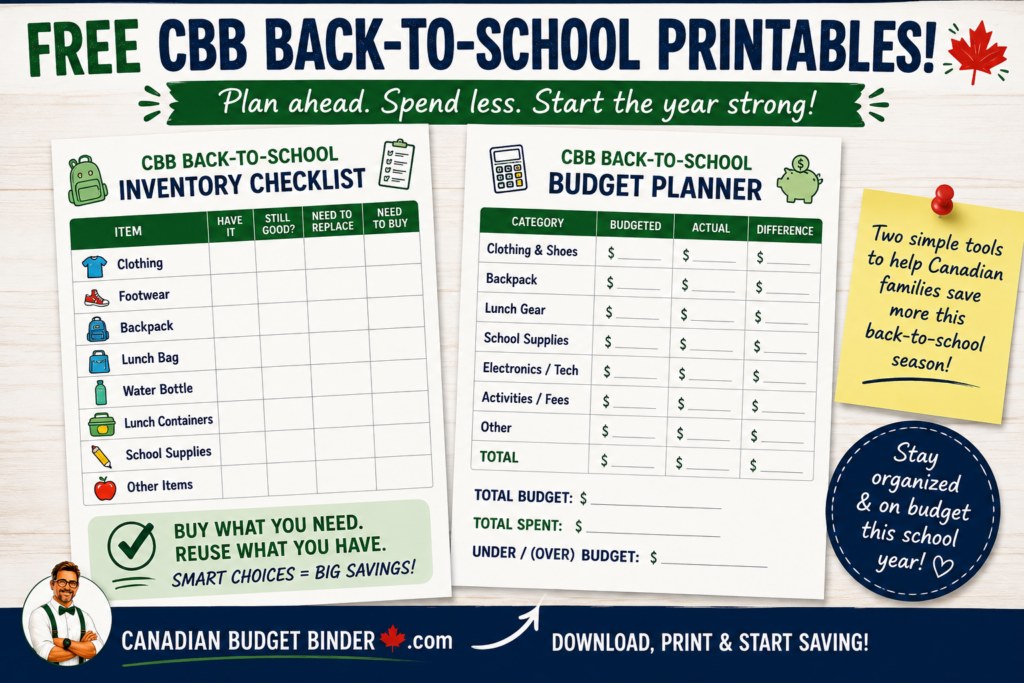
I’ve created two free Canadian Budget Binder printables to help you plan before you shop.
CBB Back-To-School Inventory Checklist
Use this checklist to go through what your family already owns.
You’ll be able to mark whether you already have an item, whether it still fits or works, whether it needs replacing, and whether you actually need to buy it.
[DOWNLOAD: CBB Back-To-School Inventory Checklist]
CBB Back-To-School Budget Planner
Decide how much you want to spend in each category before shopping.
Then record the actual cost and see whether your family finished under or over budget.
[DOWNLOAD: CBB Back-To-School Budget Planner]
Print both pages and complete the inventory before starting your shopping list.
You may find that one of the easiest ways to reduce your back-to-school spending is simply knowing what you already own.
Let Older Kids Help With The Back-To-School Budget
Back-to-school shopping can also provide a simple real-life money lesson.
If an older child wants a more expensive backpack, shoes, or clothing, show them the available budget.
For example:
“We have $100 available for shoes. These cost $70, and these cost $100. Which would you choose?”
There’s no need to turn every shopping trip into a financial lecture.
Giving children age-appropriate choices can help them understand that household spending involves priorities and trade-offs.
It can also give them some control over which purchases matter most to them.
Have an older student heading to college or university? My school budget guide for students goes further into planning for tuition, books, housing, food, transportation, and other educational expenses.
Back-To-School Savings Don’t Have To Mean Going Without
Saving money on back-to-school doesn’t mean your child can’t have anything new.
Maybe new shoes are important this year, but the backpack can last another year.
Perhaps most of their clothes still fit, leaving room in the budget for something they’re excited about.
Or maybe your family has deliberately saved all year and plans to buy everything new.
Every family’s financial situation, priorities, and traditions are different.
The goal isn’t to spend as little as humanly possible or make anyone feel guilty for buying something new.
It’s about looking at what you already have, deciding what your children actually need, and spending your back-to-school money intentionally.
Before putting something in the shopping cart, ask yourself one simple question:
Does this need replacing — or are we replacing it because it’s September?
Sometimes the answer will be, “Yes, we need it.”
Sometimes you’ll put it back and keep the money in your bank account.
Both can be good decisions when they’re part of your family’s plan.
Sources
Financial Consumer Agency of Canada — Setting up an emergency fund: FCAC explicitly lists school supplies as an occasional expense that should be planned for in a budget.
Government of Canada — Setting up an emergency fund
Canada Revenue Agency — Provincial point-of-sale rebates: This confirms the qualifying children’s clothing/footwear rules and that Ontario’s qualifying purchases are eligible for relief from the provincial HST portion.
CRA — Provincial point-of-sale rebate rules
Health Canada — Back-to-school and second-hand product safety: This supports our advice on recalls and electrical certification.
Health Canada — Back-to-school shopping safety