


Estimated reading time: 17 minutes
Which are the most expensive grocery stores in Canada?
It sounds like a simple question, but there is no official Canadian government ranking that puts grocery chains in order from most expensive to cheapest.
Statistics Canada tracks food inflation and average retail prices. The Competition Bureau studies grocery competition. Neither publishes an official national ranking declaring Metro, Sobeys, Loblaws, Save-On-Foods or another chain Canada’s most expensive grocery store.
That’s an important distinction.
When I originally wrote this article, I included my own observations about Canadian grocery stores I considered expensive, particularly here in Ontario. After years of grocery shopping, budgeting and comparing prices, I still believe there can be a noticeable difference between stores.
However, a personal observation isn’t the same thing as a Canada-wide price study.
For this update, I want to look at what Canadian data actually tells us, explain the difference between full-service and discount grocery stores, look at who owns many of Canada’s major grocery banners, and most importantly, show you how to determine whether your grocery store is expensive for the food your family buys.
Is There A Most Expensive Grocery Store In Canada?
The short answer is no—not according to any official national ranking I could find.
A grocery store that feels expensive in one Ontario community may have different prices than another location operating under the same banner.
Prices can vary based on:
- Province and city
- Individual store location
- Local competition
- Regular price versus sale price
- Loyalty or member pricing
- Brand
- Package size
- Seasonal availability
- Online versus in-store shopping
- The products your household buys most often
That’s why I would be cautious about any list declaring one chain the definitive most expensive grocery store in Canada without explaining how the prices were collected.
Was the same product compared?
Was it the same package size?
Were sale prices mixed with regular prices?
Were stores across Canada included, or just one city?
Those details matter.
A much more useful question is:
Which grocery store is most expensive for your household where you live?
That’s something you can actually measure.
Canadian Grocery Prices Remain A Concern
Canadian families have good reason to pay close attention to grocery prices.
Statistics Canada reported that prices for food purchased from stores were 3.1% higher in July 2026 than in July 2025.
That was slightly higher than the overall Consumer Price Index increase of 3.0%.
July 2026 was also the 18th consecutive month in which grocery-price inflation was higher than overall inflation.
The Competition Bureau also noted that grocery prices rose approximately 22% between 2022 and 2025, compared with about 13% for other consumer prices, citing Bank of Canada data.
Even when the rate of grocery inflation slows, that doesn’t necessarily mean grocery prices have returned to where they used to be.
Prices can rise more slowly while remaining much higher than they were several years ago.
That’s one reason many Canadians continue to feel pressure at the grocery store.
Average Grocery Prices In Canada
Statistics Canada’s Food Price Data Hub publishes average retail prices for selected grocery products across Canada.
Here are several examples from July 2026:
- Milk, 2 litres — $5.53
- White bread, 675 g — $3.60
- White rice, 2 kg — $9.62
- Butter, 454 g — $5.92
- Ground beef, per kg — $16.49
- Chicken breasts, per kg — $14.68
- Eggs, 1 dozen — $4.95
- Apples, per kg — $6.45
- Bananas, per kg — $1.88
- Tomatoes, per kg — $4.98
- Vegetable oil, 3 litres — $10.23
These figures are useful as broad Canadian benchmarks, but they should not be treated as proof that a particular grocery store is cheap or expensive.
Average retail prices can be affected by brand, package size, quality, regional differences, and what consumers are buying.
This is Canadian grocery-price data—not a grocery-store ranking.
Canada’s Grocery Market Is Highly Concentrated
One thing we do know is that Canada’s grocery industry is concentrated.
The Competition Bureau has identified five companies that account for much of Canadian grocery spending:
- Loblaw
- Empire/Sobeys
- Metro
- Costco
- Walmart
That can be confusing because the grocery-store’s name above the door isn’t necessarily the parent company’s name.
A shopper could visit No Frills one week and Real Canadian Superstore the next and still be shopping within the Loblaw family.
Someone could shop at Sobeys, FreshCo, Farm Boy or Safeway and be shopping within the Empire family.
Understanding who owns Canada’s grocery banners makes it easier to understand the market.
Who Owns Canada’s Major Grocery Stores?
Here are some of the major grocery families and selected banners operating in Canada.
Loblaw Companies Limited
Selected banners include:
- Loblaws
- No Frills
- Maxi
- Real Canadian Superstore
- Atlantic Superstore
- Your Independent Grocer
- Zehrs
- Fortinos
- Provigo
- Dominion
- Valu-mart
- T&T
Empire Company / Sobeys
Selected banners include:
- Sobeys
- Safeway
- IGA
- Foodland
- FreshCo
- Chalo! FreshCo
- Farm Boy
- Longo’s
- Thrifty Foods
Metro Inc.
Selected banners include:
- Metro
- Metro Plus
- Food Basics
- Super C
- Adonis
- Marché Richelieu
Pattison Food Group
Selected banners include:
- Save-On-Foods
- Buy-Low Foods
- Nesters Market
- Quality Foods
- PriceSmart Foods
- Urban Fare
Walmart Canada
Walmart operates grocery departments in many Walmart and Supercentre locations across Canada.
Costco Wholesale
Costco operates warehouse clubs using a membership-based retail model.
This isn’t intended to be a complete list of every Canadian grocery banner. Store availability also varies considerably by province and region.
Discount Grocery Stores Vs. Full-Service Grocery Stores
This is where the discussion about expensive grocery stores becomes more useful.
Rather than trying to rank every grocery chain from cheapest to most expensive, consider the type of store you’re shopping in.
Discount Grocery Stores
Discount grocery stores operate using a lower-cost retail model.
Depending on the chain, that can include:
- Simpler store layouts
- Fewer service departments
- More private-label products
- Smaller or more focused product selections
- Reduced operating costs
- A greater emphasis on everyday value
Major Canadian examples include:
- No Frills
- Maxi
- FreshCo
- Food Basics
- Super C
These banners are specifically positioned as discount grocery formats by their parent companies.
That doesn’t mean every single product at a discount store will always be cheaper.
A full-service store may have an excellent sale.
A loyalty promotion may change the price.
One store may be cheaper for meat while another is cheaper for produce.
But the overall store format is different.
ALSO READ: Cheapest Canadian Grocery Stores
If you want to look at the value side of grocery shopping, check out my related Canadian Budget Binder guide to the cheapest grocery stores in Canada.
Full-Service And Specialty Grocery Stores
Full-service supermarkets generally compete on more than price alone.
Depending on the store, you may find:
- Larger fresh-food departments
- Butcher counters
- Bakery departments
- Deli counters
- Prepared meals
- Specialty ingredients
- International foods
- Premium private-label products
- Larger selections
- Additional customer services
Those services have value if you use them.
Someone looking for a specific cut of meat, prepared dinner or specialty ingredient may be perfectly happy shopping at a full-service grocery store.
Another shopper feeding a family on a bare-bones grocery budget may care much more about the regular prices of eggs, milk, butter, bread, meat and produce.
Neither shopper is wrong.
The problem begins when you’re paying for a shopping experience that doesn’t provide enough value for your household.
Are Full-Service Grocery Stores More Expensive?
They certainly can be, particularly when you’re comparing regular prices on basic groceries with a discount-format sister banner.
However, I would not make a blanket statement that every Loblaws, Sobeys, Metro, Safeway, Save-On-Foods, Farm Boy, Longo’s or other full-service store is always more expensive than every discount grocery store.
Grocery pricing isn’t that simple.
Promotions change constantly.
Competition differs between communities.
Private-label products make direct comparisons difficult.
Some independent and ethnic grocery stores can beat large chains on produce, meat or international ingredients.
Warehouse clubs may offer excellent unit prices while encouraging shoppers to buy quantities they don’t actually need.
The cheapest place to buy chicken isn’t necessarily the cheapest place to buy cereal.
That’s why CBB has always encouraged readers to know their prices.
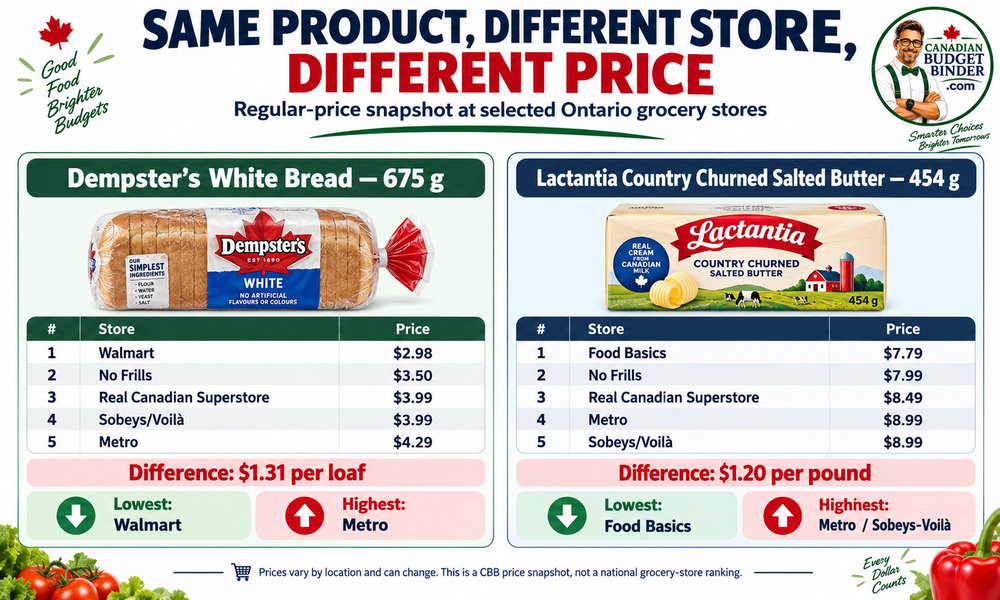
Same Product, Different Store, Different Price
To illustrate why grocery-store comparisons can be useful, I compared the regular or identified pre-sale price of the same products at selected Ontario grocery retailers.
This is a CBB price snapshot, not a national grocery-store ranking.
Prices can vary by location and change at any time.
Dempster’s White Bread — 675 g
- Walmart — $2.98
- No Frills — $3.50
- Real Canadian Superstore — $3.99
- Sobeys/Voilà — $3.99
- Metro — $4.29
The difference between the lowest and highest price was:
$1.31 per loaf
For the identical product, Metro’s price was approximately 44% higher than Walmart’s regular price in this comparison.
Lactantia Country Churned Salted Butter — 454 g
- Food Basics — $7.79
- No Frills — $7.99
- Real Canadian Superstore — $8.49
- Metro — $8.99
- Sobeys/Voilà — $8.99
The difference between the lowest and highest price was:
$1.20 per pound of butter
In this snapshot, the highest price was approximately 15% more than the lowest price for the identical product.
Again, this does not prove that Metro or Sobeys is always the most expensive store or that Walmart or Food Basics is always the cheapest.
It demonstrates something much simpler:
The same grocery item can have a noticeably different regular price depending on where you shop.
That’s why comparing the products your household buys repeatedly can make such a difference.

How I Learned Canadian Grocery Prices
When I moved to Canada, I didn’t have a mental grocery price book.
I didn’t know whether the price I was looking at was excellent, average, or expensive.
That took time.
I started reading Canadian grocery flyers, using coupons, and visiting different grocery stores simply to look around and compare prices.
It might sound a bit obsessive, but it taught me something I’ve carried with me ever since:
A sale sign doesn’t tell you whether something is a good deal. Knowing the normal price does.
Eventually, you start recognizing the prices of the products your household buys regularly.
- You know when peanut butter is actually cheap.
- You know what you’re willing to pay for chicken breasts.
- You notice when a package gets smaller.
- You recognize the difference between a genuine stock-up price and a flashy advertisement.
That’s far more valuable than memorizing somebody else’s list of Canada’s ten cheapest or ten most expensive grocery stores.
The CBB Grocery Basket Test: Is Your Store Expensive?
If you really want to know whether your grocery store is expensive, build your own comparison.
Choose approximately 15 to 20 grocery products your household buys regularly.
Don’t use unusual items you purchase once a year.
Use boring, everyday groceries because repeated purchases are where savings add up.
Your basket could include:
- Milk
- Eggs
- Bread
- Butter
- Bananas
- Apples
- Potatoes
- Rice
- Pasta
- Cereal
- Coffee
- Peanut butter
- Cheese
- Chicken
- Ground beef
- Household staples
Then compare that same basket at the grocery stores you could realistically shop at.
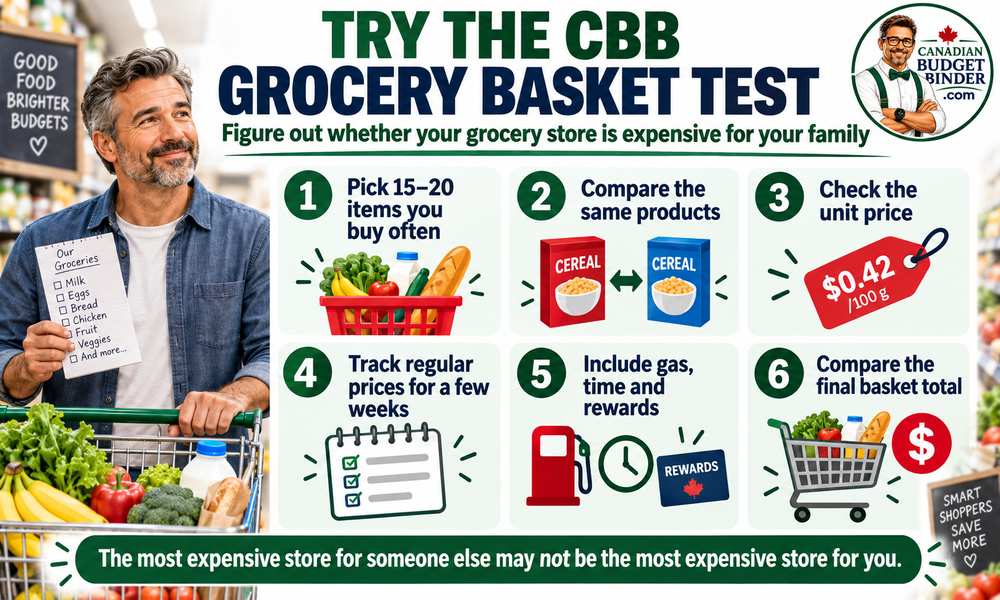
1. Compare Regular Prices
Sales matter, but first learn the store’s normal pricing.
A store can advertise three fantastic flyer deals while charging more on many of the other items going into your cart.
2. Compare The Same Product
Whenever possible, compare the same:
- Brand
- Package size
- Weight
- Variety
If you can’t compare identical products, use the unit price.
3. Check The Unit Price
Compare prices by:
- 100 grams
- Kilogram
- Litre
- 100 millilitres
- Individual unit where appropriate
A $5 package isn’t automatically cheaper than a $7 package if the $7 package contains substantially more product.
Unit pricing is one of the easiest ways to spot the real deal.
4. Track Regular Prices For A Few Weeks
One grocery trip can produce a misleading result.
Track your basket for several weeks.
This helps smooth out temporary promotions and gives you a better idea of each store’s typical pricing.
5. Include Gas, Time And Rewards
This part gets forgotten.
Driving across town to save $3 doesn’t necessarily save you $3.
Consider:
- Fuel
- Vehicle costs
- Your time
- Useful loyalty rewards
- Delivery or pickup fees
If you live in a smaller or rural community, you may have very limited grocery competition.
The theoretically cheapest grocery store isn’t much help if it’s 60 kilometres away.
6. Compare The Final Basket Total
At the end of your test, add everything up.
You may discover that the store everyone calls expensive is surprisingly competitive for the products your family actually buys.
Or you may discover that convenience has quietly been costing you $10, $20 or more every week.
Either way, you’ve learned something useful.
The most expensive grocery store for somebody else may not be the most expensive grocery store for you.
Why An Expensive Grocery Trip Isn’t Always About The Store
One lesson Mrs. CBB and I learned years ago involved something as simple as peanut butter.
We needed it.
We’d already been busy.
Rather than buying it where we’d previously seen the better price, convenience won.
It wasn’t a financial disaster.
It was a few dollars.
But that’s often how grocery budgets get away from us.
It’s rarely one spectacular mistake.
It’s an extra dollar here.
Another two dollars there.
An impulse purchase.
Something bought for convenience.
A product we could have waited to buy on sale.
We also learned that making a special trip to Costco for one supposedly better-priced product could result in coming home with far more than one product.
The cheapest shelf price doesn’t save you money if the shopping trip causes you to spend more overall.
How To Spend Less At Expensive Grocery Stores
You don’t necessarily have to stop shopping at a full-service grocery store.
Sometimes the smartest strategy is using different stores for different purposes.
Shop Your Grocery Flyer Before You Shop The Store
Build part of your meal plan around foods that are genuinely on sale.
Not every flyer promotion is a good deal, which is why knowing your regular prices helps.
Make A Discount Store Your Baseline
If you have a discount grocery store nearby, price your regular grocery basket there.
Use that as a baseline when comparing other stores.
You don’t have to buy everything there.
You’re simply establishing what your normal groceries would cost.
Buy Store Brands When They Make Sense
Private-label groceries can save money, but don’t assume they’re automatically cheaper.
Compare the unit price and decide whether you like the quality.
Stock Up At Your Best Price
When something your household regularly uses reaches a genuinely good price, buying a little extra can lower future grocery costs.
But don’t buy six just because they’re cheap if your family will only use two.
Food waste costs money, too.
Check Reduced Food
Reduced produce, meat, bakery products and dairy can offer excellent savings if you can safely use or freeze them.
We’ve also used Flashfood for years as another way to reduce grocery costs.
Don’t Chase Loyalty Points
Rewards programs can be useful.
Overspending to earn rewards isn’t.
Always compare what you’re spending with what the points are actually worth.
Compare Warehouse Club Prices Carefully
Costco can have excellent unit prices.
But bigger doesn’t automatically mean cheaper.
Consider:
Price + membership + food waste + impulse spending
against what you would realistically have spent elsewhere.
Limit Grocery Store Hopping
Driving to five stores every week to save a few dollars can become a false economy.
If two stores are already close together and both have worthwhile deals, that may make sense.
Otherwise, sticking with one primary value store and shopping strategically may work better.
Use Price Matching Where Available
Some Canadian grocery retailers offer price matching, but policies change.
Check your local store’s current rules rather than relying on an old list online.
Your Cheapest Grocery Store Can Change
One of the biggest grocery-shopping mistakes is becoming too loyal to one store.
Stores change.
Prices change.
Promotions change.
Management changes.
Your family’s eating habits change.
The best store for us today may not be the best store six months from now.
That’s why I consider myself budget loyal rather than store loyal.
If Store A gives me the best overall value this month, great.
If Store B becomes better, I’ll shop there.
Loyalty should be earned through price, quality, service and convenience—not simply because you’ve always shopped under the same sign.
Grocery Competition In Canada Matters
Individual grocery-shopping strategies can help us save money, but consumers don’t control the entire grocery market.
The Competition Bureau has concluded that Canada’s grocery industry is concentrated and that stronger competition could provide consumers with lower prices, more choice, and greater innovation.
Areas of concern and recommendations have included:
- Supporting independent grocers
- Encouraging new grocery competitors
- Improving unit-price information
- Reducing barriers that make it difficult for competing stores to enter certain markets
- Examining property controls that can restrict grocery competition
The federal government and the Competition Bureau have continued to examine competition throughout Canada’s food supply chain.
The Canada Grocery Code was also fully implemented on January 1, 2026, as a voluntary, industry-led code.
The Competition Bureau launched a broader examination of Canada’s food supply chain in 2026, looking at competition and pricing throughout production, processing, transportation, distribution, and retail.
So this discussion goes far beyond whether one particular bag of potatoes costs more at one supermarket.
It’s also about how many realistic grocery-shopping choices Canadians have where they live.
What Is The Most Expensive Grocery Store In Canada?
If you arrived here because you searched that exact question, here’s my answer:
There is no authoritative national ranking identifying one chain as Canada’s most expensive grocery store.
Full-service and specialty grocery banners may have higher regular prices on many products than discount-format competitors, but it would be misleading to rank every Canadian grocery chain without:
- A consistent grocery basket
- Identical products
- The same dates
- Representative stores
- Multiple Canadian regions
- A transparent methodology
Instead, determine which grocery store is the most expensive for you.
- Build your grocery basket.
- Compare identical products.
- Check unit prices.
- Track prices for a few weeks.
- Include transportation and useful rewards.
- Then compare your final totals.
That answer will be much more useful to your grocery budget than somebody else’s Top 10 list.
Frequently Asked Questions About Expensive Grocery Stores In Canada
Which Grocery Store Is The Most Expensive In Canada?
There is no official Canadian government ranking naming Canada’s most expensive grocery store.
Prices vary by location, products, store format and promotions.
Are Loblaws, Sobeys, and Metro More Expensive Than Discount Stores?
They can be more expensive for certain products, but there is no rule that every product will always cost more.
No Frills and Maxi are discount formats within Loblaw.
FreshCo is a discount banner within Empire/Sobeys.
Food Basics and Super C are discount banners within Metro.
The better comparison is the price of the products your household actually buys.
What Are Some Discount Grocery Stores In Canada?
Major examples include:
- No Frills
- Maxi
- FreshCo
- Food Basics
- Super C
Availability varies by province and community.
Walmart and Costco also compete heavily for Canadian grocery spending, although they use different retail models.
Is Costco Always Cheaper For Groceries?
No.
Costco can offer excellent unit prices on some products, but shoppers should also consider:
- Package size
- Membership cost
- Food waste
- Storage space
- Impulse purchases
A lower unit price isn’t a saving if half the product gets thrown away.
How Can I Tell If My Grocery Store Is Expensive?
Create a basket of 15 to 20 foods your household regularly buys.
Compare identical products or unit prices at nearby stores over several weeks.
The store that consistently produces the highest realistic total for your basket is the expensive store for you.
Why Are Grocery Prices Still High In Canada?
Many things affect food prices, including:
- Production costs
- Transportation
- Labour
- Imports
- Currency movements
- Weather
- Supply chains
- Commodity prices
- Competition
That’s why grocery prices can behave differently from other parts of the Consumer Price Index.
Final Thoughts From Mr. CBB
I started comparing grocery stores because I wanted to understand where our money was going.
Years later, the basic lesson hasn’t changed.
You don’t need to memorize the price of every grocery product in Canada.
You need to know the prices of the products you buy.
Learn your regular prices.
Use a grocery price book.
Compare unit prices.
Shop sales when they make sense.
Use discount stores when they offer better value.
And don’t spend $10 in fuel and impulse purchases trying to save $3 on groceries.
There may not be an official most expensive grocery store in Canada, but once you understand your own grocery basket, you’ll know exactly which stores deserve more—or less—of your grocery budget.
Discussion: Which grocery stores tend to be more expensive where you live in Canada, and which stores give you the best value?
Share your experience in the comments and let us know your province or general region. You don’t need to share your exact location.
— Mr. CBB