


Imagine buying the same box of cereal from the same grocery store at the same time as someone else, only to discover that you were shown a higher price. Neither of you used a coupon, and the difference wasn’t a regular sale. Instead, a computer system had worked out what it thought each of you would be willing to pay.
That’s the concern behind surveillance pricing. It’s a term Canadians are hearing more often as grocery retailers introduce digital technology and shoppers use loyalty cards, grocery apps and online ordering.
After hearing food policy expert Dr. Sylvain Charlebois discuss the subject, I wanted to take a closer look. Are Canadian supermarkets actually doing this? Is a personalized loyalty offer the same thing? And what can a budget-conscious family do to stay informed?
The important fact up front: As of October 21, 2026, I have not found verified public evidence that major Canadian grocery chains are secretly increasing an individual shopper’s prices using their personal data. That’s not the same as saying the technology doesn’t exist, or that Canadians have nothing to consider. CityNews Montreal reported that Loblaw, Sobeys and Metro said they had no plans to use surveillance pricing, and Charlebois said there was no evidence Canadian grocers were using it.
Let’s separate what we know from what could happen.
Illustration: The featured image is conceptual and does not depict a documented Canadian grocery store using surveillance pricing.
Surveillance pricing in Canada: the short version
- No proven Canadian grocery case: Major chains have not been shown to secretly increase individual prices using customer profiles; three chains told CityNews they had no plans to do so.
- Personalized deals do exist: Loyalty apps and member offers can use shopping data to offer certain customers discounts. That does not establish secret, data-driven price increases.
- Consumer protection is evolving: Manitoba has new protections in force. Ontario has proposed a law, but it has not passed.
What is surveillance pricing?
Surveillance pricing generally describes the use of information about a customer to influence the price that customer sees or pays. A retailer might use automated software, data analysis or artificial intelligence to estimate what a particular shopper is prepared to spend.
Potential inputs include purchase histories, shopping-app activity, browsing behaviour, approximate location, demographics, device information and predicted willingness to pay. Canada’s Competition Bureau explains that personalized algorithms can tailor prices to individuals or groups using consumer information.
A hypothetical grocery example: Two people order the identical 500-gram box of cereal from the same store at the same time. One sees $4.49 and the other sees $5.49 because a system predicts the second person will pay more. That is the kind of individualized pricing consumers worry about. This is an illustration, not a documented Canadian grocery incident.
One striking detail from Ontario: Proposed Bill 104 specifically lists someone’s employment pay period or financial-assistance payment schedule among the kinds of information that might be used in personalized algorithmic pricing. This is a list of possible data inputs in a proposed law—not a finding that grocery stores are already tracking Canadians’ paydays or benefit deposits to set prices.
The risk isn’t simply that a computer changes prices. It’s that personal information could affect what one individual pays without that person clearly understanding why.
Is this happening in Canadian supermarkets now?
There is an important difference between a documented current practice and a potential future risk.
Canadian grocery loyalty programs already provide personalized offers, and online platforms can display different promotions to different members. But those facts alone do not prove that stores secretly raise individual prices because a customer’s shopping profile suggests they will tolerate a higher price.
In an October 12, 2026, CityNews Montreal interview, Dr. Sylvain Charlebois, director of Dalhousie University’s Agri-Food Analytics Lab, discussed the ethical questions. The story reported that Loblaw, Sobeys and Metro said they had no plans to implement surveillance pricing, while Charlebois said there was currently no evidence Canadian grocery stores were using it.
We should continue watching the issue without accusing any retailer of conduct that hasn’t been established.
Surveillance pricing, dynamic pricing and loyalty offers are not the same
These terms can be confusing, so here’s a practical comparison.
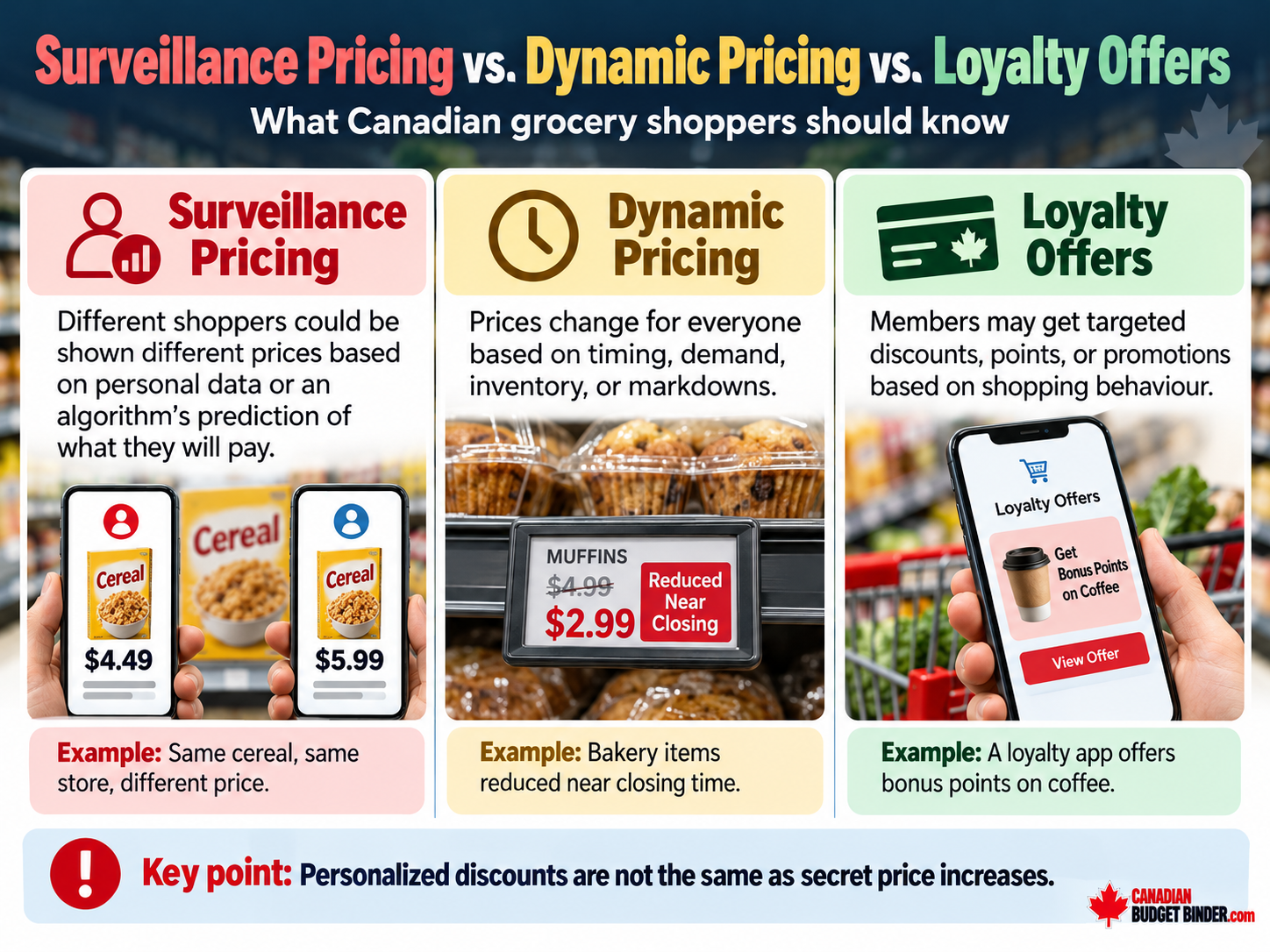
Regular pricing: Everyone sees the same $5.99 shelf price for an item. This is a common posted price.
Dynamic pricing: A bakery markdown lowers the price for everyone later in the day. Prices may change with time, inventory or demand, not necessarily with a customer’s identity.
Personalized loyalty offer: Your grocery app offers you $1 off coffee, perhaps because of your purchase history. That’s a targeted promotion, not proof of a hidden price increase.
Surveillance pricing: An online shopper is quoted more because their data profile suggests they may be willing to pay more. The price itself is tailored using customer information.
Real-world systems can combine methods, so the dividing lines aren’t always perfect. But it is misleading to call every coupon, digital price tag or price difference surveillance pricing.
What information do grocery loyalty programs collect?
Many Canadians use loyalty programs because points and coupons can genuinely reduce grocery costs. That’s understandable. But it is worth knowing what we give up in exchange for those benefits.
PC Optimum: The program offers personalized promotions. Purchase and account information can play a role in how offers are tailored. This is not proof of individualized price increases.
Moi Rewards: Metro’s Moi Rewards program terms specifically mention exclusive member prices and, where applicable, personalized prices on selected products. That is an important example of Canadian personalized promotional pricing; it does not establish secret surveillance-based increases.
My approach: Use rewards on things you already planned to buy, but compare the final cost against the price you could pay elsewhere. Points should help the grocery budget, not become a reason to spend more.
For additional savings ideas, see our 2026 Canadian coupon and grocery coupon guide.
Why grocery-data privacy matters: the PC Optimum investigation
A real Canadian privacy case helps explain why the questions about customer data deserve attention.
On March 5, 2026, the Office of the Privacy Commissioner of Canada published findings about Loblaw’s retention of data from former PC Optimum members. The investigation described the retention of loyalty, browsing, device and historical transaction information after accounts had closed. It concluded that Loblaw had not demonstrated adequate anonymization of retained data and identified other privacy-compliance concerns. Loblaw disagreed with aspects of the findings and agreed to further assessment and risk-reduction measures.
This was a privacy investigation, not a finding that Loblaw used surveillance pricing. It illustrates a different but related question: how long does a company retain what it knows about our shopping behaviour, and could that information be linked back to us?
What happened with Instacart in the United States?
A December 2025 investigation by Consumer Reports, Groundwork Collaborative and More Perfect Union found that shoppers on the American Instacart platform sometimes saw different prices for the same product, from the same store, at the same time.
The research involved 437 volunteer shoppers across four cities, who recorded displayed prices rather than completing actual purchases. According to the published methodology and dataset, 193 submissions were sufficiently complete for the final analyses, an important detail when interpreting the figures. Researchers reported the following price differences in the tested products and baskets, not a measure of what Canadian households currently pay:
- Approximately 74% of tested grocery items appeared at multiple prices.
- For some items, the highest observed price was 23% above the lowest.
- The spread between the highest and lowest basket totals averaged about 7% across the tests.
These were U.S. tests, not Canadian grocery prices. The results do not mean every household paid 7% more, nor do they establish why any particular shopper was assigned a price.
On December 22, 2025, Instacart announced it was ending the item-price experiments. Instacart said the experiments were not based on personal information, demographics or individual shopping behaviour.
The bottom line: The investigation documented different customer prices; it did not prove surveillance pricing driven by individual personal data. Both findings and limitations belong in the conversation.
Do electronic grocery shelf labels mean surveillance pricing?
Not by themselves. Electronic shelf labels are small digital price displays used instead of paper tags. Stores can update them centrally, making it easier to change promotions or correct prices.
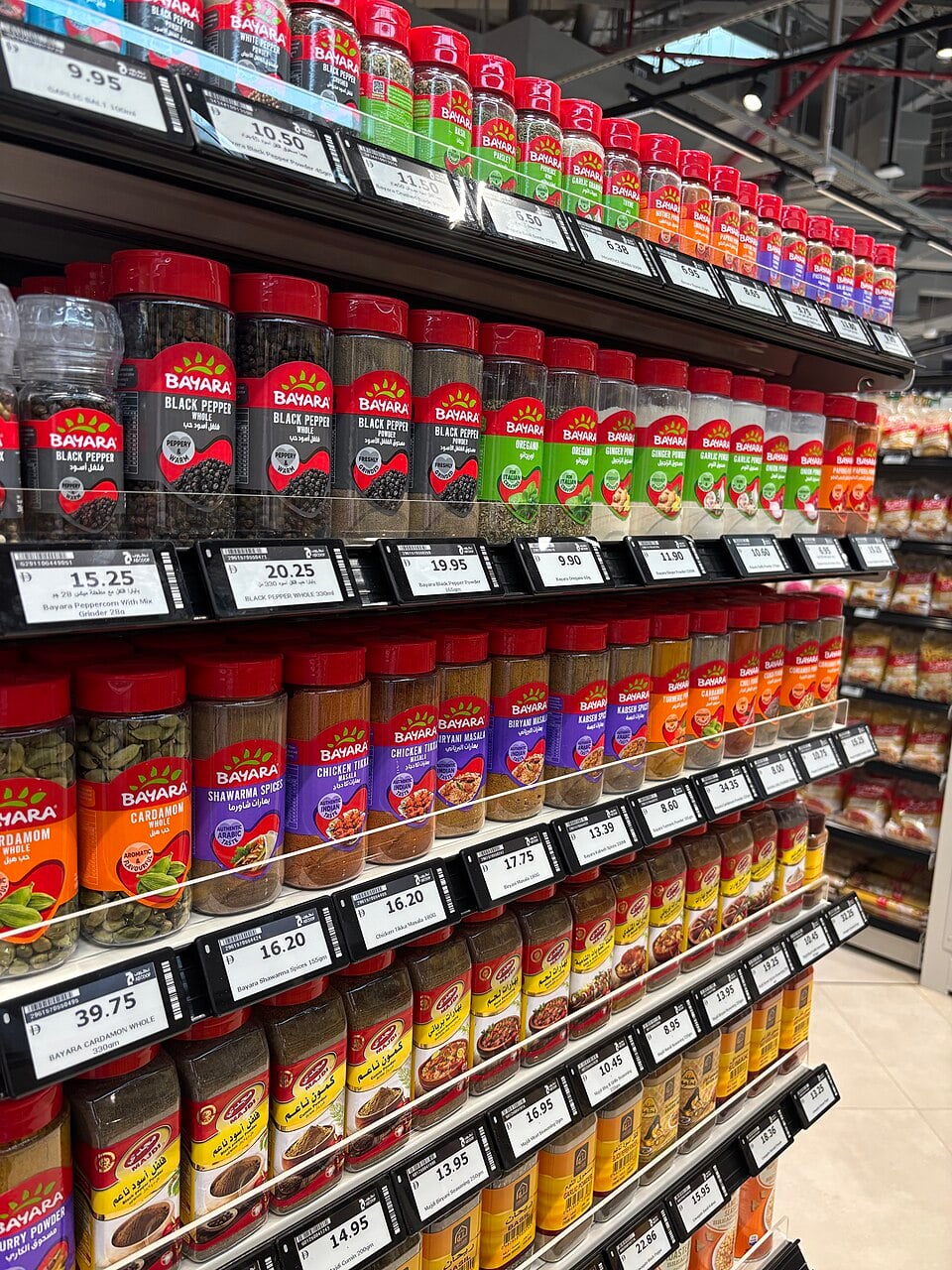

A digital tag doesn’t necessarily know who is looking at it. If everyone is offered the same updated price, that’s not surveillance pricing. Concern arises when the displayed or charged price is tied to an identifiable shopper’s data.
Remember, a shelf-versus-checkout discrepancy is a different issue from surveillance pricing. Canadian shoppers can read our updated guide to the Scanner Price Accuracy Code (SCOP) to understand participating retailers, eligibility requirements and what to do about eligible scanning errors. The Code is voluntary in participating jurisdictions; Quebec has separate regulated rules. The Retail Council of Canada also explains that loyalty or membership-based prices are not covered by the voluntary Code, so a member-price difference is not automatically an eligible scanning error.
How would this work when you’re actually grocery shopping?
Let’s make it simple. Imagine you’re standing in a grocery aisle looking at the same box of Cheerios as another customer. The shelf label says $5.49. What happens next depends on the kind of pricing the store is using.
- Ordinary shelf price: Both of you see $5.49 and, without any special offer, expect to pay $5.49 at checkout.
- Competitive or dynamic price change: The store decides to lower Cheerios to $3.99 to compete with a nearby grocer. Once the shelf display and checkout price are properly updated, the new advertised price applies generally to shoppers at that store. An electronic label makes this update easier; it does not need to identify you.
- Personalized loyalty discount: The shelf still says $5.49, but your account has an eligible $1-off offer. If you use it, you pay $4.49. Another customer without that offer pays $5.49. Canadians already encounter this kind of discount; it does not prove secret price increases.
- Hypothetical surveillance pricing: You sign into a grocery app and are shown $5.49 for the same product, while another signed-in shopper is shown $6.49 because the system uses personal information to predict what each person may be willing to pay. That’s an example of a personalized price, not an example established at a Canadian supermarket.
What happens when three shoppers see the same shelf price?
Now picture three people standing beside a $2.99 bag of chips. An ordinary electronic shelf label doesn’t change to three different prices just because three different people are looking at it. It usually shows one common price. A store wanting to provide individualized prices in person would need another way to identify shoppers and communicate their offers or prices, such as signed-in shopping apps, loyalty accounts or connected shopping devices. Those possibilities should not be confused with evidence that stores are actually doing this.
What if the shelf says $2.99 but the checkout rings up $3.49 because the store changed its common price while you shopped? That’s a shelf-and-checkout price discrepancy, not automatically surveillance pricing. You should question the charge and check the applicable price-accuracy rules; don’t assume you have to accept an undisclosed higher amount. A clearly stated loyalty discount is a different situation again.
Finally, think of someone shopping with $60 cash, a written list and no smartphone. They still need to see dependable shelf prices and plan what they can afford. Personalized digital offers can make shopping more complicated for people who don’t use apps. That’s why clear posted prices matter, regardless of whether a customer has a phone or loyalty account.
Canada’s Competition Bureau explains the difference: dynamic pricing generally responds to market conditions, while personalized or surveillance pricing uses information about customers to tailor prices. The examples above are intended to explain those concepts, not to claim that Canadian grocers are secretly charging individualized higher prices.
Is surveillance pricing illegal in Canada?
There is no one-size-fits-all Canada-wide ban on every form of personalized pricing. Existing privacy, consumer-protection and competition laws can apply depending on the circumstances, while some provinces have introduced more specific rules.
Manitoba: a law already in force
Manitoba’s Business Practices Amendment Act received Royal Assent on June 1, 2026, and came into force July 1, 2026. The official proclamation confirms the date.
The updated Business Practices Act addresses certain personalized algorithmic price increases involving online retailers, online distributors and electronic shelf-labelling systems. It contains consumer-protection rules about unfair individualized price increases and, in particular situations, disclosure and express consent. It is not a ban on every individual discount or loyalty offer.
Ontario: proposed Bill 104, not yet law
Ontario’s Bill 104, the Fair Grocery Prices Act, 2026, was introduced April 15, 2026. It proposes to make certain personalized algorithmic price changes for individuals an unfair practice under provincial consumer-protection law.
As checked October 21, 2026, Ontario’s legislative page shows first reading only. This is proposed legislation, not a law already in force. It is not proof that any retailer has used the sensitive information described in its proposed definition. Its status could change after this article is written.
Canada’s Competition Bureau
The Competition Bureau’s June 2025 discussion paper explains how pricing algorithms work and identifies possible risks and benefits. It noted that more than 60 companies in Canada offer services claiming to use algorithms to optimize prices. That does not mean 60 grocers are using surveillance pricing. The Bureau published a summary of consultation feedback in January 2026.
Who could be most affected?
If retailers ever use personal data to charge a higher price to someone because the system thinks they are unlikely to shop elsewhere, the burden might be particularly concerning for people with limited transportation, mobility barriers, few nearby grocery choices or very tight household budgets.
That is a potential risk, not proof that Canadian grocery stores are currently doing this. Personalized offers could also provide savings to price-sensitive shoppers. What matters is whether the system is fair, understandable and transparent.
My personal take: why surveillance pricing doesn’t sit right with me
The more I learn about surveillance pricing, the more I come back to one question: why should two people shopping in the same grocery store pay different base prices for the same product simply because an algorithm thinks one of them is willing to spend more?
When we shop at Zehrs, we regularly look for groceries reduced by 50%. We do that because we enjoy saving money and making our grocery budget go further. But what would a computer conclude from that purchase history? Would it assume we couldn’t afford full-priced groceries? Being careful with money doesn’t tell a retailer what’s in someone’s bank account.
And what about the person who buys everything at regular price? They might not know the typical sale price, might be short on time or might simply prefer a certain brand. That doesn’t mean they should be charged more. An algorithm might get both shoppers wrong, and a retailer could lose sales or give unnecessary discounts because of bad assumptions.
Why changing shelf prices isn’t the same as judging shoppers
I’m not against stores changing prices to compete. I worked at a gas station years ago, and I remember my boss calling to tell me to put the gas price up or down in response to nearby stations. If one store has Cheerios on sale, I understand another store lowering its shelf price to compete. Everyone can see that new price. Competitive price changes and customer-specific surveillance pricing are not the same thing.
What I struggle with is how individual prices would work in a physical grocery aisle. Imagine three shoppers standing beside the same bag of chips. The electronic shelf label says $2.99. Are they each supposed to open an app or scan the bag to find out whether they’re being offered a different price? An ordinary electronic shelf label shows a common price; it doesn’t automatically identify the person standing in front of it. But if personalized prices were delivered through accounts or shopping devices, how would customers compare their deals fairly?
I remember seeing shopping carts with electronic devices on them during a trip to England around 2006. I never used one. Technology in grocery stores isn’t new, and technology itself isn’t my concern. It’s the possibility of making an everyday necessity harder to understand and budget for.
Clear prices make grocery budgeting possible
Households already have enough unpredictable expenses. Grocery shopping shouldn’t feel like another bill you can’t plan. This is why I keep recommending a grocery price book: record what you normally buy, the regular price and the best sale price you’ve seen. Not everyone knows whether $3.99 is a bargain or whether that item often sells for $2.99. Keeping a price book helps you recognize a real deal, although it can’t solve every problem with opaque personalized pricing.
And we can’t forget people who don’t own smartphones, don’t use apps or simply prefer shopping with a handwritten list and cash. Older Canadians are among those who may face barriers, but this isn’t just an age issue. Nobody should need a phone, an account or a detailed shopping profile to understand the advertised price of groceries.
I appreciate loyalty points, coupons and clearly explained member discounts. Those aren’t proof a grocer is secretly raising someone else’s price. What I oppose is the idea of using personal shopping data to quietly decide that one customer should pay a higher base price because a computer thinks they’ll accept it. I am not suggesting Zehrs or other major Canadian grocery stores have been proven to do this. I’m explaining why the possibility concerns me.
For me, the principle is simple: show shoppers clear, reliable shelf prices, explain discounts and treat people fairly. Grocery budgeting is hard enough without wondering whether an algorithm has judged what we’re willing to pay.
Eight ways to protect your grocery budget
1. Keep a grocery price book. Write down the regular and sale prices of essentials so you recognize a genuine bargain. Start with our Grocery Price Book guide and free template.
2. Compare unit prices. Check price per 100 g, kilogram or litre. Two differently sized packages can make the bigger one look cheaper when it isn’t. Read our Canadian unit pricing guide.
3. Check the total, not just the points. Loyalty rewards and bonus offers are useful only when the final purchase makes sense for your budget.
4. Compare online and in-store prices fairly. Use the same location, package sizes and sale conditions, and include delivery, service and pickup fees.
5. Review privacy settings. Read the grocery app’s privacy policy and turn off optional tracking or marketing permissions you don’t want. Doing so might not stop all necessary transaction-data collection.
6. Watch shelf and checkout prices. A pricing error is not proof of surveillance pricing, but it can still cost you money. Our SCOP guide explains the rules and exceptions.
7. Question unexplained differences. If comparing two prices, make sure the product size, store location, time, sale terms and loyalty status match. Save screenshots or receipts, and ask the retailer for an explanation before concluding a pricing algorithm was responsible. Avoid publishing another shopper’s private information.
8. Track what you actually spend. Build your shopping list around meals and pantry supplies, then check your receipts against the budget. Our Grocery Savings Budget Binder can help keep everything together.
How small differences could add up
This is another hypothetical illustration, not an estimate of what Canadian stores are charging. If a shopper paid 50 cents extra on ten groceries each week, that would be $5 per week, or $260 over 52 weeks. It shows why a price-conscious household notices even small differences.
Can I ask a grocery retailer what information it holds about me?
Yes, Canadians generally have access rights under applicable privacy laws. For businesses covered by the federal Personal Information Protection and Electronic Documents Act (PIPEDA), you can make a written request for access to personal information held about you. Alberta, British Columbia and Quebec have private-sector privacy laws that may apply instead.
The Office of the Privacy Commissioner of Canada provides a sample request and explains the process. You can ask about your transaction history, account records, profiling and how the company uses your information. Specific responses and deletion rights depend on the law and circumstances.
Three useful questions for a retailer’s privacy officer: What purchase and browsing records do you hold about me? Do you create inferred shopping or willingness-to-pay profiles linked to my account? Are any of those profiles used to determine the prices or discounts I personally see? Request the information in writing, and provide only the identifying details necessary for the company to locate your records.
Frequently asked questions
Is surveillance pricing the same as dynamic pricing?
No. Dynamic pricing usually responds to market conditions such as demand and inventory. Surveillance pricing uses consumer information to influence an individualized price. Some systems may combine both.
Does a loyalty discount prove a store is secretly raising individual prices?
No. Personalized coupons and member prices can use purchase information, but they are not evidence that the retailer secretly raises prices based on willingness to pay. However, they are examples of the wider use of data to personalize offers.
Do digital shelf labels track individual shoppers?
Not inherently. A digital shelf label mainly displays a price. The presence of electronic labels alone does not prove shopper tracking or personalized pricing.
Are all Canadian grocery chains using surveillance pricing?
No such conclusion is supported by the public evidence reviewed for this article. In October 2026, major chains told CityNews they had no plans to do so.
Has Ontario banned surveillance pricing?
No. As of October 21, 2026, Bill 104 had only passed first reading. Manitoba’s relevant amendments, by contrast, are already in force.
Could a grocery app charge me more on payday?
It’s a theoretical concern, not a verified practice at major Canadian grocery chains. Ontario’s proposed legislation mentions pay periods and financial-assistance payment schedules as possible categories of information in personalized pricing. No evidence reviewed here establishes that a Canadian grocery app is using those schedules to increase individual customers’ prices.
Final thoughts: grocery prices should be understandable
I want Canadians to know what they’re agreeing to when they use a loyalty card or grocery app. These programs can offer real savings, and there’s no reason to throw away a good discount just because an algorithm helped select it.
But I also believe shoppers deserve clear information if their personal data is being used to change the price they pay. Food is essential, and families already have enough work to do stretching their grocery budgets.
For now, let’s not mistake a risk for a proven practice. Canada has documented personalized promotions, meaningful privacy questions and new consumer-protection legislation. What we do not have is verified public proof that major Canadian grocery chains are secretly charging individual shoppers more based on personal profiles.
The practical response is to keep comparing prices, protect your information where you can and follow developments as the technology and laws change.
What do you think? Are personalized grocery discounts worth sharing your purchase history, or would you rather everyone see the same prices? Let me know in the comments.
Sources and further reading
- CityNews Montreal — Could algorithms affect Quebecers’ grocery bills? (October 12, 2026)
- Competition Bureau — Algorithmic pricing and competition (June 10, 2025)
- Competition Bureau — Algorithmic pricing consultation: What We Heard (2026)
- Manitoba — Business Practices Act, consolidated text
- Manitoba — Official July 1, 2026 proclamation
- Ontario — Bill 104 status and proposed text
- Office of the Privacy Commissioner — PC Optimum investigation (March 5, 2026)
- Consumer Reports — Instacart pricing investigation (December 2025)
- Consumer Reports — Instacart data and methodology
- Instacart — Statement ending item-price tests (December 22, 2025)
- Metro — Moi Rewards program terms
- Office of the Privacy Commissioner — Accessing your personal information held by businesses
- Retail Council of Canada — Scanner Price Accuracy Code