


Updated September 2026
What are the cheapest grocery stores in Canada?
It sounds like a simple question, but after years of grocery shopping, tracking prices, and managing our family grocery budget, I’ve learned there isn’t one grocery store that will always be the cheapest for every Canadian household.
There is also no official national ranking that names one grocery chain as Canada’s cheapest from coast to coast.
Prices can vary by province, city, individual store, package size, sale cycle and even the foods your household buys most often.
However, Canadians looking to spend less on groceries have several major discount grocery banners worth comparing, including No Frills, Maxi, FreshCo, Food Basics, and Super C.
Walmart, Costco, Giant Tiger, independent grocers, ethnic grocery stores, and regional chains may also offer excellent value depending on what you buy and where you live.
The goal shouldn’t be finding a grocery store with a permanent “cheapest” label.
It should be figuring out which stores consistently give your household the best value.
That’s how we grocery shop at Canadian Budget Binder.
We’re not necessarily store-loyal.
We’re budget-loyal.
Why Finding Cheap Groceries Matters More Than Ever
Food continues to take a significant bite out of Canadian household budgets.
Statistics Canada reported that grocery prices increased 3.5% on an annual-average basis in 2025, compared with 2.2% in 2024.
Some food categories increased considerably more. Meat prices rose 5.8% on average in 2025, including a 13.5% increase for fresh or frozen beef. Coffee prices increased 20.3%.
The pressure hasn’t disappeared in 2026.
Statistics Canada reported that food purchased from stores was 3.1% more expensive in July 2026 than it was one year earlier.
July was also the 18th consecutive month in which grocery-price inflation was higher than Canada’s overall inflation rate.
In its September 2026 grocery-competition follow-up, the Competition Bureau cited Bank of Canada data showing that grocery prices rose 22% from 2022 to 2025, compared with 13% for other consumer prices.
That’s a significant increase in only a few years.
It also helps explain why knowing your grocery prices is more important today than simply assuming a favourite store offers the best deal.
Is There One Cheapest Grocery Store in Canada?
No.
At least, there isn’t reliable national evidence that allows me to tell you one particular grocery chain is always Canada’s cheapest.
Someone grocery shopping in Toronto may have completely different choices and prices from someone living in Halifax, Winnipeg, Vancouver, rural Saskatchewan, or northern Ontario.
Even stores operating under the same grocery banner can compete in different local markets.
Your grocery basket matters just as much.
A family buying lots of meat, milk and fresh produce could arrive at a different cheapest store than a household buying primarily private-label pantry staples.
Someone following a specialized diet may get a completely different result.
That’s why I would be cautious about any Canadian grocery ranking that simply announces:
- Store A is the cheapest.
- Store B is second.
- Store C is third.
Unless the comparison controls for location, identical products, package sizes, brands, dates, and promotions, it isn’t a reliable national ranking.
A more useful question is:
Which grocery store is cheapest for the food my household actually buys?
That’s something you can determine.
Canada’s Major Discount Grocery Stores
Although Canada doesn’t have one officially designated cheapest supermarket, several major grocery banners are specifically positioned around discount or value shopping.
They include:
- No Frills
- Maxi
- FreshCo
- Food Basics
- Super C
These are good places to start when comparing grocery prices.
But there’s an important distinction.
Being a discount grocery store does not mean every item on every shelf is always cheaper than every competitor.
Who Owns Canada’s Major Grocery Stores?
Understanding who owns your grocery store can also help make sense of Canada’s grocery market.
The Competition Bureau says most Canadians buy groceries from stores operated by five major companies:
- Loblaw
- Empire/Sobeys
- Metro
- Walmart
- Costco
Many grocery banners that shoppers think of as separate companies actually share the same corporate owner.
Loblaw Companies Limited
Loblaw’s grocery network includes banners such as:
- No Frills
- Maxi
- Loblaws
- Real Canadian Superstore
- Atlantic Superstore
- Zehrs
- Provigo
- Fortinos
- Your Independent Grocer
- T&T
No Frills and Maxi are Loblaw’s major hard-discount banners.
Empire Company / Sobeys
Empire’s grocery network includes:
- FreshCo
- Chalo! FreshCo
- Sobeys
- Safeway
- IGA
- Foodland
- Farm Boy
- Longo’s
- Thrifty Foods
FreshCo and Chalo! FreshCo operate as discount formats.
Metro Inc.
Metro operates grocery banners, including:
- Food Basics
- Super C
- Metro
- Metro Plus
- Adonis
Food Basics is its major discount banner in Ontario, while Super C is a principal discount banner in Quebec.
Costco and Walmart
Walmart and Costco are also major competitors in Canadian grocery spending, although their retail models differ from those of conventional supermarkets.
Rather than operating as a traditional grocery-only chain, Walmart combines food with a much larger general-merchandise business.
Costco follows a membership warehouse model, with many groceries sold in larger package sizes and bulk quantities.
Because the two retailers use different formats, comparing them with a conventional supermarket is not always an apples-to-apples comparison.
Discount Grocery Stores vs. Full-Service Supermarkets
A discount grocery store and a full-service supermarket are not necessarily trying to provide exactly the same shopping experience.
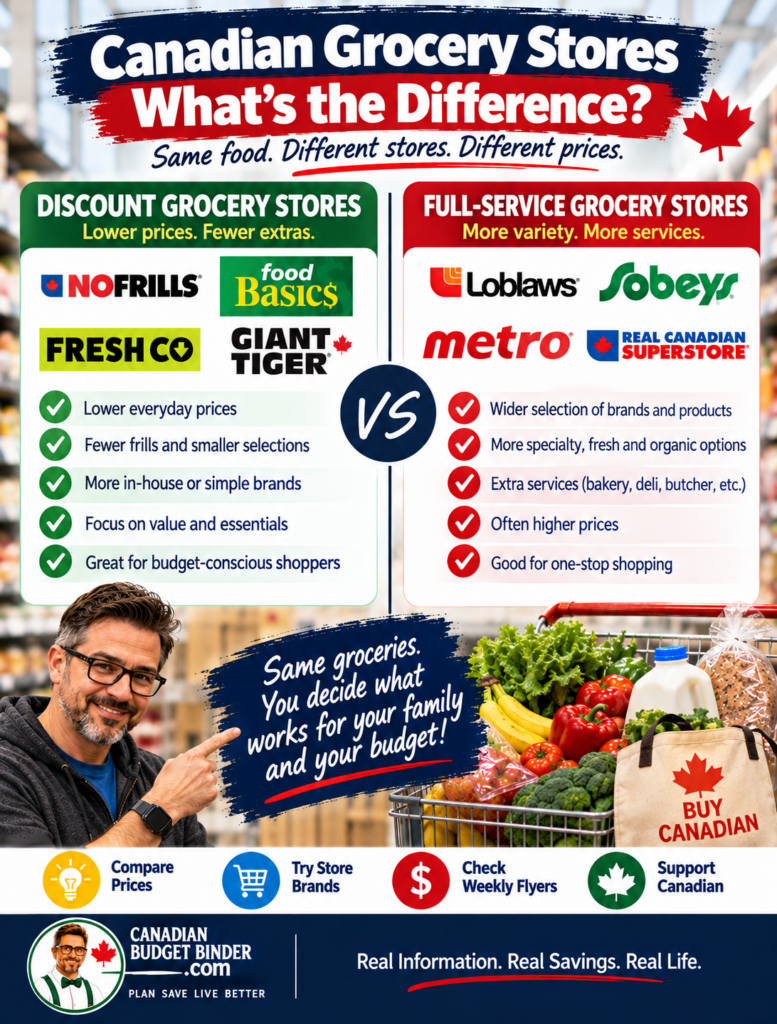
Discount formats typically place greater emphasis on keeping prices competitive and may operate with fewer extras, a more limited assortment, or simpler stores.
A full-service grocery store may offer more:
- prepared foods
- bakery products
- deli counters
- butcher or seafood counters
- specialty products
- premium brands
- organic selections
- service departments
- larger product assortments
None of those things automatically makes a full-service supermarket a bad value.
They’re simply different retail models.
Sometimes paying slightly more at one store may make sense because it saves you another stop, offers a product you can’t find elsewhere or provides better quality for something that matters to you.
If you’d like to explore the other side of this discussion, read my companion Canadian Budget Binder guide to Expensive Canadian Grocery Stores.
That article explains why some grocery formats tend to cost more and when paying more might — or might not — be worthwhile.
Discount Doesn’t Mean Every Item Is Cheaper
This is one of the biggest grocery-shopping lessons I’ve learned over the years.
Never walk into a discount grocery store and assume every price must be good.
One store might have the lowest regular price on milk, but charge more for cereal.
Another might offer inexpensive produce but higher meat prices.
A third store might normally be more expensive but have the best sale price on several products you need that week.
We’ve purchased excellent produce from discount grocery stores such as Food Basics.
We’ve also found excellent deals at stores we normally consider too expensive for our main grocery shop.
If the quality is good and the price works for our budget, I’m interested.
That’s what I mean when I say we’re:
Budget-loyal, not store-loyal.
How to Find the Cheapest Grocery Store for Your Family
Instead of relying on somebody else’s Top 10 list, build your own comparison using the groceries your family actually buys.
1. Start With the Foods You Buy Most Often
Choose 10 to 25 foods your household buys regularly.
For example:
- milk
- eggs
- butter
- bread
- cheese
- yogurt
- bananas
- apples
- potatoes
- onions
- chicken
- ground beef
- rice
- pasta
- canned tomatoes
- cereal
- peanut butter
- coffee
- cooking oil
- frozen vegetables
Your list should reflect your household.
If you never buy cereal, cereal prices shouldn’t determine where you shop.
Once you have your list, compare those products at the grocery stores you can realistically visit.
2. Compare Regular Prices with Before Sale Prices
Weekly sales are fantastic when they’re for products you need.
But flyer specials can make one store appear cheaper than it normally is.
If you want to determine your best everyday grocery store, start by comparing regular prices.
Record:
- product
- brand
- package size
- regular price
- store
- date
Then compare equivalent products.
Once you know the regular price, it’s much easier to recognize a genuinely good sale.
3. Compare Unit Prices
Package size can make grocery price comparisons surprisingly difficult.
A smaller package might have the lowest shelf price but cost considerably more per 100 grams.
Whenever possible, compare:
- price per 100 g
- price per kilogram
- price per 100 ml
- price per litre
- price per item
If the unit price is displayed on the shelf tag or website, use it.
If it isn’t, calculate it yourself.
The package with the lowest sticker price isn’t automatically the cheapest product.
4. Start a Grocery Price Book
One of the best grocery-saving tools we’ve used at Canadian Budget Binder is a Grocery Price Book.
A grocery price book records the prices of foods you buy regularly.
Over time, you’ll begin recognizing:
- a normal, regular price
- a good sale price
- an excellent stock-up price
- which stores normally offer your best prices
You don’t need to record hundreds of products.
Start with ten.
Add more as you shop.
I also have a FREE Canadian Budget Binder Grocery Price Book printable that you can use to get started. If package sizes make comparisons confusing, my guide to unit pricing in Canada shows you how to compare the real cost of different sizes.
Knowing your prices turns grocery shopping from guessing into decision-making.
5. Read the Weekly Flyers
We still check grocery flyers.
Flyers are useful for identifying sale prices and planning meals around products that offer good value.
But there is a difference between using flyers strategically and chasing every sale in town.
If two stores are close together and each has several products we need at excellent prices, shopping at both might make sense.
Driving 25 minutes in the opposite direction to save $1 usually doesn’t.
6. Calculate the Cost of Grocery Store Hopping
Cheap groceries aren’t cheap if getting them costs more than you save.
Consider:
- gasoline
- transit
- parking
- vehicle wear
- your time
- extra impulse purchases
Location matters.
The Competition Bureau has also recognized that geography plays an important role in grocery competition because another grocery store only provides a realistic alternative if consumers can reasonably get to it.
If you spend $5 travelling somewhere to save $3, you haven’t saved money.
7. Use Price Matching Where It Still Exists
Price matching can reduce the need to drive from grocery store to grocery store. I keep a separate, regularly updated guide to Canadian grocery stores that price match, so check it before you shop because retailer policies can change.
As of this September 2026 update, several Canadian retailers continue to advertise price-match or ad-match programs.
No Frills currently matches qualifying advertised prices from major supermarket competitors within the store’s geographic trade area.
Real Canadian Superstore also maintains an ad-match program for qualifying competitors.
FreshCo’s Lowest Price Guarantee goes one step further on qualifying items by selling an eligible product for one cent less than a qualifying discount competitor’s advertised price.
Save-On-Foods also advertises a competitor flyer price-match program.
Giant Tiger’s Ad Match Guarantee currently beats an eligible local competitor’s advertised price by one cent.
Policies can vary by location, eligible competitor, product and promotion.
Always check your store’s current policy before planning your shopping trip around a price match.
Walmart Canada’s current policy is different. It allows certain in-store purchases to be matched to Walmart.ca pricing when the conditions are met, but that is not the same as matching another grocery retailer’s flyer.
Grocery-store policies can change, so never rely on an old list without checking.
8. Don’t Let Loyalty Points Make You Spend More
I like grocery loyalty rewards.
What I don’t want to do is spend $20 more somewhere just to earn $4 worth of points.
Programs such as PC Optimum, Scene+, Moi Rewards, and More Rewards can reduce your effective grocery costs when you’re purchasing products you already planned to buy.
But points don’t automatically transform an expensive product into a bargain.
Do the math.
Ask:
What is my actual cost after the reward?
If another grocery store sells the same product for less without points, the cheaper shelf price may still be the better deal.
9. Check Reduced and Clearance Food
Reduced food has saved our household a substantial amount of money over the years.
Depending on the retailer, you might find discounts on:
- produce
- meat
- dairy
- bakery products
- pantry items
- frozen foods
- overstock
- products approaching their best-before date
We also use Flashfood and Too Good To Go when there are worthwhile offers from participating stores.
The important part is buying food you will actually eat.
A half-price product thrown into the garbage is not a bargain.
10. Factor Food Waste Into the Price
Food waste belongs in any discussion about cheap groceries.
Suppose you buy a huge package because the unit price is lower.
If half of it spoils, was it really cheaper?
Sometimes paying slightly more for a smaller package makes better financial sense.
Before buying bulk groceries, ask:
- Will we eat all of this?
- Can I freeze some?
- Do I have storage space?
- Is this something we use regularly?
- Am I buying it because we need it or simply because it looks cheap?
The cheapest grocery is one you buy at a good price and actually use.
11. Compare Costco and Warehouse Shopping Carefully
Costco can absolutely save our household money on certain products.
But Costco isn’t automatically cheaper because the package is bigger.
Always calculate the unit price.
Then consider:
- membership cost
- package size
- storage space
- how quickly you’ll use the food
- potential food waste
- impulse buying
Some Costco products work exceptionally well for our grocery budget.
For others, a smaller package from another store makes more sense.
Warehouse shopping works best when you know your prices before you walk through the door.
12. Don’t Ignore Walmart, Giant Tiger, or Independent Grocers
You don’t have to buy every grocery product from a traditional supermarket.
Depending on your community, worthwhile grocery prices may be available from:
- Walmart
- Giant Tiger
- independent grocery stores
- Asian supermarkets
- Indian grocery stores
- Middle Eastern grocers
- Italian markets
- butcher shops
- produce markets
- farm markets
- dollar stores
- pharmacies
The Competition Bureau has emphasized the important role independent grocery stores play in creating consumer choice and competition.
A smaller grocer may not have the lowest price on every pantry staple, but could offer outstanding prices on produce, meat, or specialty foods.
Compare rather than assume.
13. Build Meals Around What’s Affordable
Sometimes your biggest grocery saving doesn’t come from changing stores.
It comes from changing dinner.
- If chicken thighs are on sale and chicken breasts aren’t, perhaps chicken thighs go on the menu.
- If broccoli is expensive but cabbage is inexpensive, change the side dish.
- If beef is particularly expensive, consider meals using eggs, beans, lentils or another protein.
Flexible meal planning lets you take advantage of what is affordable rather than building a grocery list around products that happen to be expensive that week.
Cheapest Canadian Grocery Stores by Type
Instead of pretending I can rank Canada’s grocery stores from first to tenth, here’s the more useful way to look at them.
Major Discount Grocery Banners
Depending on your province, start by comparing:
- No Frills
- Maxi
- FreshCo
- Food Basics
- Super C
These are major banners specifically positioned around discount or value grocery shopping.
Not every banner operates in every province.
Other Large Retailers Worth Comparing
Depending on what you buy and where you live, also compare:
- Walmart
- Real Canadian Superstore
- Atlantic Superstore
- Giant Tiger
- Costco
They’re different retail models, so don’t assume one basket will cost less simply because of the store name.
Independent and Regional Grocers
Don’t forget your independent grocery stores.
Some independent and ethnic grocery stores can offer excellent prices on produce, herbs, spices, rice, meat and international ingredients.
Others may cost more.
As always, compare the foods you buy.
Why Your Cheapest Grocery Store Can Change
Your cheapest grocery store this month might not be your cheapest store next month.
Flyers change.
Promotions change.
Seasonal produce changes.
Loyalty offers change.
Clearance items change.
Your meal plan changes.
Your family’s needs change.
This doesn’t mean you need to visit five stores every week.
Once you build a price book and learn your local market, you’ll probably identify one or two grocery stores that work well for most of your shopping.
Then use other stores strategically.
That’s largely how we’ve shopped for groceries for years.
CBB Grocery Price Snapshot — Coming Next
I’m also working on a Canadian Budget Binder grocery-price comparison using a controlled basket of common foods.
The purpose will not be to declare Canada’s cheapest grocery store.
Instead, it will compare a fixed basket at selected grocery banners at the same point in time.
The comparison will record:
- grocery banner
- location or market
- collection date
- product
- brand
- package size
- regular or promotional price
- unit price
- whether an identical item was available
Where possible, nationally branded products will be compared using the same brand and package size.
Produce and meat will be compared using consistent units such as price per kilogram.
The results will be labelled a CBB Grocery Price Snapshot, not a national ranking.
Prices change too often, and Canada is too geographically diverse, for one local basket to prove which grocery chain is cheapest everywhere.
FAQ: Cheapest Grocery Stores in Canada
What Are the Main Discount Grocery Stores in Canada?
Major discount grocery banners include No Frills, Maxi, FreshCo, Food Basics, and Super C.
Availability varies by province and community.
Is No Frills Always the Cheapest Grocery Store?
No.
No Frills operates as a discount grocery banner, but that doesn’t mean every product will always cost less than every competitor.
Compare the products your household buys regularly.
Is Walmart Cheaper Than a Grocery Store?
Sometimes.
Walmart can offer competitive grocery prices, but the answer depends on the products, package sizes, location and current promotions.
Compare your own grocery basket instead of assuming one retailer will win every time.
Is Costco Cheaper for Groceries?
Costco can offer excellent unit prices on certain groceries, particularly when you will use the larger quantity.
However, membership cost, package size, storage space, and food waste all matter.
Bulk isn’t automatically cheaper.
What Is the Best Way to Find the Cheapest Groceries?
- Know your regular prices.
- Use a Grocery Price Book.
- Compare unit prices.
- Read flyers.
- Price match where available.
- Use loyalty rewards wisely.
- Check the reduced food.
- Avoid food waste.
And factor in transportation costs when calculating your savings.
My Best Advice for Finding Cheap Groceries in Canada
Don’t become obsessed with finding one perfect grocery store.
Instead:
- Know your prices.
- Compare unit prices.
- Read the flyers.
- Keep a Grocery Price Book.
- Price match when it makes sense.
- Use loyalty points strategically.
- Shop for reduced food.
- Compare bulk packages carefully.
- Meal plan around affordable foods.
- Don’t waste what you buy.
And don’t spend $5 travelling somewhere to save $3.
Grocery shopping is one area of our household budget where small decisions are repeated over and over again.
Saving 50 cents once probably won’t change your financial life.
Learning how to recognize a good price and repeating that skill hundreds of times can make a meaningful difference.
That’s why I’ve always preferred being:
Budget-loyal, not store-loyal.
Find the stores that work for your household, keep comparing and spend your grocery money where it gives you the most value.
Discussion
Which grocery stores tend to be cheapest where you live in Canada?
I’d especially like to hear how the answer changes from province to province.
Do you mainly shop at one grocery store, or do you visit several stores to get the best prices?
Leave your experiences in the comments below.
Thanks for stopping by Canadian Budget Binder.
Mr. CBB
Kool aid jammers at Walmart is always the lowest at $1.67 per pack.
Fairways on Vancouver Island
Do you shop there often?
There are some things you can get fairly cheap at dollar stores like Dollarama. I bought a can of beans for .50 cents and it would have been 88 or 99 cents for the same type at the local supermarket. Also, items like jams and jellies are a steal at the dollar store: same amount is $2 for a strawberry or apricot jam. At the regular supermarket its closer to $4 (range varies,but its significantly more). And you can buy two 1 liter bottles of pop, brand name pepsi for example, for 82 cents, buying 2 will set you back $1.64 whereas a 2 liter at many supermarkets is $1.99 and up (the most absurd price I’ve ever seen is a Metro charging $3.49 for a 2 liter of pop, which is highway robbery). I drink diet pop frequently, so I will buy 4-6 liters at a time, so it adds up… So while Dollar stores aren’t grocers, they do have some food items for a very competitive price.
Wonderful article. I’m used few of these sites already. But compare to all I prefer this site for online shopping. SAVEJI offering the best coupons and discounts for all category products across the world. You may also try it and save your money.
Where do you think Bulk Barn sits in this category? I’ve recently started getting pantry items here using reusable containers in an effort to reduce plastic use, and I’m noticing there are foods here that wouldn’t be found elsewhere–carob chips and lentil pastas, etc. They also have honey, nut butters and oils, in bulk. It’s definitely an interesting place to shop, but not all foods are cheaper than in stores, so it’s still a matter of checking the flyers for the weekly deals. Freshness is also a consideration.
Hi Irene,
I agree you always have to check your prices even at the cheapest grocery stores because there is always someone who might be selling the same item cheaper. We find Bulk Barn hit or miss however the do like you say sell unique food products and their coupons are pretty good.
Save on foods, Sobeys and Safeway are like the corner store you go to pick up emergency items only. During covid 19 there are no line ups, as the prices are so high. they are slowly killing themselves trying to grab every dollar. They are driving there customers away,
Bi g 3 for me are freshco, nofrills, foodbasic. I wait for there lower sale prices than buy what I know I’ll use ether before the expiry date or about 3 months in the freezer. So if its 500g of bacon for 1.99 I will buy 15 or more.
I’m with you. If I saw bacon that cheap I’d buy whatever I was allowed to as well.
Thanks for sharing your feedback!
Mr.CBB
I find buying some things at fresh co or food basics a steal. Bags of pizza bites no name vs brand name way better. Far better deal to buy a 5kg bag for 10 bucks ( 10 meals roughly) vs same thing at 3.99 for 2 meal package. The grand kids dont know the difference and in reality besides the odd one being split open there is no difference. Same goes for buying sausages. 7.99 for 15-18 sausages works out to 0.50-0.60/ sausage n they are just under bun length so not a bad score. N slap a colony down with for michelangelo brand reduces the price another buck so its like stealing. I thank the wonderful Stacey M. Who taught me to copoun and intro me to Mr. CBB. For all the sweet deals n tips.
Hi Jeff,
You’re right about finding deals at Food Basics which is where we shop along with Zehrs for 50% off stickers. We also shop at Costco for some items but at the end of the day like you we all need to do the math. It’s the math that makes the most sense when pairing it with a grocery budget, coupons and coupon apps. What a nice thing to say. I haven’t heard from Stacey M in a while, send her my hello! Mr.CBB
Toxic
Walmart doesn’t price match anymore.
Hi Dee,
Thanks for reminding me to update this post. I did update the price matching post but forgot about this.
I appreciate you taking the time to tell me. I’ll fix that now.
Mr.CBB