

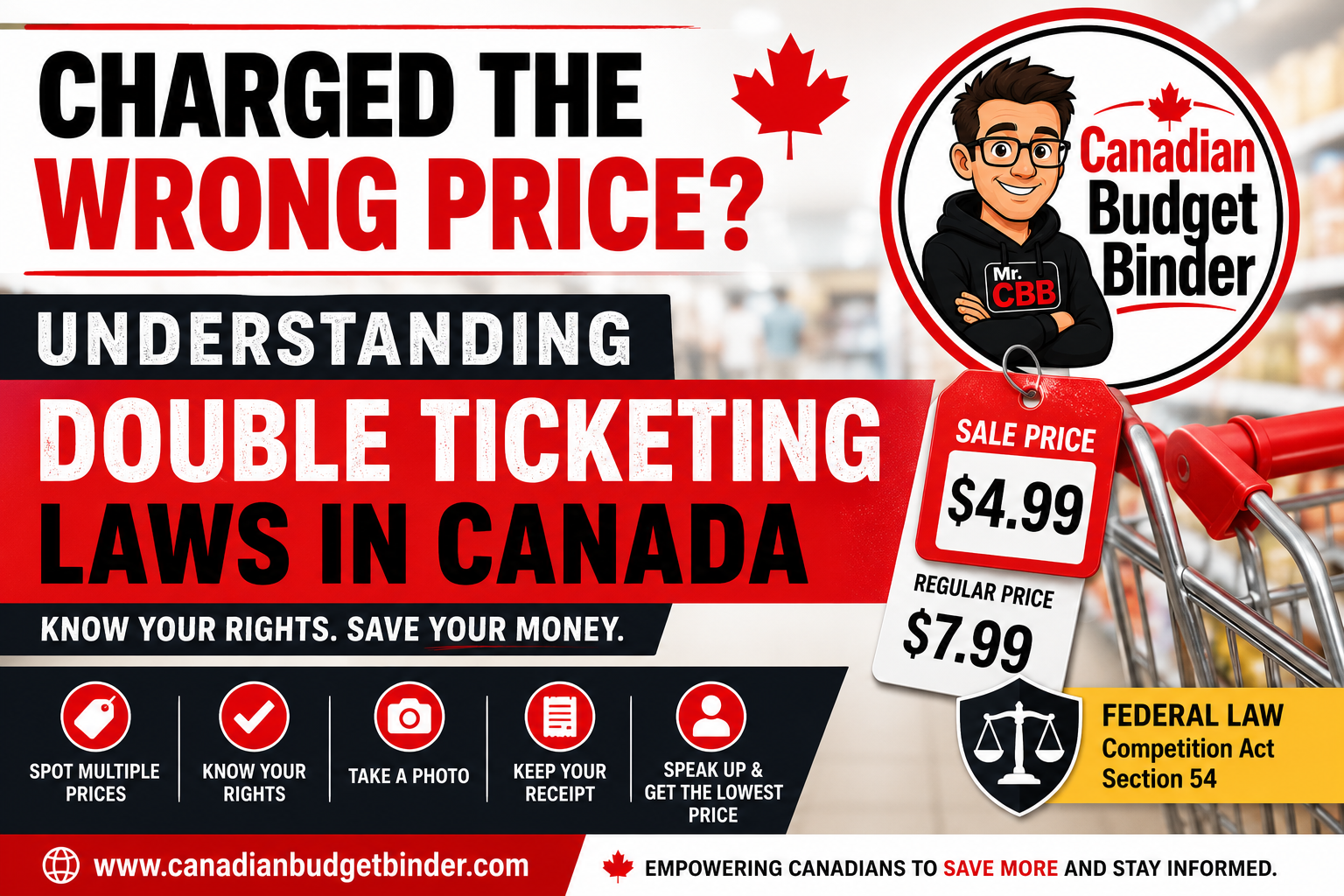

You pick up a product from a store shelf after spotting a good deal. Maybe it’s a discounted blender, a sale-priced cereal box, or a jacket with a clearance sticker attached.
As you examine the item, you notice something unusual. The product displays two different prices. A sale sticker shows one price, while another visible tag or label shows a higher amount.
At checkout, the cashier charges the higher price.
Which price should apply?
Many Canadians assume the store can choose either price, but Canada’s double-ticketing laws say otherwise.
For many shoppers, this feels unfair — and in some situations, it may actually violate Canadian law.
This issue is known as double ticketing, a deceptive pricing practice that is prohibited under Canada’s Competition Act. While many consumers have experienced pricing confusion in stores, few fully understand what double ticketing means or what rights they have when it happens.
My Walmart Double Ticketing Experience
During a recent shopping trip at Walmart, I noticed a package of bacon with two prices displayed. A yellow Rollback sticker showed $4.97, while another visible price sticker on the same package showed $6.97.
When the bacon was scanned at checkout, the higher price appeared on the register. Because both prices were clearly visible, I asked customer service to review the pricing. The lower displayed price was honoured after the issue was brought to their attention.
While pricing mistakes can happen at any retailer, this example demonstrates how double ticketing differs from a simple scanner pricing error. The key issue was that two prices were displayed for the same product.
Here’s what Canadian shoppers should know.
What Is Double Ticketing?
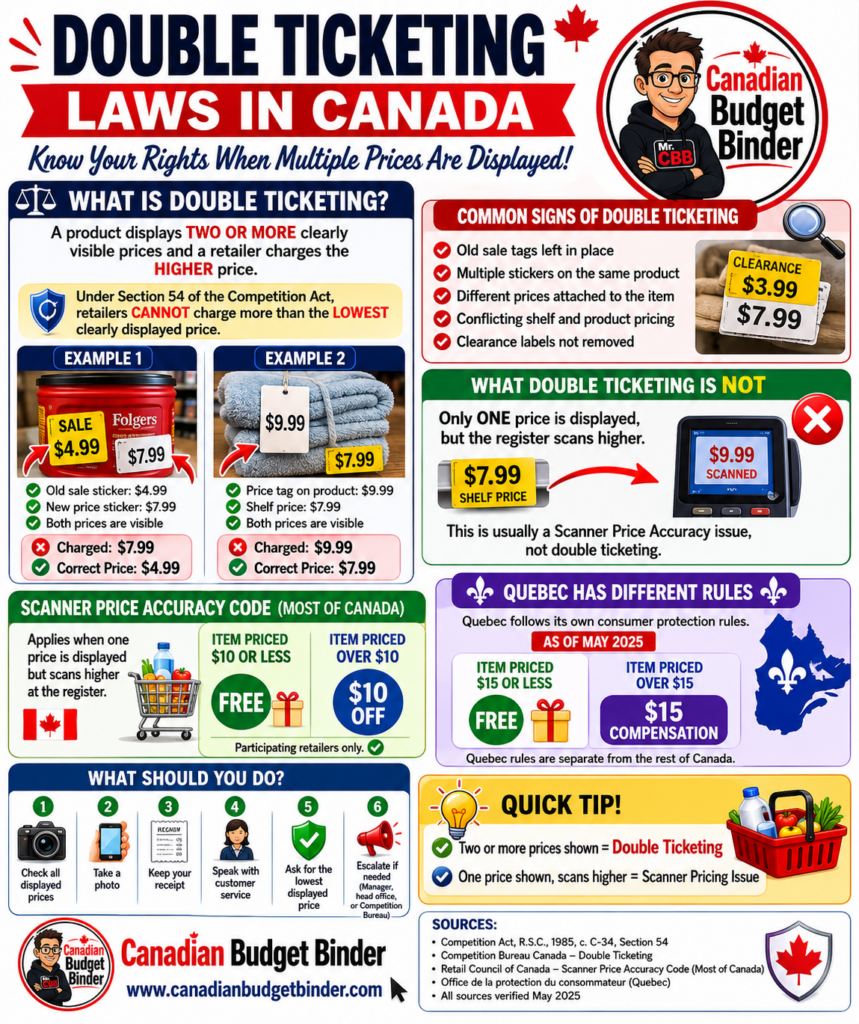
Double ticketing occurs when a product displays two or more clearly visible prices, but the retailer attempts to charge the higher price.
Under Section 54 of Canada’s Competition Act, businesses cannot sell a product at a price higher than the lowest of two or more clearly expressed prices displayed for the same item.
The purpose of the law is straightforward: consumers should not be misled or forced to pay more due to conflicting pricing information.
Double ticketing can occur in several ways, including:
- A product displaying both an old sale sticker and a newer, higher-priced label
- A shelf tag showing one price while another price remains clearly visible on the product or its packaging
- A digital shelf sign displaying one price while another visible price is attached to the item
- Multiple price labels attached to the same product
In each case, the issue is not simply a pricing error. The concern is that multiple prices are clearly displayed for the same product, creating confusion about the actual selling price.
Is Double-Ticketing Illegal in Canada?
Yes.
Double ticketing is specifically prohibited under Section 54 of Canada’s Competition Act.
The law states that a business cannot supply a product at a price that exceeds the lowest of two or more clearly expressed prices displayed for that product.
In practical terms, if a shopper sees multiple clearly displayed prices for the same item, the retailer must honour the lowest displayed price.
This rule applies across Canada and helps protect consumers from deceptive pricing practices.
Retailers that violate the law may face enforcement action, fines, or other legal consequences under the Competition Act.
How To Spot Double Ticketing While Shopping
Before heading to checkout:
- Check for multiple price stickers
- Look for old sale tags
- Compare shelf labels with product labels
- Review your receipt before leaving
- Take a photo if you notice conflicting prices
Common Examples of Double Ticketing
Double ticketing is more common than many consumers realize, especially in large retail environments where prices change frequently.
Here are a few examples shoppers may encounter.
Clearance Sticker Conflicts
A winter jacket has a clearance sticker showing $49.99. A newer price label displaying $79.99 is also clearly visible on the same item.
Because two prices are clearly displayed, charging the higher amount could qualify as double ticketing.
Multiple Visible Product Prices
A product displays one price on its packaging while a different price tag is attached directly to the item, and both prices remain clearly visible to shoppers.
If two prices are displayed for the same product, consumers may have the right to pay the lower amount.
Digital Pricing Discrepancies
A digital shelf label displays one price while a different price tag remains attached to the product itself.
If multiple prices are clearly visible at the point of purchase, the lower displayed price may apply.
Promotional Tags Left Behind
Retail employees occasionally forget to remove expired promotional signs during busy sales periods.
When multiple prices remain clearly visible to customers, confusion can arise and the lower displayed price may need to be honoured.
What Should Consumers Do If It Happens?
Pricing disputes are often resolved quickly when shoppers remain calm and organized.
If you believe you were charged more than the lowest displayed price, consider taking the following steps.
Check the Product Carefully
Before raising the issue, confirm that:
- The shelf label matches the exact item
- The product size, flavour, colour, or model is correct
- The promotional sign clearly applies to that product
Small differences between products can sometimes create pricing confusion.
Take a Photo
A quick photo can be helpful if the pricing display changes later.
A quick photo can be helpful if the pricing display changes later.
Try to capture:
- The shelf label
- The displayed sale sign
- The product itself
- Any visible price stickers
Photos provide valuable evidence of what was displayed at the time of purchase.
Speak With Customer Service
Most stores will review pricing concerns immediately when approached politely.
Explain:
- The displayed price
- The price charged
- The location of the product in the store
Many pricing disputes are resolved without further escalation.
Keep Your Receipt
Receipts provide proof of purchase and can help support any refund request or complaint.
Report Serious Issues
According to the Competition Bureau of Canada, retailers cannot charge more than the lowest of two or more clearly displayed prices for the same product.
If a retailer repeatedly engages in misleading pricing practices, consumers may submit a complaint to the Competition Bureau of Canada.
The Competition Bureau investigates deceptive marketing and pricing practices under federal law.
💡 Did You Know?
Many Canadians know about the Scanner Price Accuracy Code, but far fewer know that double ticketing is addressed under Canada’s Competition Act.
Double Ticketing vs. Scanner Pricing Errors
Many Canadians confuse double ticketing with scanner pricing errors, but they are not the same thing.
Double ticketing involves two or more clearly displayed prices for the same product and is governed by Canada’s Competition Act.
Scanner pricing errors occur when a product scans at a higher price than the displayed shelf price, even though only one price may have been visible to the customer.
Many retailers participate in the Scanner Price Accuracy Code, a voluntary policy that provides compensation when eligible items scan at a higher price than the displayed price.
Under the Scanner Price Accuracy Code:
- If the correct displayed price is $10 or less, the item may be provided free of charge.
- If the displayed price exceeds $10, the customer may receive $10 off the correct price.
However, the Scanner Price Accuracy Code is voluntary and separate from Canada’s double-ticketing law.
Understanding the difference helps consumers know which protections may apply to their situation.
Other Pricing Practices Consumers Should Recognize
Double ticketing is only one type of pricing issue consumers may encounter.
Drip Pricing
Drip pricing occurs when a business advertises a low initial price but adds mandatory fees later in the purchasing process.
Examples may include:
- Service charges
- Processing fees
- Mandatory booking fees
These added costs can make the advertised price unattainable for consumers.
Bait-and-Switch Advertising
Bait-and-switch advertising occurs when a business promotes a product at an attractive price but fails to maintain a reasonable supply, thereby encouraging customers to purchase a more expensive alternative.
Canadian regulators continue to monitor and enforce rules surrounding deceptive pricing practices to help ensure consumers receive clear and accurate pricing information.
FAQ’s About Double Ticketing
Is double ticketing illegal in Canada?
Yes. Double ticketing is prohibited under Section 54 of Canada’s Competition Act. Retailers cannot charge more than the lowest of two or more clearly displayed prices for the same product. The law is designed to protect consumers from confusing or misleading pricing practices.
What is considered double ticketing?
Double ticketing occurs when a product displays two or more clearly visible prices, and the retailer attempts to charge the higher price.
For example, a package of bacon may have a Rollback sticker showing $4.97 while another visible price sticker shows $6.97. If the higher price is charged, this could be considered double ticketing.
Is double ticketing the same as a scanner pricing error?
No. These are two different situations.
Double ticketing involves multiple displayed prices on the same product or display.
A scanner pricing error occurs when only one price is displayed, but the cash register scans a higher price at checkout.
Many retailers participate in the Scanner Price Accuracy Code, which provides compensation when eligible items scan at a higher price than the displayed price.
What should I do if I notice double ticketing?
If you notice two different prices displayed for the same product:
- Take a photo of the product and pricing.
- Keep your receipt.
- Politely speak with customer service.
- Ask for the lower displayed price to be honoured.
Most pricing disputes can be resolved quickly when supported with clear evidence.
Does the Competition Act apply across Canada?
Yes. The Competition Act is federal legislation and applies throughout Canada. Consumers in every province and territory are protected by the double-ticketing provisions contained in Section 54 of the Act.
Can I request a refund if I discover the issue later?
Possibly. Many retailers will review pricing concerns after a purchase if you have your receipt and can explain the situation. However, store policies vary, so it is always best to address the issue as soon as possible.
Does double ticketing apply to online shopping?
Generally, double ticketing is most commonly associated with prices displayed in physical stores. Online pricing disputes may be subject to different consumer protection rules depending on the circumstances and the province.
Can stores be fined for double ticketing?
The Competition Bureau of Canada is responsible for enforcing the Competition Act. Businesses that engage in deceptive pricing practices may face investigations, enforcement actions, and other legal consequences.
Why do double-ticketing mistakes happen?
In many cases, double ticketing occurs because old sale tags, clearance stickers, promotional labels, or pricing updates were not removed properly. While some situations may simply be human error, consumers should still be aware of their rights when multiple prices are displayed.
How can I avoid being overcharged while shopping?
A few simple habits can help:
- Check products for multiple price stickers.
- Compare shelf tags and product labels.
- Review your receipt before leaving the store.
- Take photos of any conflicting prices.
- Ask questions if something does not look right.
Being aware of pricing discrepancies can help you avoid overpaying and ensure you receive the price displayed clearly.
Final Thought
Most Canadians expect pricing to be straightforward when shopping. When multiple prices appear for the same product, consumers should not be left wondering which price is correct.
That is one of the reasons Canada’s double ticketing law exists.
Under Section 54 of the Competition Act, businesses cannot charge more than the lowest of two or more clearly displayed prices for the same product. This protection helps ensure consumers are treated fairly when pricing errors or conflicting price displays occur.
While not every pricing mistake qualifies as double ticketing, understanding your rights can help you recognize potential pricing issues, avoid overpaying, and confidently address discrepancies at checkout.
The next time you notice multiple prices displayed for the same item, take a closer look. Knowing your consumer rights could save you money and help ensure retailers honour the prices they advertise.
Consumers can also review Section 54 of the Competition Act, which addresses double ticketing in Canada.
Discussion: Have you ever caught a pricing mistake at a Canadian store? Did the retailer honour the lower price, or did you have to fight for it?
Please leave your comment below. I read all of the comments and reply to them.
Mr. CBB