


Estimated reading time: 15 minutes
Master the art of building and protecting generational wealth. Gain insights into the strategies and mindset needed to pass on wealth through the generations.
The Gift Of Wealth For Generations
Creating generational wealth is an umbrella term because there’s more to it than meets the eye.
Once you’ve conquered your financial goals and are debt-free, you can focus your goals on safeguarding generational wealth.
The Chinese have a saying that generational wealth will not survive three generations, and for good reason.
Or you may have heard the adage “Shirtsleeves to Shirtsleeves in three generations,” which means the same thing.
This is how it all goes down.
The first generation typically suffers the most, working to build generational wealth for their kids and going without.
In comes the second generation who saw what their parents went through and worked just as hard, if not more challenging, to live a better life and to pass that on to their children and grandchildren.
Then, the third generation comes in and grows the generational wealth that is passed down or loses it all.
This means that the cycle of generational wealth must start over again, and it will.
In our case, we were met with the Silent Generation beginning in 1923, Baby Boomers in 1945, and Generation X in 1961 (that’s us with current ages between 41-59). – Source: Generation Summaries
Our son will be part of the fourth generation, Generation Alpha, born in 2014.
Luckily, Mrs. CBB and I, both third-generation, have managed to amass a net worth without any generational wealth.
There are some honors to the Chinese, but not all third generations will wipe out their generational wealth.
Meaning Of Generational Wealth
What Is Generational Wealth?
Generational wealth is simply assets or money passed down from generation to generation.
So, for example, if you save money in your child’s Registered Education Fund and pass it along to them, that’s generational wealth.
You’ve given your child a running start at life by paying for all or part of their education, whereas other students may have to get a bank or OSAP loan.
We started to save for our son’s education, and by the time he starts college or university, he will have enough to cover five years of school, including residence.
That total will run into the 100,000 dollar mark, and for any child, that’s a massive amount of money to be given or taken as a loan.
Keeping Wealth In The Family
How do you keep wealth in your family?
You teach your family the values of wealth and how to sustain the wealth that might be coming their way by creating a wealth strategy.
Notice how the word ‘wealth’ comes up often?
That’s because generational wealth is about keeping the castle you’ve built in the family.
I remember my nan who would sew anything that ripped, and my mum would repair and sew us clothes.
We bought used clothes, and the millennials in our family would buy new ones.
There was always chatter about why we bought new and could mend this quickly because there was little money to spend.
It seems that by the time the second or third child comes along, depending on their generation, some parents give up on them.
Not all third generations will mess up the family fortune, especially if the family takes time to communicate and explain wealth.
Even today, my parents save as much money as possible, although they happily retired without financial worry.
Why? Well, I’m sure in part to leave for their kids and grandkids.
Something is empowering about being successful and being able to pass on some form of wealth when you’re gone.
Children Have Their Dreams
Another consideration is that not all children want to take over a family business.
However, there is generally one child or another family member who will take over the reins.
When I was young, my parents owned a business in the hunting and fishing industry, and I worked there for years.
Would I have liked to take it over if they left it to us, kids?
Hell no, because I had zero interest in spending all my time at the shop.
My wife’s father’s parents had a large farm, and none of the kids wanted it, so it was sold to the cousins who still own it today.
The farm was profitable and was their only source of income growing up in the silent generation, but none of the kids stuck around.
He later came to regret that decision to move to a new country instead of staying home to take care of the farm.
Plus, it would be best to ponder the pros and cons of skill sets between generations as times change, as do resources and education.
What you used to do as a farmer may be far different for your child or their children based on new technology, education, and government legislation.
There will always be that fine line moving from generation to generation regarding a family business, investments, or real estate assets.
Passing down what you’ve learned is critical, but it’s also essential for their successors to update their knowledge, or everything can flop.
Leaving a million-dollar-a-year business to your child with zero business sense is a disaster waiting to happen.
Creating Generational Wealth
Before building generational wealth for future heirs, you must ensure your financial health is in order.
Let’s look at ways to create generational wealth by taking care of some critical financial details.
Budgeting
If you want to know where your money is going and how much money is coming in, you must budget.
A budgeting system allows you to cut expenses where necessary and pay off debt faster.
You can save even more money when you can crush your financial goals.
Always pay yourself first, pay off your debts, and save for the future.
Saving Money
Once you have your budget under control, you should pay yourself first by building an emergency savings fund and other savings.
After a while, you’ll get used to the life of a saver, where you splurge on the necessities and hold off on the wants.
There’s also a point where you must ensure that you are still enjoying life but putting money by for everything else.
That’s the balance of budgeting or financial wealth management that many struggle with the most.
It’s far easier to do the opposite and then wonder where the money went.
Don’t be that person.
Passive Income
Passive income is a system where money rolls in while you’re sleeping.
For example, this blog earns a 5-figure income yearly, and although I work on it, the money is still passive if I stop blogging today.
Owning a home that is fully paid off and rent brings in passive income that you can invest to earn even more money.
Investing and earning dividend income can also be classified as passive income because your money earns you money.
Side Hustles
Find things to do that will earn you extra money, such as blogging, dog-walking, babysitting, tutoring, music teaching, etc.
When you can bring cash in on the side, you can put that extra cash towards debt to help fuel your retirement savings or other investments.
Multiple Income Sources
Having multiple income sources is a great way to build wealth, which we’ve been doing for years.
Having this blog is one income source; the other is buying and selling items for higher than we paid.
Financial Communication
Money talks are a big deal, especially regarding your family, who may inherit wealth from you one day.
Teaching children from a young age about money management is only the beginning of their journey to modern wealth savings.
Being prepared to handle large amounts of money they may get at some point in their lives is critical for future generations.
Understanding the basics of budgeting, accounting, debt, and the importance of a credit score is critical.
Wealth Preparation (Investing in and mentoring your heirs)
There’s nothing more powerful about generational wealth giving than to prepare your successors for when the time comes.
No matter your situation, you must go through the process of finance, business, and investing with your children.
Ensure everyone is on the same page and those with no interest understand where they stand in the process.
If there is no suitable family successor for an existing family business, to also plan the liquidation of the business so that you can pass cash on to the heir(s) to grow in a manner that suits them.
Sometimes it’s a simple as liquidating the assets inside the business, renaming and re-purposing that business so that your heir can build a business that they are interested in running and growing.- Mary C (CBB Facebooke)
Charitable Giving
Giving is a massive part of growing wealth, but with the heart, and although it’s not something that will increase your bank account, it does help with any tax receipts.
At the same time, you are helping others in need of money or even your time by volunteering, which also helps educate them.
Show your children the benefits of giving and its importance, and encourage them to volunteer with you.
Often, when children see what they don’t want, it drives them to do something they do not wish to do.
Just because someone comes from a poor upbringing doesn’t mean they will be in one forever.
Marriage and Common-law Prenuptial Agreements
I’m not saying a prenuptial agreement is a must.
However, if you have a successful business and want to protect it from a possible divorce, common-law relationship, or step-children brought into the relationship, then consider this option.
Generational Wealth Examples
Some examples of generational wealth that spring to mind are often the easiest to accumulate if you have the money to invest.
Teach Children Financial Literacy
When our son is 21, he will have access to an Informal In-Trust Account, a Bank Savings Account with Tangerine, a Life Insurance investment policy (if we are dead), and an RESP when he is ready for university or college.
He will also be the successor of this business I started in 2012, “Canadian Budget Binder‘ if he wants to continue blogging.
There will also be many other assets and investments coming his way as the years go on, and we’ll have to talk to him about all of this.
We’re still young, too, so who knows what the future holds for our family.
Teaching children financial literacy from a young age is essential, especially when transitioning to high school and adulthood.
Build A Family Business
Starting a family-oriented business venture is a great way to keep wealth in the family.
The only con is that your children may not want to continue with the business after you’re gone.
As mentioned, this blog is our little family business; however, I may open something new in the future.
If interested, have your children work in the family business and teach them everything they need to know.
Find out if they are interested in the business once you have died, and if the answer is yes, the company can stay with the family.
Invest In The Stock Market or Other Investments
Investing is a great way to create wealth for yourselves and generational wealth for your successors or heirs who will be around when you’re gone.
If you invest wisely, you may not even use all the money that leaves money to those named in your Will.
Some examples are investing in the stock market, retirement funds, and real estate.
Related: What happens to your TFSA when you die?
Life Insurance Policies
Mrs. CBB and I have insurance policies that are term life insurance and whole life-Par, which is invested.
Earlier this year, we converted our life insurance into permanent solutions called partial conversion without medical evidence.
We did this because it guaranteed early cash values, meets flexibility, and provides long-term protection with potential tax-saving advantages.
We’ve also bought our son an insurance policy that, after ten years, will be fully paid for by us, and he won’t ever need to buy one.
Life insurance from Policy Me is critical when dependents rely on you for financial support.
By doing so, you are leaving money behind if both you and your spouse pass away.
Beneficiaries
Without a doubt, you must name beneficiaries on any documents that include assets, businesses, savings, investments, and your estate plan.
Estate Planning With A Will
Do yourself a favor and ensure you have a Will prepared soon.
Talk to the Power of Attorney that you chose to take care of your affairs and their responsibilities.
Related: Estate Planning Guide For Canadians
If you die without a Will, there could be consequences, especially if your bank accounts are not in both your names.
Related: Widow has bank account frozen when her husband dies
Choose a lawyer to draw your Will and Estate plan or opt for a legally binding online Will option such as using Epilogue.
Related: The harsh consequences of dying without a Will
Informal In-Trust Account – Non-Registered investment account
As I mentioned, we started a non-registered investment account for our son, which will be great for him, but we still pay tax time.
Since we are maxing out his education plan and saving his birthday money, government cheques, and other income, the next best thing is an informal in-trust account.
Any dividends/interest generated by the account are taxed to the contributor (ie. in my case, I would take the tax hit – not great).
However, capital gains are taxed in the hands of the beneficiary (ie. the children – bonus!).
With capital gains taxed in the hands of minors, this would result in very little tax in most situations. – Frugal Trader (Investing on behalf of your children)
Final Thoughts
Whether you can stash cash, own a business, or have investments for your heirs, all you can do is hope they make the right decisions.
You can pass on money but can’t make the financial decisions once the money is gone.
Always be passionate about what you do, but be open to the fact that your children may not be your successors.
Generational wealth will always be one step ahead for anyone; they can either build it, sit on it, or blow it.
Discussion: Will you be saving generational wealth to pass down to your family, and were you gifted any? Share your comments below, and I’ll be sure to respond.
Net Worth Losses and Gains
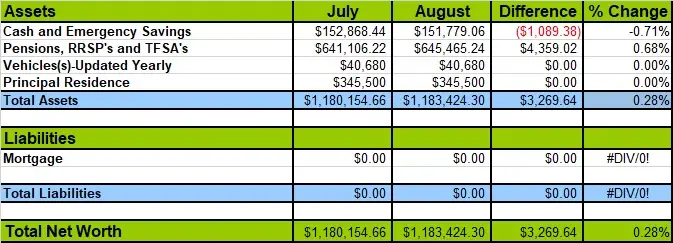
What happened to our money in August?
We have not much happened in August apart from our investments creeping up by 4359.02 dollars.
As you can see, due to renovations, we didn’t do anything good with our cash and emergency savings for August.
We’re currently working on a no-spend month for September, so hopefully, we can get out of the red.
How was your month for money? Share your comments below.
Understanding Net Worth
What Does Individual Net Worth Mean?
Net Worth is a snapshot of your financial health, like a picture of debt to net assets.
In simple terms, it’s a total of the value of your assets minus your liabilities.
We credit our net worth growth to patience, perseverance, using a monthly budget, and not giving up.
Your numbers may go up and down, but don’t let the numbers scare you.
If you would like to use our budget, I offer a FREE downloadable budget, which I created and that you can use.
I don’t charge for it because I want you to save money, not spend more!
There are many other free resources at Canadian Budget Binder to help you build your net worth.
Calculate Your Net Worth
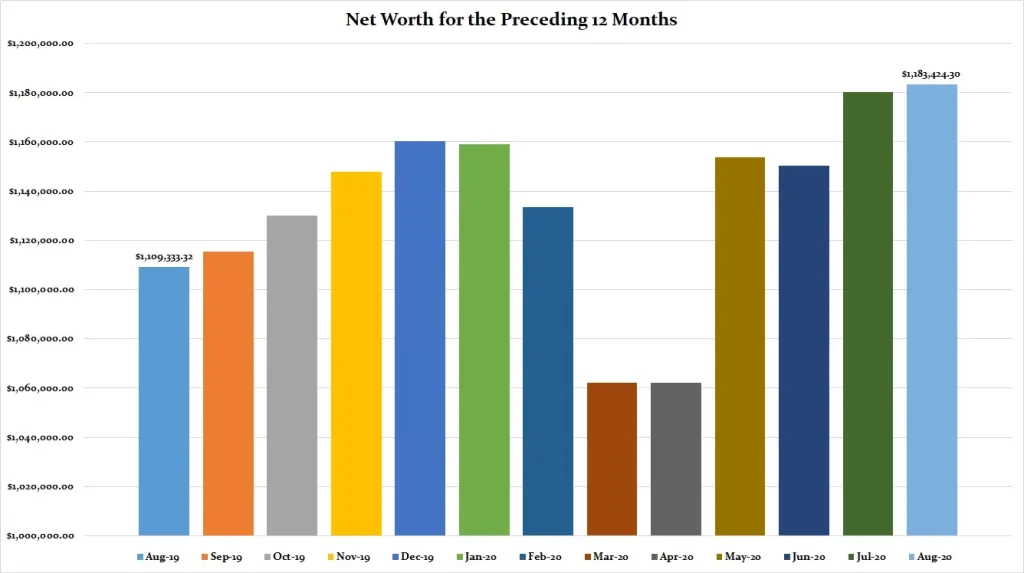
Do you know how to calculate your own Net Worth?
We want to calculate our monthly net worth to see if we are still on track.
Some people calculate it yearly or quarterly, but it’s up to you and how informed you want to stay.
Net Worth is only an estimate, and not everyone uses the same type of figures to tally it up.
Some of you may not include vehicles as we do or leave out assets inside the home as we have.
You might be that person who believes that your house should be excluded.
It depends on what you want to calculate or what you can sell today and make money for tomorrow.
Determining your net worth is relatively easy as you know your monthly financial numbers.
Net Worth is adding up all your assets (what you own) and then taking away your liabilities (what you owe), giving you a net worth number.
Understanding your net worth will help determine if you are on track to meeting or beating your financial goals.
It doesn’t get any easier than that.
Determining Net Worth
Net Worth = Assets – Liabilities
Financial Numbers
When budgeting, anything is possible; we are proof of that, although we still have a long way to go in our journey.
These are our numbers and goals, not a means of comparing your own goals and others’ target goals.
We don’t care how much money others earn if they have a high net worth or are lower than ours, as it’s not a competition.
I hope our experiences will help guide you along your financial path, working towards debt freedom.
Not everyone has the same path in life.
Some of you may have had to start over as I did or go to school again and now have OSAP loans to pay back.
Others may have divorced, lost money in the stock market or other investments, suffered job loss, or fell ill or injured, but you can’t let that stop you from achieving your financial goals.
You may have been given trust funds, paid-for homes, education, or other perks that give you a financial kick-start, and that’s OK, too.
Earn It, Save It, Invest It, Build It
Remember what I said, “It’s not about how much money you make; it’s how you save it.”
People accumulate wealth because they know how to save or invest, even if they have an inheritance or a lottery win.
The most minor improvements should mean significant strides in reaching your goals.
Sometimes, we fail to learn, and we’ve all been there.
Money can be evil for some people, especially those with a negative attitude toward their financial situation.
Be optimistic and with determination; little by little, you should see improvements if you want that to happen.
Canadian Budget Binder Net Worth Updates 2020
Click the links below to read our net worth updates for the year.
- January 2020 Net Worth Update
- February 2020 Net Worth Update
- March 2020 Net Worth Update
- April- Oops, I forgot
- May 2020 Net Worth Update
- June 2020 Net Worth Update
- July 2020 Net Worth Update
That’s all for this month’s net worth update, but please check in the middle of October 2020 to see how we made out in September 2020 with our financial portfolio.
~Mr.CBB